

In This Article
8 sectionsQuick answer
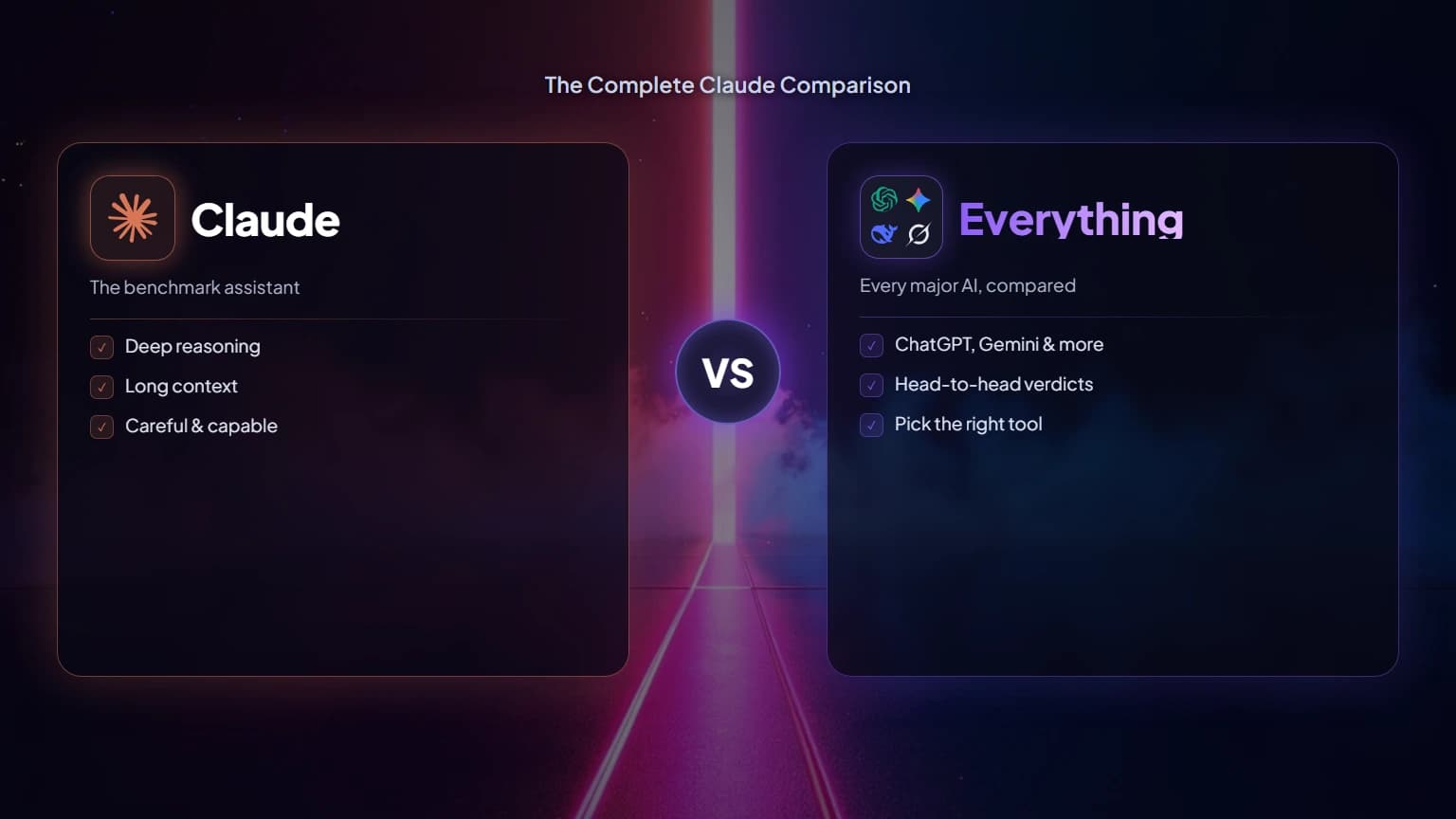
How Claude stacks up against ChatGPT, Gemini, Copilot, Grok, Perplexity, and DeepSeek — one honest master table, pricing, and how to test it yourself.
In every Claude comparison we run, the same pattern repeats: Claude wins on coding, long-document reasoning, writing quality, and agentic work; it loses on ecosystem breadth, image generation, real-time data, and free-tier generosity. ChatGPT is the stronger all-rounder, Gemini the better bundle, and Claude the better specialist for serious text and code. This pillar maps the whole landscape so you can pick fast.
Model lineup and API pricing verified 31 July 2026 against the Anthropic pricing page.
Key takeaway
Across every Claude comparison, Claude wins on coding (Opus 4.8 scored 69.2% on SWE-bench Pro, and Opus 5 now leads the lineup), long-document reasoning over a 1M-token context window, writing quality, and agentic work — while losing on ecosystem breadth, image generation, real-time data, and free-tier generosity.
The honest pattern: where Claude wins, where it loses
Claude wins wherever output quality is expensive to verify: production code, long-document analysis, prose that does not read like a template, and long agentic sessions. It loses on breadth — no images, thin voice, a tight free tier.
We use these tools daily — Claude Code for our own codebase, ChatGPT and Gemini side by side for content work — and the pattern above has held through every model release of the past year. It is worth internalizing before any single Claude comparison, because it predicts most verdicts in advance.
Claude's consistent wins. Anthropic's models — Claude Opus 5, Claude Sonnet 5, and Claude Haiku 4.5 — are strongest where output quality is expensive to verify: production code (Claude Opus 4.8 scored 69.2% on SWE-bench Pro), long-document analysis across a 1M-token context window, prose that doesn't read like a template, and long-running agentic sessions in Claude Code, where small reasoning errors compound. Our full breakdown of the flagship matchup lives in Is Claude better than ChatGPT? — that article goes feature by feature; this one gives you the whole map.
For example, Gemini's free CLI tier undercuts everyone on price — and trails Claude Code on agentic depth; that trade shows up in every row below.
Claude's consistent losses. Claude generates no images, has only limited voice support, and its free tier is capped tightly enough that heavy free users will bounce off it. It has no consumer hardware, no search engine, no office suite behind it. If your workflow depends on one vendor doing everything, Claude is not that vendor — and Anthropic seems comfortable with that.
The practical consequence: almost nobody should ask "which AI assistant is best?" The productive question is "which one is best for the two or three tasks I actually repeat every week?" Everything below in this Claude comparison is organized around answering that faster.
The Claude comparison master table: six rivals, one view
ChatGPT for breadth, Gemini for Workspace integration, Copilot for cheap in-editor completions, Grok for live social data, Perplexity for cited research, DeepSeek for price. Only ChatGPT competes across every column.
Here is the entire competitive landscape in one table — each rival's real strength over Claude, its real weakness, and the situation where we'd honestly pick it instead.
| Rival | Strength vs Claude | Weakness vs Claude | Pick it when |
|---|---|---|---|
| ChatGPT (OpenAI) | Broadest feature set: image generation, mature voice mode, huge plugin/app ecosystem | Weaker sustained coding sessions; prose drifts generic faster | You want one tool for everything, including images and voice |
| Gemini (Google) | Deep Google Workspace integration; generous free tier; strong multimodal | Less reliable on long agentic coding; weaker instruction-following on nuanced edits | You live in Gmail, Docs, and Drive all day |
| GitHub Copilot (Microsoft) | Cheapest entry to AI coding ($10/month); native in GitHub PRs and IDEs | Autocomplete-first heritage; weaker at large multi-file, plan-then-execute work | You mostly want in-editor completions, not an agent |
| Grok (xAI) | Real-time X/Twitter data; fewer refusals; personality | Weaker code quality and long-context document work | Your work depends on live social and news signals |
| Perplexity | Best-in-class cited web research; instant sourced answers | Not a writing or coding workhorse; thin agentic tooling | Research with verifiable citations is the whole job |
| DeepSeek | Free consumer chat; API from ~$0.14/M input tokens | Behind frontier on hardest reasoning; data-residency concerns for many companies | Budget is the binding constraint and stakes are low |
Three notes on reading that table honestly.
First, ChatGPT is the only rival in this Claude comparison that competes with Claude across every column of knowledge work — the tightest matchup of them all is the raw model face-off, Claude versus OpenAI's GPT-5. The others are specialists, which makes them easy to slot in beside Claude rather than instead of it — we run Perplexity next to Claude ourselves, not as a replacement.
Second, GitHub Copilot competes with Claude Code, not with Claude the assistant. That distinction confuses more buyers than anything else in this market, so it gets its own section below.
Third, DeepSeek's price advantage is genuine — its API undercuts Claude Sonnet 5 by an order of magnitude — but in our testing the gap in multi-step reasoning shows up exactly on the tasks where you'd care most about the answer. Cheap tokens are only cheap if you don't have to re-verify the output.

Assistant or coding tool? Compare at the right layer
Claude competes at two layers with different rivals. As an assistant it faces ChatGPT, Gemini, Grok, Perplexity, and DeepSeek. As a coding agent, Claude Code faces Cursor and GitHub Copilot. Never cross the two.
Half the bad advice in any Claude comparison comes from mixing two different product categories. Claude competes at two layers, and each layer has different rivals.
| Layer | What Claude offers | Direct rivals | The question you're really asking |
|---|---|---|---|
| Assistant (chat, documents, analysis) | Claude.ai apps, Projects, Artifacts, Skills, Claude Cowork | ChatGPT, Gemini, Grok, Perplexity, DeepSeek | "What do I open first every morning?" |
| Coding tool (agentic development) | Claude Code — CLI, VS Code/JetBrains, desktop, and web | Cursor, GitHub Copilot, Codex-style agents | "What ships code in my repo?" |
At the assistant layer, the fight is about breadth: features, integrations, and price per useful answer. Anthropic's differentiator here is agentic knowledge work — Claude Cowork lets Claude operate on your local files and folders from Claude Desktop, a capability we unpack in What is Claude Cowork?
At the coding-tool layer, the fight is about trust: which agent can you leave alone in a branch for twenty minutes? Claude Code's terminal-first design, subagents, hooks, and plan mode compete most directly with Cursor's editor-first approach — we've compared them at length in Cursor vs Claude Code. A dedicated GitHub Copilot vs Claude Code piece is in the works.
There's also a third choice inside Claude that trips people up: which model. Claude Sonnet 5 handles the large majority of everyday coding work at a fraction of the flagship's price, and our Claude Sonnet vs Opus guide gives you the escalation framework. Get the layer right first, then the vendor, then the model.
The 2026 pricing landscape
Entry paid tiers have converged near $20 a month, so the real differences sit in free tiers, power tiers, and API rates. Anthropic lands mid-market on tokens and unusually strong at $20 because Claude Code is included.
Sticker prices converged around $20/month for entry paid tiers, so the real differences are in free tiers, power tiers, and API rates. Prices below are current as of July 2026.
| Vendor | Free tier | Entry paid | Power tiers | Worth knowing |
|---|---|---|---|---|
| Claude (Anthropic) | Yes — Claude Sonnet, tight caps | Pro $20/mo | Max $100/mo (5x) or $200/mo (20x) | Claude Code requires a paid plan or API key |
| ChatGPT (OpenAI) | Yes — solid daily allowance | Plus $20/mo | Pro ~$200/mo | Best message volume at the $20 tier |
| Gemini (Google) | Yes — the most generous free tier | Google AI Pro $19.99/mo | Ultra tier for heavy users | Bundles Google One storage and Workspace features |
| GitHub Copilot | Yes — limited completions | Pro $10/mo | Pro+ $39/mo | Shifting to usage-based credit billing from June 2026 |
| Grok (xAI) | Limited free usage | SuperGrok $30/mo | Heavy tier | Also bundled into X Premium subscriptions |
| Perplexity | Yes | Pro $20/mo | Max tier | Pro caps Deep Research runs (~20/month) |
| DeepSeek | Fully free consumer chat | — | — | API ~$0.14/$0.28 per M tokens (V4-Flash) |
On the API side, Anthropic sits mid-market: Claude Sonnet 5 launched June 30, 2026 with introductory pricing of $2/$10 per million tokens (input/output) until August 31, then $3/$15; Claude Opus 5 runs $5/$25; Claude Haiku 4.5 runs $1/$5. That's more than DeepSeek, comparable to OpenAI's mid-tier, and — in our experience — justified only when the task actually uses the quality. For bulk classification, nobody should pay Opus rates.
One subscription subtlety we'd flag: Claude's $20 Pro plan is unusually strong for coding because it includes Claude Code, while the equivalent capability in the Microsoft ecosystem splits across GitHub Copilot and Microsoft 365 Copilot as separate line items. If you're a developer, the per-dollar comparison tilts toward Claude harder than the table suggests.

How to run your own head-to-head test: the one-real-task method
Take one real task you already finished, give both tools identical prompts and context, iterate three rounds with each, then score correctness, instruction-following, iteration quality, context handling, and honesty under uncertainty.
Benchmarks predict rankings; they don't predict your experience. After two years of running these tools professionally, the only evaluation we trust is embarrassingly simple: take one real task from last week — not a toy prompt — and run it through both candidates in the same sitting.
The method:
- Pick a task you already finished, so you know what "correct" looks like. A bug you fixed, a document you summarized, an email sequence you wrote.
- Give both tools the identical prompt and identical context. Same files, same instructions, same constraints.
- Iterate three rounds with each. First responses are marketing; the third iteration — after you've pushed back twice — is the product.
- Score against the rubric below, weighted for what you repeat weekly.
| Dimension | What to check | Red flag |
|---|---|---|
| Correctness | Does it match the answer you already know? | Confident, specific, wrong |
| Instruction-following | Did it respect constraints ("don't touch X", word limits)? | Silently ignoring one constraint |
| Iteration quality | Does round three improve on round one? | Rewriting everything instead of fixing the one thing you flagged |
| Context handling | Does it use the files you gave it, accurately? | Citing things that aren't in your documents |
| Honesty under uncertainty | Does it say "I'm not sure" when it should? | Never hedging, ever |
Two hours of hands-on testing beats fifty review articles — including ours — because it measures the interaction between the model and your prompting style, your domain, and your tolerance for verification. Most tools offer a free tier or trial, so the experiment costs $20 at most.
Which Claude alternative fits specific needs?
Free unlimited usage points to DeepSeek, Gemini, or a self-hosted open-weight model. Image generation means ChatGPT or Gemini. Live news favours Grok or Perplexity. Google Sheets work favours Gemini on friction alone.
Sometimes the honest answer to a Claude comparison is "use something else" — or "use Claude plus something else." The patterns we see most:
Free, unlimited usage. Claude's free tier is deliberately tight. If you can't pay, DeepSeek's completely free chat and Gemini's generous free tier are the realistic picks — or, if you can self-host, an open-weight model like Meta's Llama gives you unlimited runs on your own hardware, with Alibaba's open, multilingual Qwen another strong pick in that vein — and we're putting together a full guide to using Claude and its alternatives for free.
Image generation. Claude simply doesn't do it. ChatGPT and Gemini both generate images natively; pairing Claude for text with one of them for visuals is a common (and sensible) two-tool setup.
Creative writing. This one is contested. Claude's prose quality is a genuine strength — less template-flavored than most rivals — but some fiction writers prefer other models for specific voices, and a dedicated piece on Claude alternatives for creative writing is on our roadmap.
Real-time information. Claude has built-in web search, but Grok's native X/Twitter firehose and Perplexity's citation-first research remain stronger for live-news workflows.
Spreadsheet-heavy work. Claude in Excel (Pro plans and above) closed part of this gap in the Microsoft ecosystem, but if your whole company runs on Google Sheets, Gemini's native integration wins on friction alone.
Where to go next: the Claude comparison series
Default to Claude when coding or serious writing dominates your week. Default to ChatGPT when you need one tool that does everything acceptably. Run the one-real-task experiment before committing a whole team to either.
This Claude comparison pillar is the hub; the depth lives in the cluster. Here's what's live and what's coming.
| Matchup | The question it settles | Status |
|---|---|---|
| Claude vs ChatGPT | Which assistant should be your daily default? | Read the deep dive |
| Cursor vs Claude Code | Editor-first or terminal-first agentic coding? | Read the comparison |
| Claude Sonnet vs Opus | Which Claude model earns your tokens? | Read the framework |
| What is Claude Cowork? | Can Claude do real work in your files? | Read the explainer |
| Claude vs Gemini | Specialist quality or Google-scale integration? | Coming soon |
| Claude vs Perplexity | Assistant or research engine? | Coming soon |
| GitHub Copilot vs Claude Code | Completions or a full coding agent? | Coming soon |
Our Claude comparison advice, compressed to three lines: default to Claude if coding or serious writing dominates your week. Default to ChatGPT if you need one tool that does everything acceptably. Run the one-real-task experiment before committing a team to either.
Claude pricing at a glance
Free covers Sonnet on tight caps, Pro is $20 a month, Max runs $100 or $200 for five and twenty times the usage, and API access is billed per token — from $1/$5 on Haiku 4.5 up to $5/$25 on Opus 5.
| Plan | Price |
|---|---|
| Free | $0 |
| Pro | $20 / month |
| Max | from $100 / month |
| API | Pay per token |
For the full breakdown of every plan, see our how much Claude costs guide.
Frequently Asked Questions

Written by
Edith
Writing about Claude and the Anthropic toolkit — models, Claude Code, pricing, features, and fixes, in clear, practical, hands-on guides tested by daily use.
View all posts →