

Part ofClaude Comparison: Which AI Should You Actually Use?
In This Article
8 sectionsQuick answer
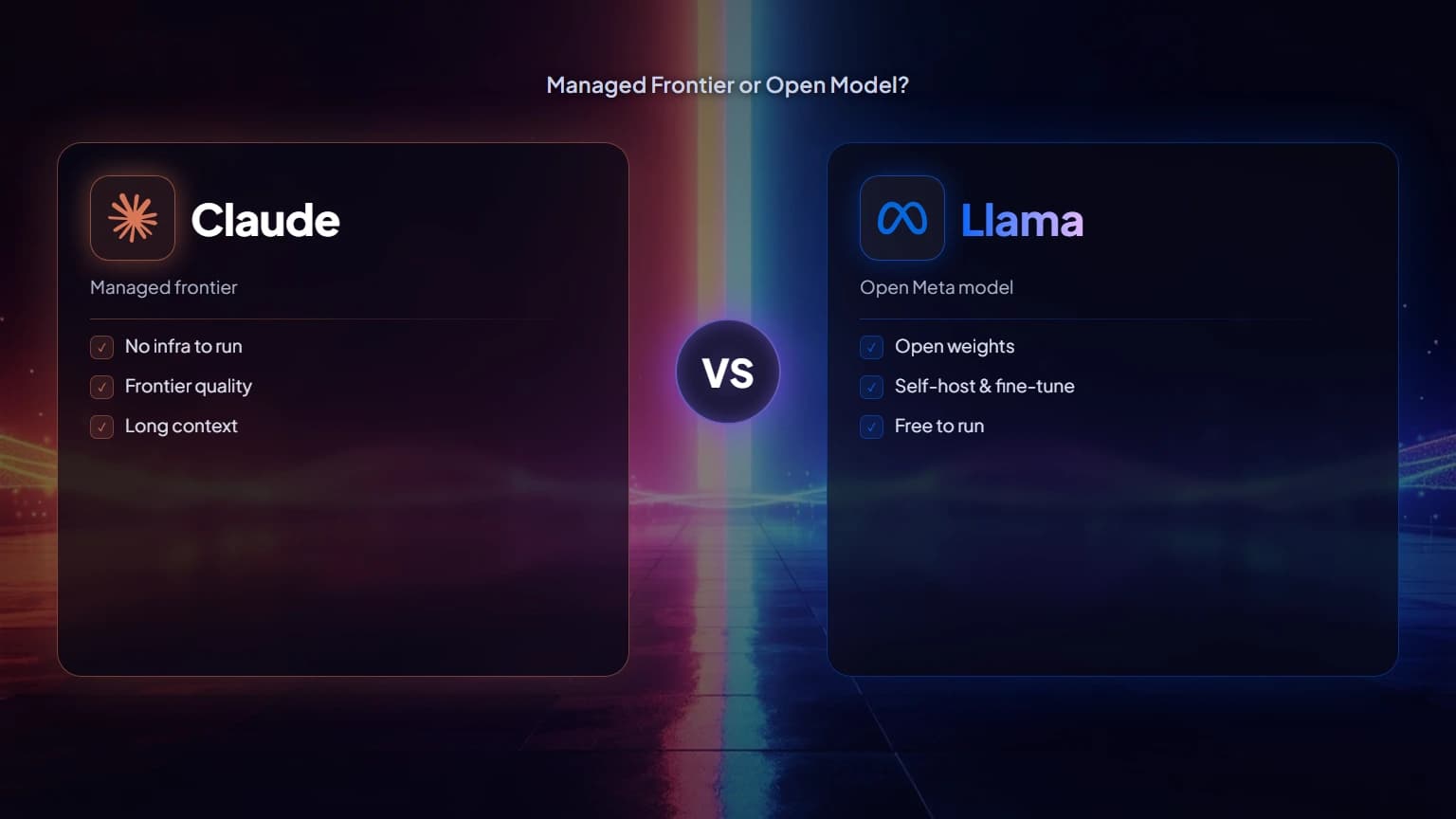
Claude is the managed frontier — closed weights, turnkey quality; Llama is Meta's open-weight family you self-host and fine-tune. A task-by-task verdict.
In the Claude vs Llama decision, Claude is the managed frontier: closed weights and top-tier reasoning and coding quality you rent through Anthropic's API with zero infrastructure. Llama is Meta's open-weight family you download, self-host, and fine-tune, trading some out-of-box polish for control, data sovereignty, and lower cost at scale. Pick by whether you value turnkey quality or ownership.
Claude model lineup and pricing verified 31 July 2026 against Anthropic's model overview.
We run both in production — Claude Code against our own repository, self-hosted Llama for high-volume, privacy-sensitive batch jobs where per-token API fees would bankrupt the project. This guide is part of our wider Claude comparison hub, and it settles the Claude vs Llama question the way buyers actually ask it: quality, cost, privacy, self-hosting, ecosystem, and the honest line where each one wins.
Key takeaway
Claude Opus 4.8 tops SWE-bench Pro at 69.2%, and the current flagship Claude Opus 5 ships at the same $5/$25 per million tokens (Sonnet 5 at $3/$15) as a managed API, while Meta's Llama gives open weights you self-host — Llama 4 Scout advertises a ~10M-token context against Claude's up-to-1M ceiling.
Claude vs Llama: the one-minute verdict
Claude is closed-weight frontier quality you rent through Anthropic's API; Llama is Meta's open-weight family you download and run yourself. Choose Claude for turnkey reasoning and coding polish, Llama for self-hosting, fine-tuning, and cost control at scale.
The Claude vs Llama fight is a clash of two opposite bets, the same open-versus-managed axis we mapped in our Claude vs DeepSeek breakdown — only here the open side is Meta, not a Chinese lab. Anthropic sells closed, frontier-grade quality you rent through an API or apps. Meta ships Llama's weights under a community license, so you download the model, run it on your own hardware, and fine-tune it on proprietary data. Almost every row below follows from that split.
| Claude (Anthropic) | Llama (Meta) | |
|---|---|---|
| Current family | Opus 5, Opus 4.8, Sonnet 5, Haiku 4.5 | Llama 4 Scout, Maverick |
| Model access | Closed — API and apps only | Open weights, self-hostable |
| License | Proprietary, API terms | Llama Community License (source-available) |
| Context window | Up to 1M tokens | Up to 10M tokens (Scout) |
| First-party API | Yes — Anthropic | No — third-party hosts or self-host |
| Fine-tuning | Not on open weights | Full fine-tuning on your data |
| Data residency | US, enterprise controls | Wherever you host it |
| Signature strength | Reliability, safety, polish | Control, cost at scale, ownership |
Framed simply, the Llama vs Claude choice is open control versus managed reliability. Hand both the same vague ticket and messy repo: Claude returns the diff you'd merge without a rewrite, while Llama returns capable output that you own end to end and can run offline for a fraction of the per-call cost. That trade — turnkey quality versus ownership and price — is the whole comparison.
Coding: agentic refactors vs high-volume generation
Claude leads on agentic, multi-file production work — Opus 4.8 tops SWE-bench Pro at 69.2% and ships Claude Code. Llama matches frontier models on standard single-function generation and wins on throughput once you self-host it.
Coding is where most buyers start, and the honest answer is that both are strong at different coding. On agentic, production-style work, Claude leads. Claude Opus 4.8 tops the hard SWE-bench Pro suite at 69.2%, and in day-to-day use that shows up as maintainable, deployment-ready diffs: Claude keeps multi-file refactors coherent, matches your existing style, and produces edits you can review instead of re-read line by line. Anthropic also ships Claude Code, a first-party agentic coding tool Llama has no direct equivalent to.
Llama's strength is standard code generation at volume. On classic single-function benchmarks like HumanEval, Llama 4 Maverick sits in the low-90s — close enough to frontier models that the benchmark barely separates them anymore. Where Llama pulls ahead is throughput and price: self-host Maverick and you can run thousands of code-completion or generation calls per hour with no per-token invoice, which is decisive for high-iteration workloads. Where it falls behind is the hardest multi-file engineering, exactly the agentic tasks SWE-bench Pro measures.
| Coding dimension | Claude | Llama |
|---|---|---|
| SWE-bench Pro (agentic) | 69.2% (Opus 4.8) | Trails frontier models |
| Standard code generation | Excellent | Excellent (Maverick, low-90s HumanEval) |
| Multi-file production refactors | Cleaner, deployment-ready | Capable, less consistent |
| First-party agentic coding tool | Claude Code | None (bring your own harness) |
| High-volume iterations | Per-token cost adds up | Self-host, effectively unmetered |
The Claude vs Llama coding verdict we've landed on: reach for Llama when the task is high-volume generation you'll host yourself and read once, and reach for Claude when the code has to survive in a codebase other people maintain. The same quality-first pattern holds against OpenAI — we walk through it in Is Claude better than ChatGPT? — and it's the most reliable predictor of which tool you'll trust with a real branch.

Claude vs Llama on quality, reasoning, and context
Claude is the stronger out-of-box generalist on nuanced, judgment-heavy reasoning. Llama wins the raw context headline — Scout advertises roughly 10 million tokens against Claude's up-to-1M ceiling — but usable recall matters more than the advertised window.
Out of the box, Claude is the higher-quality generalist. Its edge is judgment-based reasoning: following nuanced, layered instructions, weighing trade-offs, and staying honest under uncertainty instead of confidently inventing an answer. Llama 4 is a capable, natively multimodal family, but on the messy, ambiguous reasoning that dominates real client work, a general Claude reads as more careful.
Context window is the one spec where Llama simply wins the headline number. Llama 4 Scout advertises a roughly 10-million-token window, per Meta's official Llama 4 specs, while Maverick offers 1M and Claude's flagship models reach up to 1M. For genuinely enormous inputs — an entire monorepo, years of logs — Scout has headroom Claude can't match. In practice, though, usable recall matters more than raw window size, and Claude's reasoning stays sharper across the tokens it does hold; our Claude context window guide covers why the advertised ceiling and the effective one diverge.
One roadmap note: Meta's much larger Llama 4 Behemoth (around two trillion parameters) stayed in training and was never publicly released, so the herd you can actually run today is Scout and Maverick.
Is Llama cheaper than Claude?
Only above a volume break-even. Claude charges per token with zero infrastructure; Llama's weights are free but inference is not. At low and medium volume Claude is cheaper all-in; at sustained high volume self-hosted Llama wins.
On price, the Claude vs Llama cost gap depends entirely on volume, and this is where the comparison gets interesting. Claude charges per token but you carry no infrastructure: the current flagship Claude Opus 5 runs $5/$25 per million tokens and Claude Sonnet 5 runs $2/$10 during its introductory window (through 31 August 2026), per Anthropic's published pricing. Llama's weights are free, but running them is not — you either rent GPU-hosted inference from a third party (Meta operates no first-party API) or buy the hardware and absorb the DevOps.
| Tier | Claude (Anthropic) | Llama (Meta) |
|---|---|---|
| Consumer chat | Free / Pro $20/mo / Max $100–$200/mo | Free via Meta AI apps |
| Cheapest API model | Haiku 4.5 — $1/$5 per 1M | Scout (hosted) — ~$0.08/$0.30 per 1M |
| Flagship API model | Opus 5 — $5/$25 per 1M | Maverick (hosted) — ~$0.15/$0.60 per 1M |
| Self-host option | None | Yes — you pay only compute |
| Infrastructure burden | None | GPUs, ops, scaling on you |
The break-even is the whole story. At low and medium volume, Claude is almost always cheaper all-in because you skip the GPU bill and the engineers who babysit it. At high, sustained volume, self-hosted Llama wins decisively: once you saturate your own hardware, the marginal cost per call trends toward electricity. Our Claude API pricing guide breaks down the managed side in detail.
Which wins on privacy, Claude or Llama?
Llama, if control means possession — open weights run air-gapped on your own hardware, with nothing leaving your network. Claude, if control means contract — US data residency, SOC 2, and no training on business API traffic.
This is where the Claude or Llama decision stops being about quality and becomes about control. Llama's defining advantage is that you can download the weights and run the model entirely on your own servers — air-gapped, on-premise, with no data ever leaving your network. For regulated industries or teams that can't send prompts to a third party, that capability alone can decide the evaluation. Claude offers nothing equivalent: Anthropic's models are closed and reachable only through its cloud API.
Claude's counter is that its default hosted path already ships with the controls enterprises need: US data residency, SOC 2 and enterprise agreements, a commitment not to train on business API traffic, and stronger safety guardrails out of the box. You get privacy through contract and architecture rather than possession. The meta Llama vs Claude trade here is clean: Llama gives you data control by letting you hold the model; Claude gives you data protection by managing it under enterprise terms so you don't have to.

Ecosystem, licensing, and fine-tuning
Llama's open weights allow full fine-tuning on proprietary data; Claude adapts only through prompting, tools, and context. Llama ships under an open-weight community licence, not OSI open source, with a 700-million-monthly-user threshold that triggers negotiation with Meta.
Two ecosystem details decide more real projects than any benchmark. First, fine-tuning: because Llama ships open weights, you can fully fine-tune it on proprietary data, and a specialized Llama routinely beats a general Claude on a narrow, well-defined task. Claude offers no open-weight fine-tuning; you adapt it through prompting, tools, and context, not gradient updates. If your moat is a domain-specific model trained on data only you have, that points squarely at Llama.
Second, the license fine print. Llama is "open-weight," not OSI open source: the Llama Community License permits commercial use but adds clauses no true open-source license contains — most notably a 700-million-monthly-active-user threshold above which you must negotiate a separate license with Meta, plus a ban on using Llama's outputs to train competing models. For the overwhelming majority of teams that never approach that scale, it's a non-issue; for a hyperscale competitor, it's a deliberate moat. On the assistant side, Claude ships Claude.ai, Claude Code, and Cowork, while Llama powers Meta AI across Meta's apps — so both come with polished front ends, not just raw weights.
The task-by-task verdict
Pick Llama when self-hosting, fine-tuning, data sovereignty, or per-token cost at scale is the binding constraint. Pick Claude when output quality or freedom from running infrastructure matters more. Many teams run both and route by task.
No single winner survives contact with real work, so here's the honest Claude vs Llama call by use case:
| Your main task | Better pick | Why |
|---|---|---|
| Production, client-facing code | Claude | Deployment-ready, maintainable diffs |
| High-volume self-hosted generation | Llama | Effectively unmetered once hosted |
| Nuanced instruction-following | Claude | Fewer confident errors, better judgment |
| Fine-tuning on proprietary data | Llama | Open weights, full customization |
| Air-gapped / sovereign deployment | Llama | Runs entirely on your hardware |
| Enterprise data under contract | Claude | US residency, no-train guarantees |
| Turnkey quality, no infra team | Claude | Zero GPUs, zero DevOps |
| Cost at massive sustained scale | Llama | Marginal cost trends to compute |
The pattern is consistent: Llama is the ownership play you pick when self-hosting, fine-tuning, data sovereignty, or per-token cost at scale is the binding constraint; Claude is the reliability play you pick when output quality — or freedom from running infrastructure — matters more than owning the model. Many teams run both and route by task, which is the pragmatic answer to Claude vs Llama. For most professionals working client-facing without a GPU cluster, Claude earns its price; for platform teams at scale, Llama's economics and control are hard to beat.
The quick version:
- Claude is closed but turnkey; Llama is open and self-hostable
- Claude leads agentic multi-file coding
- Llama wins on cost at scale and data ownership
- Both handle huge context — 1M (Claude) vs 10M (Llama Scout)
For example, in the Claude vs Llama test we ran on the same 30-file refactor, Claude shipped a cleaner agentic diff, while a self-hosted Llama 4 model ran the job in-house at roughly a tenth of the per-token cost.
Claude pricing at a glance
Claude is free to try, $20 a month on Pro, and from $100 a month on Max. API access is pay-per-token, from Haiku 4.5 at $1/$5 per million up to Opus 5 at $5/$25.
| Plan | Price |
|---|---|
| Free | $0 |
| Pro | $20 / month |
| Max | from $100 / month |
| API | Pay per token |
For the full breakdown of every plan, see our how much Claude costs guide.
Frequently Asked Questions

Written by
Edith
Writing about Claude and the Anthropic toolkit — models, Claude Code, pricing, features, and fixes, in clear, practical, hands-on guides tested by daily use.
View all posts →