

Part ofClaude Comparison: Which AI Should You Actually Use?
In This Article
9 sectionsQuick answer
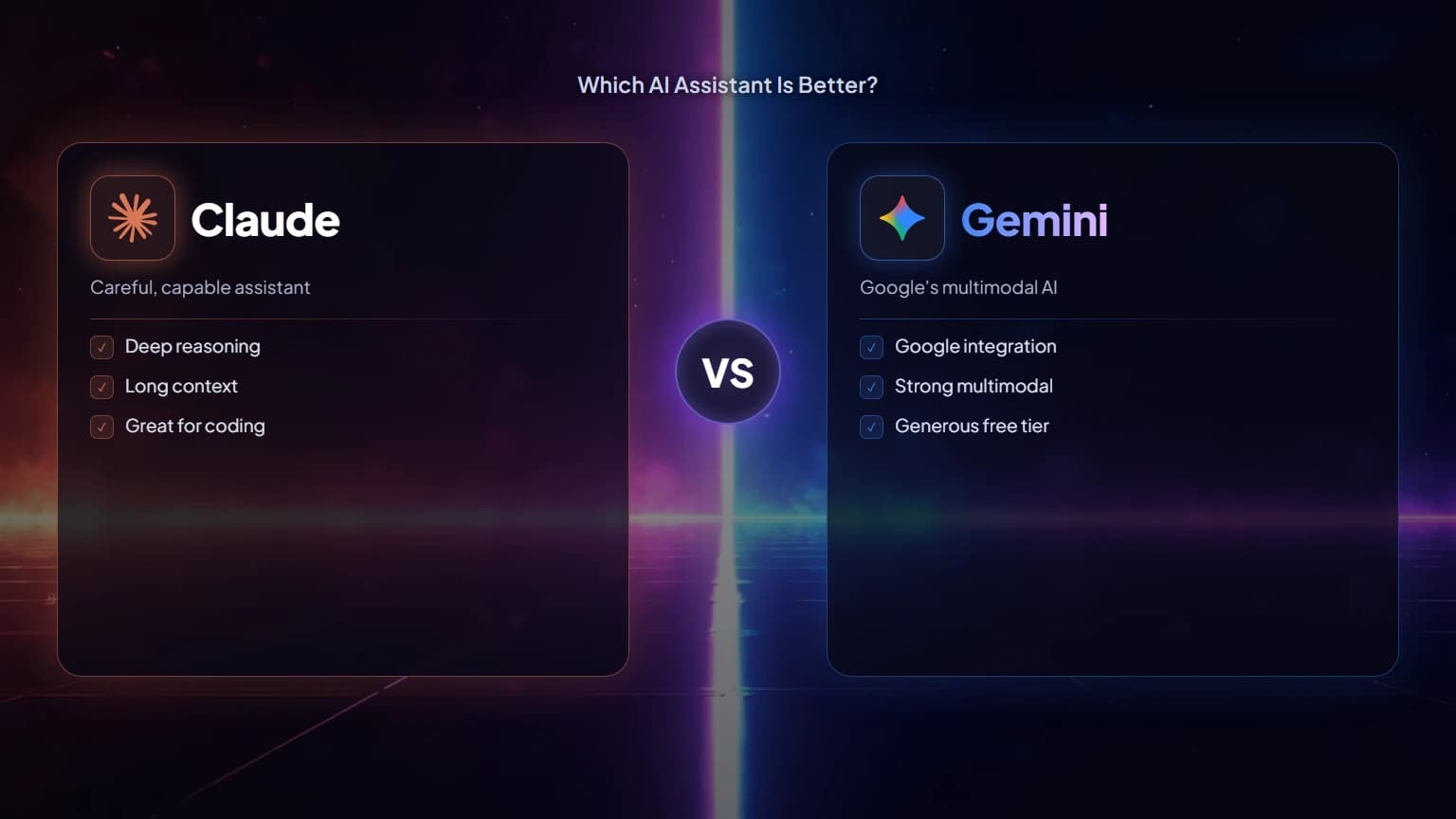
Claude wins on writing quality, coding, and careful reasoning; Google Gemini wins on context size, multimodal generation, price, and Workspace integration.
In the Claude vs Gemini matchup, Claude wins on writing quality, complex coding, and careful reasoning, while Google Gemini wins on context size, multimodal image and video generation, price, and Google Workspace integration. Neither assistant is universally better — the right pick depends on whether you value output quality or ecosystem breadth.
Claude context windows, model line-up, and per-token pricing verified 31 July 2026 against Anthropic's model overview.
We run both every day: Claude for our own codebase and long-form drafts, Gemini next to Google Docs, Gmail, and Search. This guide is part of our wider Claude comparison hub, and it settles the Claude vs Gemini assistant question task by task — not the coding-tool question, which we handle separately in Gemini CLI vs Claude Code.
Key takeaway
Claude leads Google Gemini on coding (about 80.9% vs 76.8% on SWE-bench Verified) and writing quality, while Gemini still stretches further at the very top end — up to 2M tokens on Pro against Claude's 1M — and its API costs a fraction as much per token.
Claude vs Gemini: the one-minute verdict
Anthropic tunes for careful, verifiable output; Google tunes for reach — more modalities, deeper product integration, lower per-token cost. Pick on that axis: the quality of a single answer versus breadth across many jobs.
These are the two strongest non-OpenAI assistants, and they're built around opposite priorities. Anthropic tunes Claude for careful, verifiable output. Google tunes Gemini for reach — more context, more modalities, deeper product integration, lower per-token cost. The Claude vs Gemini split comes down to those opposite priorities, and almost every row below follows from it.
| Claude (Anthropic) | Gemini (Google) | |
|---|---|---|
| Current flagship | Opus 5, Sonnet 5 | Gemini 3 Pro, 3 Flash |
| Standard paid plan | Pro — $20/mo | Google AI Pro — $19.99/mo |
| Default context window | 1M tokens | 1M tokens (Pro up to 2M) |
| Image generation | No | Yes — Nano Banana |
| Video generation | No | Yes — Veo |
| Signature strength | Writing, coding, reasoning | Multimodal, context, Google apps |
Framed simply, the Claude vs Google Gemini choice is quality-first versus reach-first. Hand both a messy 40-page brief and ask for a polished summary: Gemini reads it faster and cheaper, Claude writes the tighter, more usable draft. That trade — reach versus polish — is the whole comparison in miniature.
Writing quality: Claude's clearest edge
Claude holds voice, tone, and structure across a long draft and sounds more human; Gemini drifts toward a flatter default the longer it writes. For prose that ships, Claude's drafts usually need fewer editing passes.
If your output is prose, this is where Claude vs Gemini stops being close. Claude produces more human-sounding, nuanced long-form writing, and it holds voice, tone, and structure across an extended draft better than Gemini does. Give it three paragraphs of your own writing and it stays in that register; Gemini tends to drift toward a flatter, more generic default the longer it writes.
That's not a knock on Gemini's competence — its first drafts are clean and factually careful. But for emails, essays, marketing copy, and fiction, Claude's output typically needs fewer editing passes, which is the metric that matters when writing is your job. This mirrors what we found comparing Claude to OpenAI in Is Claude better than ChatGPT?: prose quality is Anthropic's most consistent advantage.
Claude vs Gemini for coding
Claude leads measurably — roughly 80.9% on SWE-bench Verified against about 76.8% — and produces cleaner, more idiomatic multi-file edits. Google's advantage is reading a large repository quickly rather than changing one reviewably.
Coding is the other place Claude leads, and it's measurable. On SWE-bench Verified — the real-world software-engineering benchmark — Claude scores around 80.9% against Gemini's roughly 76.8%, and Claude Opus 4.8 tops the harder SWE-bench Pro suite at 69.2%. In practice Claude produces cleaner, more idiomatic code and handles multi-file refactoring more consistently, especially across a large repository.
| Coding dimension | Claude | Gemini |
|---|---|---|
| SWE-bench Verified | ~80.9% | ~76.8% |
| Multi-file refactoring | Cleaner, more idiomatic | Capable, less consistent |
| Agentic coding tool | Claude Code | Gemini CLI |
| Reviewable, style-matched edits | Strong | Adequate |
The nuance for Claude vs Gemini for coding: Gemini's larger peak context lets it read a giant codebase in one shot, which is genuinely useful for exploration. But when the job is to change code across many files and keep the diff reviewable, Claude's edits are the ones we trust more. The head-to-head of the two coding agents — Claude Code versus Gemini CLI — gets its own full breakdown in our Gemini CLI vs Claude Code comparison.

Context windows: where Gemini still stretches further
Both assistants now default to a 1M-token window on their current models, so the old five-fold gap is gone. Gemini Pro still reaches 2M, which matters only for the very largest single-prompt document loads.
On context, the gap has narrowed sharply. Anthropic's current models — Opus 5, Sonnet 5, and Opus 4.8 — all carry a 1M-token window as standard, matching Gemini's default; only Haiku 4.5 stays at 200K. Gemini Pro still reaches up to 2M, and you can confirm the current limits on Google's own model documentation. For anyone routinely dropping entire document sets, research corpora, or huge logs into a single prompt, that extra headroom is still a real convenience.
Two honest caveats. First, raw window size isn't the same as usable recall — Claude stays notably coherent deep into its context, so a window used well beats a larger one used loosely. Second, the workflows that genuinely need more than a million tokens in one prompt are rare; we cover when size actually matters in Claude's context window guide. On peak capacity Gemini Pro still wins, but it is no longer a five-fold lead.
Can Claude generate images the way Gemini can?
No. Claude analyses images and PDFs and can output SVG or diagram code, but it never produces pixels or frames. Gemini generates both natively — stills through Nano Banana, video through Veo — inside the same assistant.
In the Claude vs Gemini multimodal comparison, this is the cleanest win on the board — and it's Gemini's. Claude does not generate images or video — full stop. Gemini generates both natively: still images through Google's Nano Banana models and video through Veo, all inside the same assistant. If your workflow touches visuals at all — thumbnails, mockups, storyboards, social assets — Gemini does in one place what Claude can't do anywhere.
Claude can analyze images and PDFs you upload, and it can output SVG or diagram code, but "describe this chart" and "make me a chart image" are different jobs. For the gemini vs claude decision, multimodal generation is often the single feature that ends the debate: if you need pixels or frames out, Gemini is the answer and Claude isn't a candidate.
Does Claude or Gemini integrate better with Google Workspace?
Gemini, decisively. It reads and writes inside Gmail, Drive, Docs, and Calendar with no copy-paste. Claude has no native Workspace access and answers with depth instead: Projects, Artifacts, Skills, and its agentic tools.
Gemini's other structural advantage is where it lives. It integrates directly with Gmail, Drive, Docs, and Calendar, so it can draft a reply from your inbox, summarize a Doc in place, or pull context from your files without copy-paste. Claude has no native Workspace access — it's a focused assistant you bring your content to, not one wired into your productivity suite.
If you spend your day inside Google's apps, that integration usually outweighs Claude's quality edge for routine tasks, because friction beats a marginally better paragraph. Claude's counter-move is depth over breadth: Projects, Artifacts, Skills, and agentic tools like Claude Code and Claude Cowork that go further on the specific tasks they cover. It's the classic claude or gemini split — a precise specialist versus an integrated generalist.
Pricing and free tiers
Consumer plans are near-identical at roughly $20 a month. The split shows up on the API and the free tier, where Google is materially cheaper per token and hands free users a broader model allowance.
At the consumer level, this is nearly a tie: Claude Pro is $20/month and Google AI Pro is $19.99. The Claude vs Gemini pricing story splits cleanly on the API and the free tier.
| Tier | Claude | Gemini |
|---|---|---|
| Free | Basic chat, modest caps | Broader — full 3 Flash + limited 3 Pro |
| Entry paid | Pro — $20/mo | AI Pro — $19.99/mo |
| Budget API model | Haiku 4.5 — $1/$5 per 1M | 3 Flash — ~$0.15 input per 1M |
| Flagship API model | Opus 5 — $5/$25 per 1M | 3 Pro — ~$2/$12 per 1M |
For developers building on the API, Gemini is materially cheaper — Gemini Flash runs roughly $0.15 per million input tokens against Claude Sonnet's $2–$3, per Anthropic's published API pricing. If you're doing high-volume, low-stakes work — bulk classification, summarization at scale — that gap is decisive. On the free tier, Gemini is again broader: full access to its 3 Flash model plus limited Gemini 3 Pro, where Claude's free plan gives basic chat with tighter limits. Pay for Claude when output quality has to be verified; reach for Gemini when volume and cost dominate.

The task-by-task verdict
Route writing, production coding, and careful judgment to Claude. Route image and video generation, Workspace workflows, and high-volume API calls to Gemini. Plenty of professionals pay for both and choose per task.
No single winner survives contact with real work, so here's the honest claude vs gemini call by use case:
| Your main task | Better pick | Why |
|---|---|---|
| Writing & editing | Claude | More human, holds voice over long drafts |
| Production coding | Claude | Higher SWE-bench, cleaner refactors |
| Long-document reading | Gemini | Up to 2M tokens on Pro |
| Image or video generation | Gemini | Claude can't; Nano Banana + Veo |
| Google Workspace work | Gemini | Native Gmail/Docs/Drive access |
| High-volume API calls | Gemini | Far cheaper per token |
| Careful reasoning & judgment | Claude | Fewer confident errors |
| One tool, most tasks | Gemini | Broader features and cheaper reach |
The pattern: Claude is the specialist you pick when the quality of one output matters more than anything; Gemini is the generalist you pick when breadth, context, cost, or Google integration matter more. Plenty of professionals pay for both — around $40/month — and route each task to the stronger tool. For the wider field, including ChatGPT and Perplexity, our Claude comparison hub maps every rival at once.
The quick version:
- Claude leans writing, coding and long context
- Gemini leans multimodal and Google Workspace
- Both start at $20/month for the paid tier
- Free tiers exist on both — Gemini is more generous
For example, hand both the same 300-page contract: Claude holds it comfortably, while a quick image-from-text request is where Gemini pulls ahead.
Claude pricing at a glance
Claude is free to start, $20 a month on Pro, and from $100 a month on Max, with API access billed per token. Running both assistants costs roughly $40 a month combined.
| Plan | Price |
|---|---|
| Free | $0 |
| Pro | $20 / month |
| Max | from $100 / month |
| API | Pay per token |
For the full breakdown of every plan, see our how much Claude costs guide.
Comparing against the newest Google model specifically? Claude vs Gemini 3 matches the two by tier — context, pricing, and where each one actually wins.
Frequently Asked Questions

Written by
Edith
Writing about Claude and the Anthropic toolkit — models, Claude Code, pricing, features, and fixes, in clear, practical, hands-on guides tested by daily use.
View all posts →