

Part ofClaude Models Explained: Opus vs Sonnet vs Haiku
In This Article
9 sectionsQuick answer
Sonnet costs 60% of what Opus costs and wins some agentic benchmarks outright. The real numbers, the pricing math, and a simple decision framework.
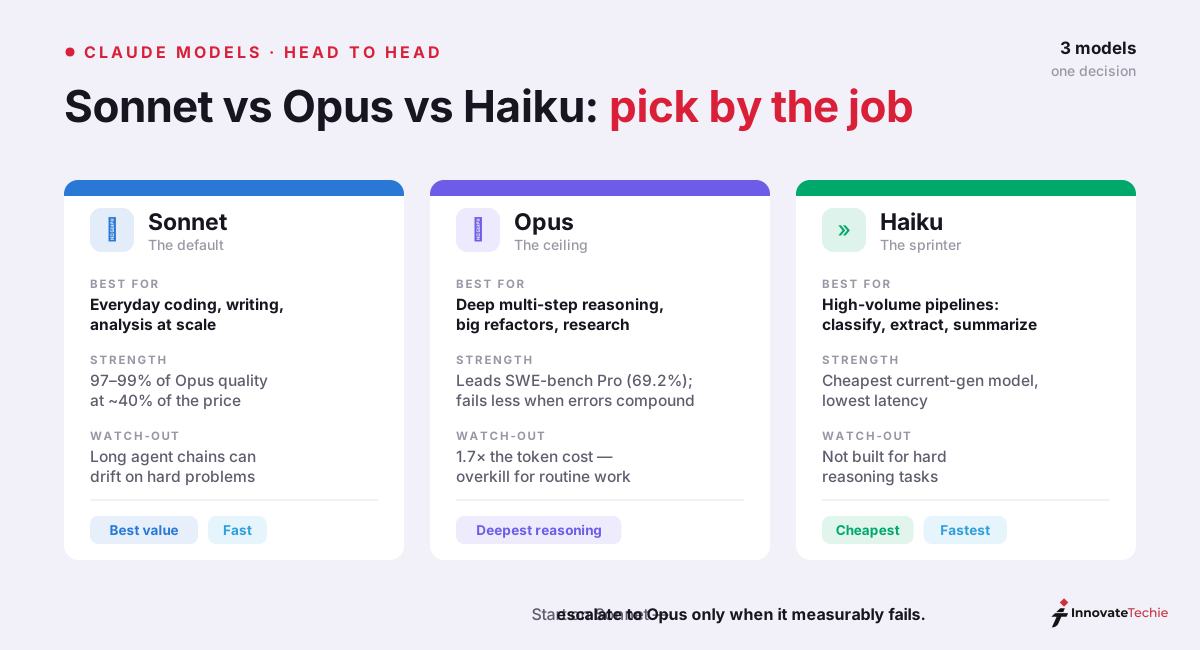
Short answer: use Sonnet for 90% of your work — coding, writing, analysis — and reserve Opus for the hardest multi-step reasoning, large-scale refactors, and research synthesis. Sonnet costs 60% of what Opus costs and actually beats it on some agentic benchmarks, while Opus keeps a real edge on deep, chained reasoning where mistakes compound.
Prices and benchmark figures verified 31 July 2026. Claude Opus 5 is now the current Opus model at the same $5/$25 as Opus 4.8; published benchmark comparisons still cite 4.8.
Key takeaway
Claude Sonnet 5 costs $3/$15 against the Opus tier's $5/$25 — 60% of the price — and wins Terminal-Bench 2.1 outright (80.4 vs 74.6). Opus still leads on deep coding and maths, so default to Sonnet and escalate for chained reasoning.
Claude Sonnet vs Opus: the one-minute comparison
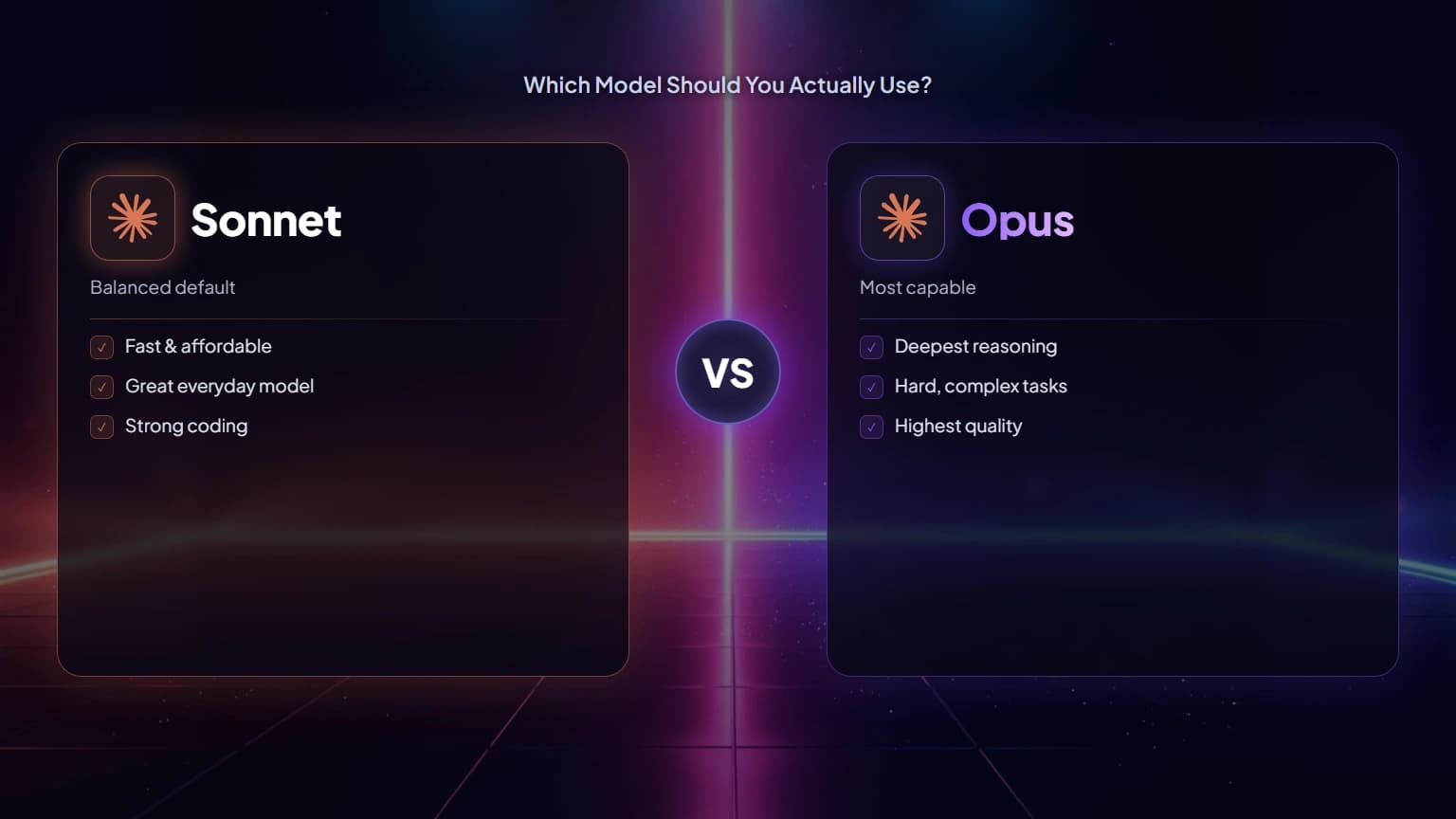
Sonnet is the balanced workhorse; Opus is the frontier tier. Same 1M context, a 1.67× price gap, and a capability gap that has narrowed sharply.
| Claude Sonnet | Claude Opus | |
|---|---|---|
| Current version | Sonnet 5 (30 June 2026) | Opus 5 (Opus 4.8 remains as legacy) |
| API price (in/out per MTok) | $3 / $15 — intro $2 / $10 until 31 Aug 2026 | $5 / $25 |
| Best at | Everyday coding, writing, analysis, agents at scale | Deep reasoning, large refactors, research |
| Context window | 1M tokens | 1M tokens |
| Speed | Faster | Slower, more deliberate |
| Availability | All plans, including free tier | Paid plans and API |

What the benchmarks actually say
Sonnet wins agentic terminal work; Opus wins deep coding and maths. Neither sweeps — which is why this is a routing decision, not a ranking.
| Benchmark | What it measures | Sonnet 5 | Opus 4.8 |
|---|---|---|---|
| Terminal-Bench 2.1 | Agentic terminal tasks | 80.4 | 74.6 |
| SWE-bench Pro | Real-world software fixes | 63.2 | 69.2 |
| USAMO | Olympiad-level maths | 79.5 | 96.7 |
| OSWorld | Computer use | 81.2 | 83.4 |
| HLE (with tools) | Broad expert reasoning | 57.4 | 57.9 |
Three findings matter more than any single leaderboard number, and together they settle the Claude Sonnet vs Opus question on evidence rather than tier labels:
- Sonnet beats Opus outright on agentic terminal work — 80.4 to 74.6. A mid-tier model outscoring the flagship on the workload a lot of daily Claude Code usage actually looks like.
- Opus keeps the ceiling on hard reasoning. Its widest margin is USAMO, at 96.7 against 79.5 — a 17-point gap on olympiad maths — with narrower leads on SWE-bench Pro and OSWorld.
- HLE with tools is effectively a tie. 57.4 versus 57.9 is inside the noise, so on broad expert reasoning there is no meaningful gap to pay for.
The honest summary: Sonnet raised its floor to near Opus's level and passed it in places; Opus still owns the hardest reasoning.
Claude Opus vs Sonnet for coding
Default to Sonnet. Escalate for large multi-file refactors, long agentic sessions, and architecture decisions.
Coding is where most people actually face the Claude Sonnet vs Opus choice. For the bread-and-butter of software work — writing functions, fixing bugs, generating tests, explaining unfamiliar code, small refactors — the two produce nearly indistinguishable results, and Sonnet returns them faster. If you review and run everything the model writes (you should), Sonnet's occasional extra iteration costs you seconds, not correctness.
Escalate for three specific situations:
- Large multi-file refactors. When a change touches a dozen files and the model must hold the whole dependency graph in its head, Opus's stronger planning shows — its SWE-bench Pro lead measures exactly this.
- Long agentic sessions. An agent that runs for thirty minutes compounds every small reasoning error. Opus drifts less, which means fewer "how did it end up here?" moments at review time.
- Architecture and design decisions. When the output is a decision rather than a diff, Opus surfaces assumptions and trade-offs more explicitly, which is what you want to review.
Maintaining this site in Claude Code every day, the call is almost never a benchmark — it is a felt pattern. Sonnet handles routine feature work and drafting all day, and the tell that it is time to switch is watching it loop: the same failing test patched two different wrong ways, or a refactor that keeps forgetting a file it edited earlier. When that loop shows up, one model switch usually settles it. Escalating on a hunch before the loop just spends tokens for no gain.
A useful habit: keep Sonnet as your session default and switch per-task. Claude Code lets you change models mid-session, so escalation costs one command, not a workflow change. Our Claude models explained guide shows where Haiku fits underneath.
Writing and research
Everyday business writing is fully Sonnet territory. Opus earns its premium on research synthesis you'll act on without re-verifying.
Sonnet 5's win on GDPval-AA v2 — a benchmark built from realistic professional knowledge work — means summaries and structured reports sit comfortably here. It's fast enough for interactive drafting and its style control is excellent.
Opus matters when the output has to be right in ways you won't immediately check: reading a stack of long documents and producing analysis you'll act on directly. Both models take 1M tokens of context, so capacity is no longer the differentiator — reasoning reliability is.
Real-world cost math: two scenarios
At personal scale the difference is a coffee. At pipeline scale it's real money — and pipelines are exactly where Sonnet holds up best.
The Claude Sonnet vs Opus difference is noise at personal scale and real money at pipeline scale. Worked examples at standard API rates:
| Scenario | Monthly usage | Sonnet | Opus | Difference |
|---|---|---|---|---|
| Developer's daily assistant | 2M in + 0.5M out | (2 × $3) + (0.5 × $15) = $13.50 | (2 × $5) + (0.5 × $25) = $22.50 | $9 — a coffee |
| Bulk summarization pipeline (batch −50%) | 20M in + 4M out | ((20 × $3) + (4 × $15)) × 0.5 = $60 | ((20 × $5) + (4 × $25)) × 0.5 = $100 | $40/month, every month |
This is why the practical rule is Sonnet for volume, Opus for judgment.
Pricing: the 1.67× question
Opus costs 1.67× what Sonnet costs per token — $5/$25 against $3/$15. Sonnet's introductory rate stretches that to 2.5× until 31 August 2026.
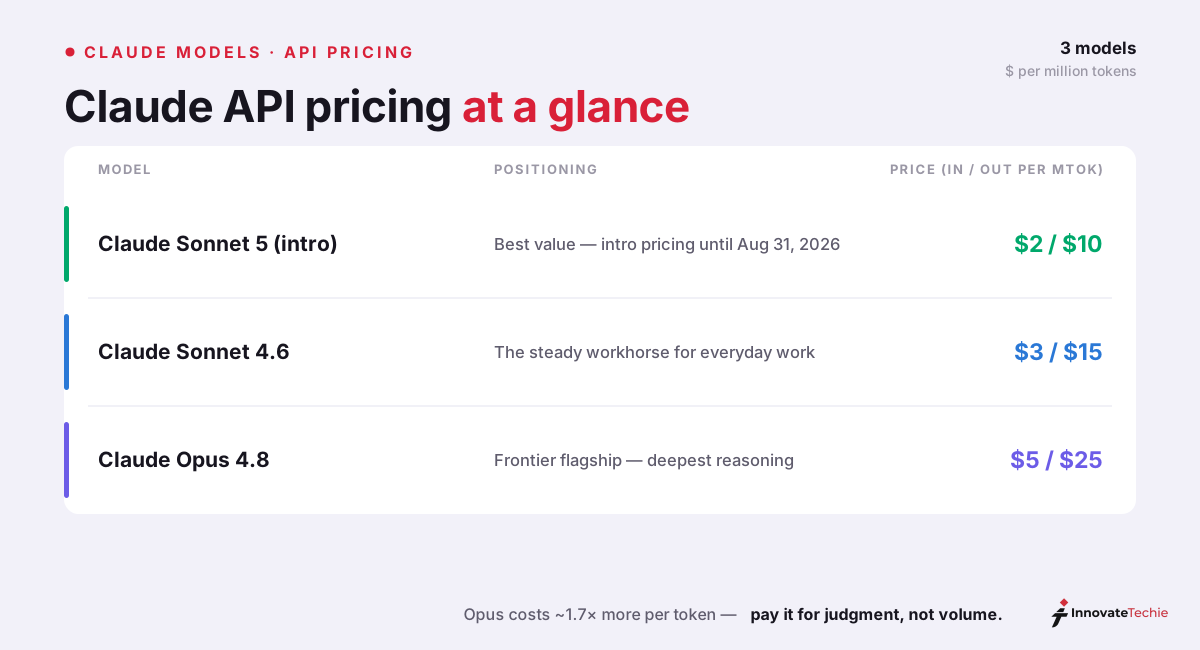
Put the other way round: Sonnet costs 60% of what Opus costs. Two levers apply to both models — batch processing cuts costs 50%, and prompt caching cuts cached input by 90%.
The subtlety: Opus is often more token-efficient on complex tasks, reaching a correct answer in fewer attempts. If a task requires three Sonnet retries but one Opus pass, Opus is the cheaper model for that task. That is exactly why a decision framework beats a blanket rule.

The decision framework
Ask one question: what happens if the model is slightly wrong?
| If a mistake is… | Pick | Because |
|---|---|---|
| Cheap to catch (you review everything anyway) | Sonnet | Code you'll run and test, drafts you'll edit, analysis you'll sanity-check |
| Expensive to catch (errors compound invisibly) | Opus | Architecture decisions, long agent chains, research you'll act on directly — anywhere step 3 silently poisons step 9 |
| Less important than volume | Haiku / Sonnet | Classification, extraction, summarization pipelines |
In practice: start on Sonnet, escalate to Opus only when Sonnet measurably fails — not when you imagine it might. Most people who run this experiment stay on Sonnet for far more than they expected.
If you're choosing a model inside a coding tool instead of the API, see our comparison of Cursor vs Claude Code. Still deciding between assistants entirely? Start one level up with Is Claude better than ChatGPT?
What changes on subscription plans
The math inverts: you're not paying per token, so use the best model your limits allow.
On subscriptions the Claude Sonnet vs Opus math changes shape entirely. On Claude Pro ($20/month) and Max ($100–$200/month) you get usage windows rather than per-token billing. Pro users hit caps quickly on Opus, so Sonnet stretches a session much further. Max 20x users can afford to default to Opus for interactive work. Weekly limits (one across all models, one Sonnet-only) reset at a fixed time assigned to your account.
Claude pricing at a glance
On a subscription this whole comparison is free to run either way; the $3/$15 versus $5/$25 gap only bites on the API.
| Plan | Price |
|---|---|
| Free | $0 |
| Pro | $20 / month |
| Max | from $100 / month |
| API | Pay per token |
For the full breakdown of every plan, see our how much Claude costs guide.
Frequently Asked Questions

Written by
Edith
Writing about Claude and the Anthropic toolkit — models, Claude Code, pricing, features, and fixes, in clear, practical, hands-on guides tested by daily use.
View all posts →