

In This Article
10 sectionsQuick answer
Every Claude model in one place: Opus 5, Sonnet 5, and Haiku 4.5 compared on price, context, and use case — plus how to decode Anthropic's version names.
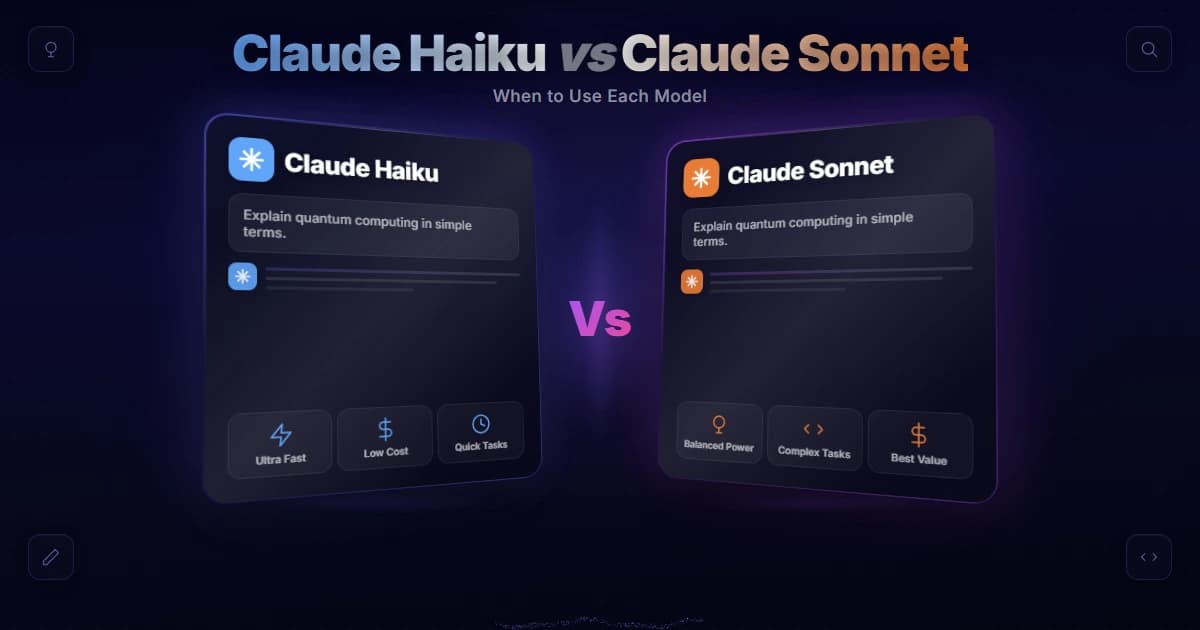
Anthropic ships Claude models in three tiers: Haiku (fast and cheap), Sonnet (the balanced default), and Opus (the frontier flagship). As of July 2026 that means Claude Haiku 4.5 at $1/$5 per million tokens, Claude Sonnet 5 at $3/$15, and Claude Opus 5 at $5/$25 — pick Sonnet unless you have a measured reason not to.
Lineup, pricing, and version details verified 31 July 2026 against Anthropic's model overview. Tiers refresh roughly every one to two quarters — re-check before pinning anything in production.
This page is our hub for the whole lineup: what each tier is for, exact pricing with every discount lever, how to decode Anthropic's version strings, and which models you actually get inside claude.ai, the API, and Claude Code. Where one comparison deserves full depth, we link out to a dedicated article rather than skim it here.
Key takeaway
Anthropic ships Claude in three tiers — Haiku 4.5 ($1/$5 per million tokens, 200K context), the balanced default Sonnet 5 ($3/$15, 1M context), and the frontier Opus 5 ($5/$25, 1M context) — so pick Sonnet unless you have a measured reason to move up or down. Above them sits Fable 5 at $10/$50 for work that genuinely outruns Opus.
Why Anthropic ships Claude models in three sizes
Because bigger models reason more reliably but cost more and respond slower. Rather than sell one model and make you accept its compromises everywhere, Anthropic lets you match the compute to the job.
The three-tier structure isn't marketing — it's an engineering trade-off made explicit.
The naming carries the metaphor: a haiku is short, a sonnet is structured and mid-length, an opus is the big work. In practice the tiers behave less like "good, better, best" and more like specialists. We route classification and extraction to Claude Haiku 4.5, everyday coding and writing to Claude Sonnet 5, and escalate to Claude Opus 5 only when a task's failure cost justifies the premium. That routing habit — not any single model choice — is what actually controls quality and spend.
If you're still deciding between vendors rather than tiers, start one level up with our comparison of Claude vs ChatGPT — this page assumes you've landed on Claude and now need to pick the right size.
Claude models at a glance: the 2026 lineup
Three mainstream tiers spanning a 5× price range, with Sonnet and Opus both at 1M context. Capacity rarely forces you up-tier any more — fit does.
Here is the current lineup as of July 2026, in one table:
| Claude Haiku 4.5 | Claude Sonnet 5 | Claude Opus 5 | |
|---|---|---|---|
| Role | Speed and volume | Balanced default | Frontier flagship |
| API price (in/out per MTok) | $1 / $5 | $3 / $15 (intro $2 / $10 until Aug 31, 2026) | $5 / $25 |
| Context window | 200K tokens | 1M tokens | 1M tokens |
| Max output | 64K tokens | 128K tokens | 128K tokens |
| Best for | Classification, extraction, high-volume pipelines | Coding, writing, analysis, agents | Deep reasoning, large refactors, enterprise agentic work |
| Relative speed | Fastest | Fast | Slowest, most deliberate |
| In claude.ai free tier | No | Yes (tight caps) | No |
Two things stand out. First, the price spread is only 5× between the cheapest and most expensive mainstream tier — narrow enough that model choice is about fit, not affordability. Second, Sonnet and Opus both reach a 1M-token context window and Haiku offers 200K, so capacity rarely forces you up-tier the way it did in 2024–2025.

Current versions: release dates and what changed
Version numbers move independently per tier, so "the latest Claude" is three different answers: Opus 5, Sonnet 5, and Haiku 4.5.
| Tier | Current version | Previous | Headline change |
|---|---|---|---|
| Opus | Claude Opus 5 | Opus 4.8 (28 May 2026) | Step up over 4.8 at the same $5/$25; thinking on by default; 512-token cache floor |
| Sonnet | Claude Sonnet 5 (30 June 2026) | Sonnet 4.6 | First mid-tier model to beat its own flagship on a major benchmark (GDPval-AA v2) |
| Haiku | Claude Haiku 4.5 (October 2025) | Haiku 3.5 | Near-frontier coding quality at $1/$5 — roughly the capability Sonnet 4 offered a year earlier |
The pattern worth internalizing: each tier eventually inherits the capabilities of the tier above it from a few releases back. Claude Haiku 4.5 performs near where Claude Sonnet 4 did; Claude Sonnet 5 now trades wins with the Opus line on knowledge work — the latest in a run of Opus releases stretching back to Claude 3. If your workload runs fine on today's Sonnet, there's a good chance next year's Haiku handles it for a third of the price. We re-test our own pipelines against the tier below every time a new release lands, and the downgrade succeeds more often than not.
Claude Opus 4.8 remains callable as a legacy model at the same $5/$25, which matters if you are pinned to it or if a safety-classifier refusal on Opus 5 needs a fallback. New work should start on Opus 5 — see our Claude Opus 5 guide for the two breaking changes to check first. Claude Sonnet 4.6 likewise remains available, but Sonnet 5 costs the same at standard rates and less during the introductory window, so there is no reason to start a new project on 4.6.
Above the three mainstream tiers sits a premium frontier line. Claude Fable 5 is Anthropic's single most capable widely released model at $10/$50 per million tokens, for the most demanding reasoning and long-horizon agentic work, with an access-restricted sibling — Claude Mythos 5, via Project Glasswing — that shares its capabilities and pricing. Most teams never need it. Because it costs double Opus, escalate only when the difficulty clearly earns the premium.
Claude API pricing in full
Per million tokens, input and output priced separately — and the two discount levers matter more than the base rates.
API pricing in full, including both levers:
| Model | Input / Output per MTok | Batch (−50%) | Cached input (−90%) |
|---|---|---|---|
| Claude Fable 5 | $10 / $50 | $5 / $25 | $1 per MTok read |
| Claude Opus 5 | $5 / $25 | $2.50 / $12.50 | $0.50 per MTok read |
| Claude Opus 4.8 (legacy) | $5 / $25 | $2.50 / $12.50 | $0.50 per MTok read |
| Claude Sonnet 5 (standard) | $3 / $15 | $1.50 / $7.50 | $0.30 per MTok read |
| Claude Sonnet 5 (intro, until Aug 31, 2026) | $2 / $10 | $1 / $5 | $0.20 per MTok read |
| Claude Haiku 4.5 | $1 / $5 | $0.50 / $2.50 | $0.10 per MTok read |
- Batch processing (−50%) applies when you submit jobs asynchronously and accept results within 24 hours. Any pipeline that isn't interactive — nightly summarization, bulk classification, report generation — should run through the batch API by default. Half price for changing an API endpoint is the easiest cost win in this ecosystem.
- Prompt caching (−90% on cached input) applies when requests share a long common prefix — a system prompt, a codebase snapshot, a document under discussion. Agents and chat apps re-send that prefix on every turn, so caching routinely cuts effective input cost substantially. Note the minimum cacheable prefix drops to 512 tokens on Opus 5, half what Opus 4.8 required, so short prompts you had written off may now cache.
Stacked together, a cached, batched Sonnet 5 workload at introductory rates pays a tenth or less of naive Opus list price. When someone tells us Claude is "too expensive," the fix is almost always routing and caching, not switching vendors.
Context windows: up to 1M tokens
Opus 5 and Sonnet 5 both reach 1M tokens — roughly 750,000 words. Haiku 4.5 caps at 200K. Capacity is rarely the constraint any more; reasoning reliability across a long context is.
Through 2024–2025, context capacity was a reason to buy the bigger model. Now the differentiator is how reliably each tier reasons over a long window, where Opus still degrades least.
Remember that input tokens are billed per request — filling a 1M window with Opus costs $5 per call before output. Prompt caching exists precisely so you don't pay that repeatedly for the same material. And on Opus 5 specifically, thinking is on by default and max_tokens caps thinking plus response text together, so a tight output ceiling can truncate a long-context answer that used to fit.

How to pick a model by task
Ask one question: what happens if the model is slightly wrong? If mistakes are cheap to catch, buy speed and volume. If they compound invisibly, buy reasoning.
There's no universal winner, so choosing the best Claude model for your task comes down to that single trade-off.
| Your task | Use | Why |
|---|---|---|
| Classification, tagging, extraction, routing | Claude Haiku 4.5 | Verifiable outputs at the lowest cost; errors surface immediately |
| Everyday coding — features, bug fixes, tests | Claude Sonnet 5 | Most of Opus's coding capability at a fraction of the price |
| Drafting, editing, business writing | Claude Sonnet 5 | Wins GDPval-AA v2 on realistic knowledge work; fast enough for interactive loops |
| Large multi-file refactors | Claude Opus 5 | Holds the whole dependency graph across many interdependent steps |
| Long agentic sessions (30+ minutes) | Claude Opus 5 | Drifts less; small reasoning errors compound over many steps |
| Architecture and design decisions | Claude Opus 5 | Surfaces assumptions and trade-offs you'll want to review |
| High-volume pipelines (summarize, translate) | Claude Haiku 4.5 or Sonnet 5, batched | Repetitive, verifiable work is where the cheaper tiers hold up best |
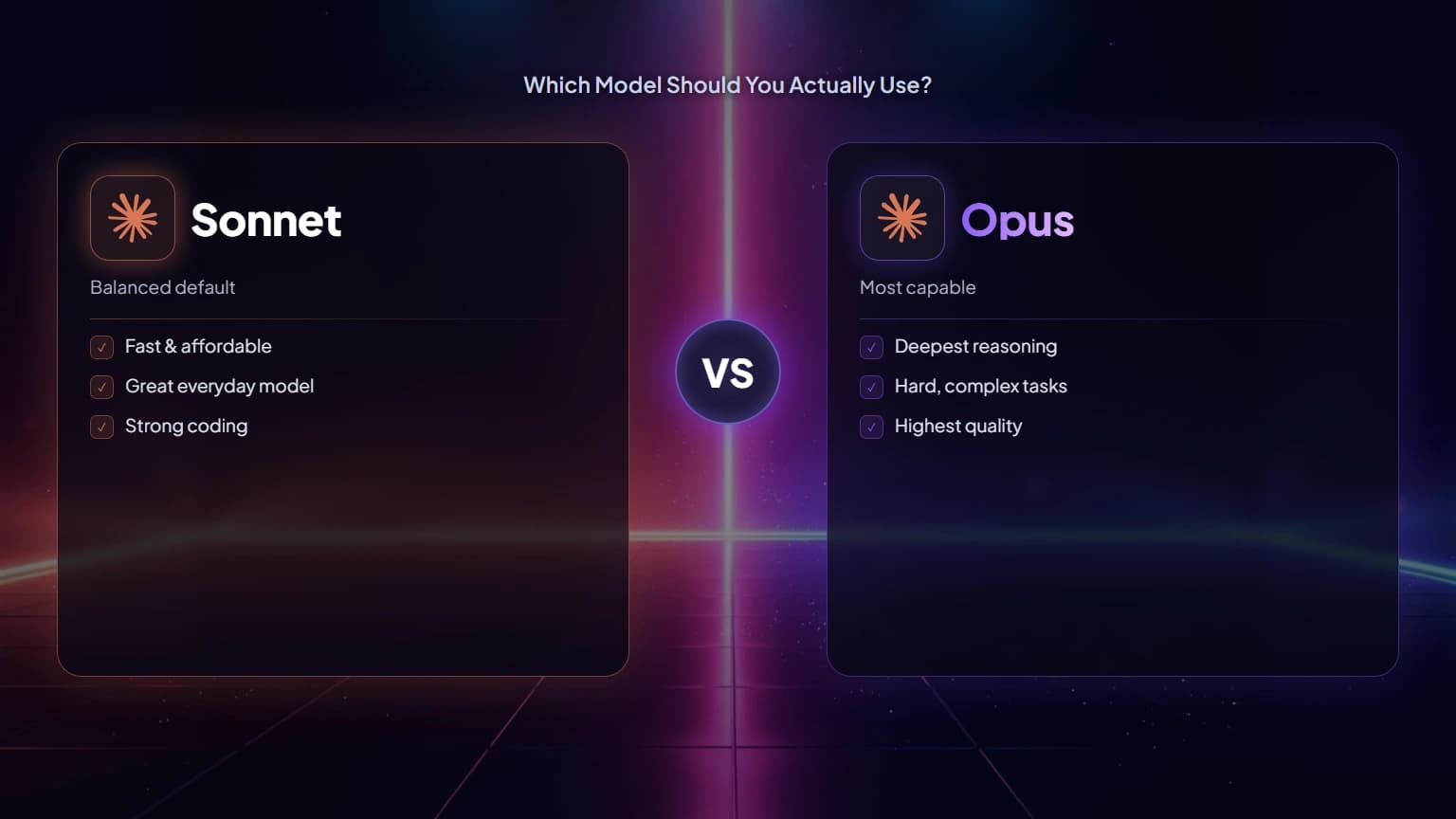
Our standing rule: start on Sonnet, escalate to Opus only when Sonnet measurably fails, and downgrade to Haiku wherever outputs are mechanically verifiable. Most teams that run this experiment stay on Sonnet for far more than they expected.
The Sonnet-or-Opus call is the one with real money and real quality on the line, so we've given it a full head-to-head with benchmark data and worked cost scenarios — see Claude Sonnet vs Opus: which model should you actually use?
Claude model names decoded
Model strings read family-tier-version-snapshot. claude-sonnet-4-5-20250929 is the Claude family, Sonnet tier, version 4.5, snapshot dated 29 September 2025.
Dashes stand in for dots, which is the part that trips people up. Current-generation IDs increasingly drop the date entirely — claude-opus-5 and claude-sonnet-5 are complete as written, and appending a date suffix to them returns a 404.
Three practical rules follow:
- Pin snapshots in production where they exist. A dated string always returns the exact same model. Undated aliases resolve to the newest snapshot and can change behaviour under you without warning.
- Version numbers only compare within a tier. Claude Haiku 4.5 is not "almost Sonnet 4.6" — the tiers are different model sizes that happen to share a versioning scheme. Sonnet 5 is not bigger than Opus 5.
- The marketing name maps directly. "Claude Opus 5" in a press release is
claude-opus-5in the API. If a tool's model picker shows a string you don't recognize, decode it segment by segment rather than guessing.
Which models you get in claude.ai, the API, and Claude Code
The same models surface differently by product — and the pricing logic inverts. On subscriptions you should use the best model your limits allow; on the API you should use the cheapest that passes.
| Surface | Models you get | How you pay |
|---|---|---|
| claude.ai Free | Sonnet only, tight caps | Free |
| Claude Pro ($20/mo) | Sonnet + Opus, moderate limits | Flat monthly; usage windows, not tokens |
| Claude Max 5x ($100/mo) / 20x ($200/mo) | All models, expanded limits | Flat monthly; Max 20x can default to Opus |
| Team / Enterprise | All models, admin controls | Per-seat |
| API | Every model incl. pinned snapshots | Per token (see pricing table above) |
| Claude Code | Model switchable mid-session | Requires a paid plan or API key |
Pro users burn through caps quickly on Opus, so Sonnet stretches a session much further; Max 20x subscribers can comfortably default to Opus for interactive work.
Claude Code — Anthropic's agentic coding tool, available as a terminal CLI, VS Code and JetBrains extensions, a desktop app, and on the web at claude.ai/code — makes the tier system tangible: you can switch models mid-session, so escalation from Sonnet to Opus costs one command. How that compares to routing models inside other editors is exactly what we cover in Cursor vs Claude Code. On the knowledge-work side, Claude Cowork runs the same models against files and documents instead of codebases.
Upgrade cadence: how to stay current
A tier refresh lands roughly every one to two quarters. That pace rewards a process, not vigilance.
Anthropic shipped Claude Opus 4.8 — the successor to Claude Opus 4.7 — in May 2026, Claude Sonnet 5 five weeks later, and Claude Opus 5 after that.
- Keep a small eval set. Ten to twenty real tasks from your own workload, with known-good outputs. When a release lands, run it before reading anyone's benchmark commentary — including ours.
- Exploit introductory pricing windows. Claude Sonnet 5's $2/$10 intro rate runs until 31 August 2026. Anthropic has used launch discounts to accelerate migration; treat them as a scheduled deadline for your own testing.
- Test the tier below on every release. The consistent pattern is capability flowing downhill. Yesterday's Sonnet workload is often today's Haiku workload at a third of the cost.
- Watch deprecation notices. Older snapshots retire on published schedules. Pinned production models buy you stability, not immortality — calendar the sunset dates.
- Re-check rate-limit buckets. Opus 5 draws on a separate pool from the shared Opus 4.x limit, so a model-string swap can quietly become a capacity problem.
Claude pricing at a glance
Every consumer plan runs the same models, so paying more buys usage headroom rather than a smarter model.
| Plan | Price |
|---|---|
| Free | $0 |
| Pro | $20 / month |
| Max | from $100 / month |
| API | Pay per token |
For the full breakdown of every plan, see our how much Claude costs guide. Tracking what shipped when at the frontier? The Claude Mythos release timeline has the dates.
Working from an older pin? Claude 3.7 Sonnet is retired now, and the thinking-budget mechanism it pioneered is rejected outright on current models.
Frequently Asked Questions

Written by
Edith
Writing about Claude and the Anthropic toolkit — models, Claude Code, pricing, features, and fixes, in clear, practical, hands-on guides tested by daily use.
View all posts →