



Part ofClaude Models Explained: Opus vs Sonnet vs Haiku
In This Article
7 sectionsQuick answer
Claude Haiku 4.5 is Anthropic's fastest, cheapest model — $1/$5 per million tokens, 200K context, and near-frontier coding. When to pick it, and its limits.
Claude Haiku 4.5 is Anthropic's fastest and cheapest model, priced at $1 per million input tokens and $5 per million output, with a 200,000-token context window. It matches Claude Sonnet 4 on coding, scores 73.3% on SWE-bench Verified, and is the first Haiku with extended thinking and computer use built in.
Pricing and specs verified 31 July 2026 against Anthropic's model overview.
We route a lot of high-volume, low-glamour work through this tier — classification, extraction, first-draft summaries, and the parallel subagents that fan out under a bigger model. It changed the arithmetic of what belongs where. Below is the honest breakdown: what the model is, what it costs, how it stacks up against Sonnet 5 and the Opus tier, when to reach for it, and where it genuinely falls short.
Key takeaway
Claude Haiku 4.5 is Anthropic's cheapest model at $1 per million input and $5 per million output tokens, with a 200,000-token context window and a 73.3% SWE-bench Verified score that matches the older Claude Sonnet 4 on coding.
What is Claude Haiku 4.5?
The small, speed-optimised tier of Anthropic's family — built for volume rather than the hardest reasoning. What makes this release notable is that "small" no longer means "limited."
According to Anthropic's launch announcement, it delivers near-frontier intelligence: matching the previous flagship, Claude Sonnet 4, on agentic coding while running more than twice as fast and costing a third as much.
It handles both text and images, carries a 200,000-token context window, and is the first model in its tier to ship with extended thinking, computer use, and context awareness. That last point matters more than the spec sheet suggests. Earlier generations were fast text machines; this one can pause to reason, drive a browser, and call tools like bash, code execution, text editing, and web search. If you have only ever thought of this tier as autocomplete-grade, this release resets that assumption. For the full lineup, our pillar guide Claude models explained maps every tier.

Pricing and specs
$1 in, $5 out per million tokens — the cheapest model Anthropic sells, with a gap to the mid-tier large enough to change how you architect an application.
| Spec | Claude Haiku 4.5 |
|---|---|
| Input price | $1 / million tokens |
| Output price | $5 / million tokens |
| Context window | 200,000 tokens |
| Max output | 64,000 tokens |
| Modalities | Text + images |
| Extended thinking | Yes (first in this tier) |
| Computer use | Yes |
| SWE-bench Verified | 73.3% |
| API model name | claude-haiku-4-5 |
Two discounts stack on top and they are the real cost story for production workloads. Prompt caching cuts as much as 90% off repeated context — invaluable when every request shares the same system prompt or document. Batch processing takes another 50% off for non-urgent jobs. Run a nightly classification pass through the Batch API against cached context and the effective rate drops far below the sticker price. We cover how those levers compound in our Claude API pricing breakdown.
Haiku 4.5 vs Sonnet 5 vs Opus 5
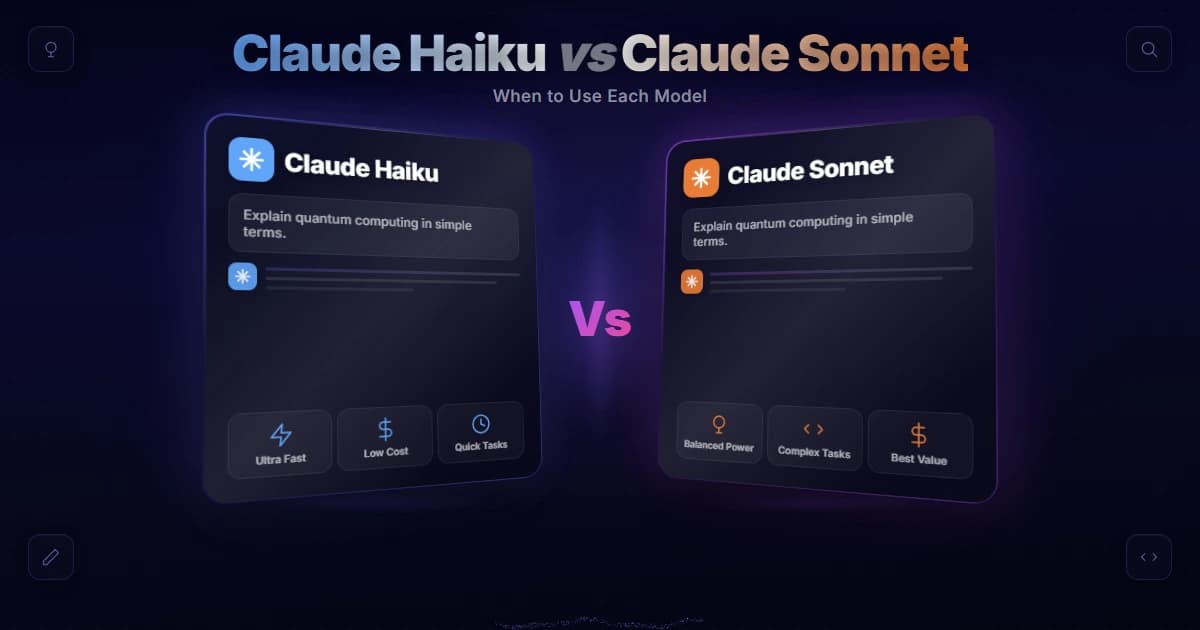
Roughly a third the price of Sonnet 5 and a fifth the price of Opus 5, while running faster than both. What you give up is ceiling, not competence.
| Model | Input / Output (per M) | Best for | Relative speed |
|---|---|---|---|
| Claude Haiku 4.5 | $1 / $5 | High volume, subagents, simple tasks | Fastest |
| Claude Sonnet 5 | $3 / $15 (intro $2 / $10) | Balanced coding and reasoning | Fast |
| Claude Opus 5 | $5 / $25 | Hardest reasoning, deep agentic work | Slowest |
The Opus tier leads on the toughest agentic benchmarks — Opus 4.8 posts 69.2% on SWE-bench Pro, work involving multi-hour tasks and sprawling codebases where the small tier will lose the thread. Sonnet 5 sits in the middle as the balanced default. Haiku 4.5 wins decisively on any task where speed and cost dominate and the reasoning demand is moderate.
A concrete rule we follow: if a task is well-defined and repeats thousands of times, start here and only escalate the cases it fails. If a task is open-ended and you cannot describe the finish line in a sentence, start on Sonnet or Opus. Our Claude Haiku vs Sonnet comparison drills into that trade-off task by task, and Claude Sonnet 5 covers the mid-tier in depth.
When to pick it
Four situations: high-volume repetition, subagent orchestration, latency-sensitive interfaces, and cost-capped coding.
- High-volume, repetitive tasks. Tagging support tickets, extracting fields from documents, moderating comments, generating short product blurbs. When you are running a task tens of thousands of times, the price difference is the entire budget.
- Subagent orchestration. This is the pattern Anthropic highlights: a Sonnet or Opus planner breaks a job into parallel subtasks and hands each to a cheaper worker. You get breadth cheaply while the expensive model does the thinking. If you build with Claude Code subagents, this is the natural worker tier.
- Latency-sensitive experiences. Chat that has to feel instant, autocomplete, real-time suggestions. It's the fastest model Anthropic offers, so it fits interactive loops the larger tiers make sluggish.
- Cost-capped coding. At 73.3% on SWE-bench Verified, it handles a large share of everyday code generation, debugging, and refactoring at a fraction of flagship pricing.

The inverse is just as useful. Reach past this tier when a task needs sustained multi-step reasoning, deep architectural judgment, or reliability on long-horizon agentic work where a single wrong turn compounds. That is Opus territory — the Claude Opus 5 writeup covers where the ceiling actually matters.
The real limits
Three: a lower reasoning ceiling, a 200K context window rather than 1M, and thinking tokens that bill as output and can erode the cost advantage.
First, the reasoning ceiling is lower than Sonnet or Opus. On genuinely hard, multi-hour agentic problems it loses coherence over long chains where the bigger tiers hold it. It gets you roughly 90% of Sonnet 4.5's agentic-coding quality in Anthropic's cited evaluations, and that last 10% is exactly the hard part.
Second, the context window is 200,000 tokens, not the million-token window Sonnet and Opus reach. For most jobs 200K is plenty, but if you are stuffing an entire monorepo or a book-length corpus into one prompt, that is a real constraint. Claude context window explains how to work within it.
Third, extended thinking is powerful but not free — thinking tokens bill as output at $5 per million, so a heavy-reasoning call here can cost more than a plain Sonnet call. If you turn the reasoning budget up on every request, you erode the cost advantage that made you pick this tier in the first place. Use extended thinking deliberately, not by default.
How to access Claude Haiku 4.5
Every surface Anthropic ships: the Claude apps, the API as claude-haiku-4-5, and Amazon Bedrock, Google Vertex AI, and Microsoft Foundry.
In the Claude apps it powers free-tier responses; developers call it through the Claude API with that identifier; and the major clouds carry it for teams that need it inside existing infrastructure. It also drives the fast agents in Claude Code when you route work to the cheaper tier. Whichever door you use, the model, the 200K context, and the tool support are the same; only billing and access controls differ. For a first API call, our Claude API getting started guide has the minimal setup.
That reach, plus the price, is why we treat it as the default first stop for any new automation and only escalate the tasks that prove they need more. Start cheap, measure, promote the failures. It is the cleanest cost discipline the current lineup allows.
Claude pricing at a glance
Haiku 4.5 costs nothing extra on a subscription and $1/$5 per million tokens on the API — the cheapest way to run Claude at volume.
| Plan | Price |
|---|---|
| Free | $0 |
| Pro | $20 / month |
| Max | from $100 / month |
| API | Pay per token |
For the full breakdown of every plan, see our how much Claude costs guide.
Frequently Asked Questions

Written by
Edith
Writing about Claude and the Anthropic toolkit — models, Claude Code, pricing, features, and fixes, in clear, practical, hands-on guides tested by daily use.
View all posts →