

Part ofClaude Comparison: Which AI Should You Actually Use?
In This Article
8 sectionsQuick answer
Claude wins on production-ready code, safety, and polish; DeepSeek wins on cost, math, and open weights you can self-host. An honest task-by-task verdict.
In the Claude vs DeepSeek matchup, Claude wins on production-ready code, careful reasoning, safety, and product polish, while DeepSeek wins on cost and raw math, ships open-weight models you can self-host, and runs roughly 90% cheaper per token. Pick Claude when output reliability matters; pick DeepSeek when budget and openness lead.
Model line-up, context windows and pricing verified 31 July 2026 against Anthropic's model overview.
We run both weekly — Claude Code against our own repository, DeepSeek as the budget workhorse for throwaway generation and math-heavy analysis. This guide is part of our wider Claude comparison hub, and it settles the Claude vs DeepSeek question the way buyers actually ask it: coding, reasoning, price, privacy, and the honest line where each one wins.
Key takeaway
Claude wins on production-ready code (Opus 4.8 scored 69.2% on SWE-bench Pro, and Opus 5 is now the flagship at the same rate), safety, and US data residency, while DeepSeek ships MIT-licensed open weights you can self-host and runs well over 90% cheaper per token ($0.14/$0.28 vs $5/$25 per million).
Claude vs DeepSeek: the one-minute verdict
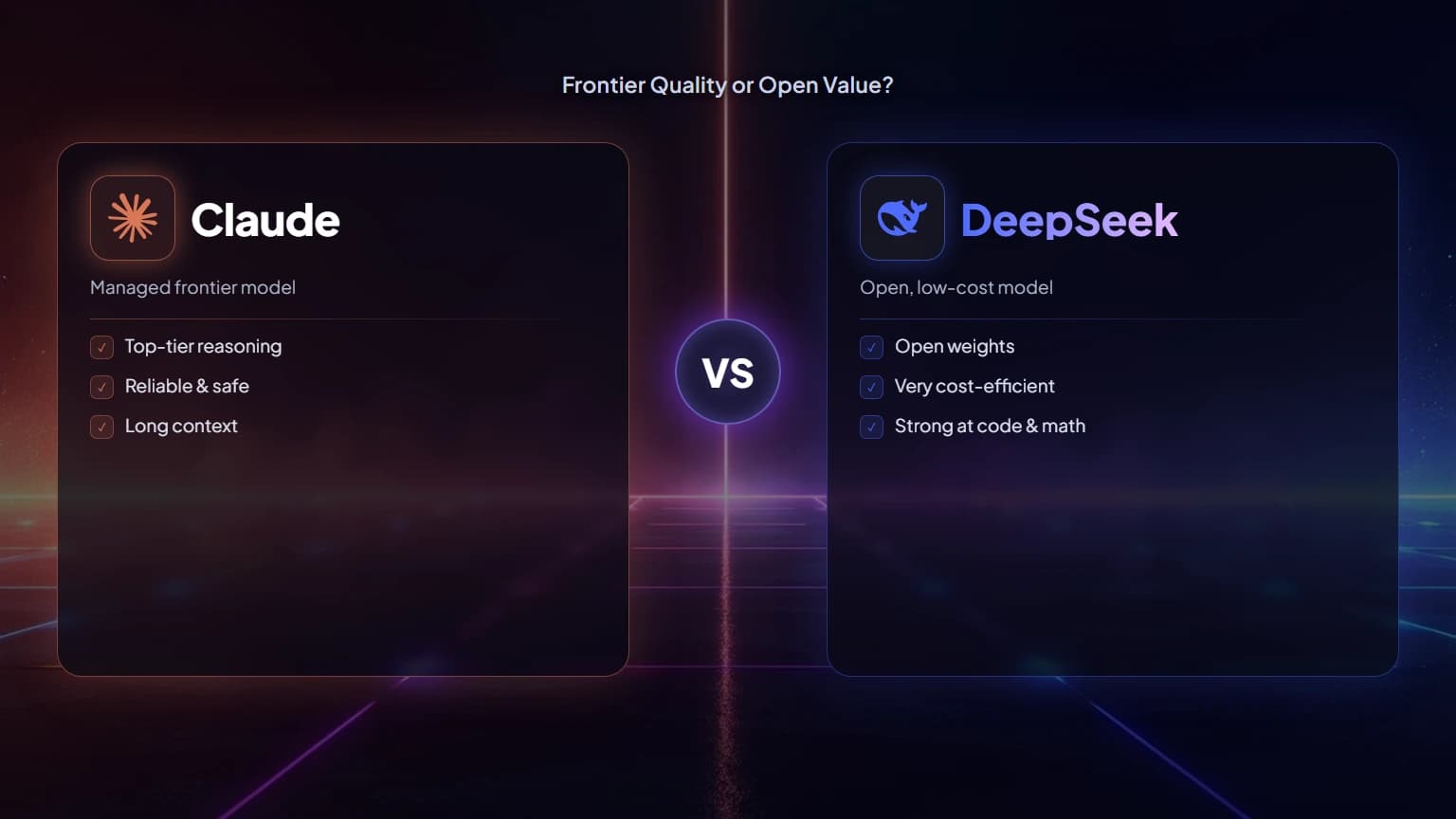
Anthropic sells closed, frontier-grade reliability you rent through an API or apps. DeepSeek publishes MIT-licensed open weights, undercuts every Western lab on price, and lets you run the model yourself. Almost every difference below follows from that split.
The Claude vs DeepSeek fight is a clash of two opposite bets. Anthropic sells closed, frontier-grade reliability you rent through an API or apps. DeepSeek ships open weights under a permissive license, undercuts every Western lab on price, and lets you run the model yourself. Almost every row below follows from that split.
| Claude (Anthropic) | DeepSeek | |
|---|---|---|
| Current flagship | Opus 5 (Opus 4.8 still available), Sonnet 5 | V4 Pro, V4 Flash |
| Model access | Closed — API and apps | Open weights (MIT), self-hostable |
| Context window | Up to 1M tokens | Up to 1M tokens (V4) |
| Cheapest API model | Haiku 4.5 — $1/$5 per 1M | V4 Flash — $0.14/$0.28 per 1M |
| Image generation | No | No |
| Data residency | US, enterprise controls | Servers in China |
| Signature strength | Reliability, safety, polish | Cost, math, openness |
Framed simply, the DeepSeek vs Claude choice is open value versus frontier reliability. Hand both the same messy repo and a vague ticket: DeepSeek returns working code for pennies, Claude returns the version you'd actually merge without a rewrite. That trade — cheap output versus trustworthy output — is the whole comparison in miniature.
Is Claude or DeepSeek better for coding?
They are good at different coding. Claude leads agentic, production-style work — coherent multi-file refactors and diffs you can merge as they are. DeepSeek is excellent on algorithmic and competitive problems, and costs a fraction as much per session.
Coding is where most buyers start, and the honest answer is that both are good — but they're good at different coding. On agentic, production-style work, Claude leads. Claude Opus 4.8 scored 69.2% on the hard SWE-bench Pro suite, roughly ten points ahead of DeepSeek V4 Pro on the same benchmark, and Claude Opus 5 has since taken over as the flagship at the same price. In day-to-day use that gap shows up as maintainable, deployment-ready diffs: Claude keeps multi-file refactors coherent, matches your existing style, and produces edits you can review instead of re-read line by line.
DeepSeek's strength is the other kind of coding. On algorithmic and competitive problems — the LiveCodeBench, HumanEval, contest-style tier — V4 Pro is genuinely excellent and, in some suites, ahead of Claude. The old deepseek r1 vs claude debate that once dominated these comparisons has moved on: V4 now folds R1's chain-of-thought reasoning into a single model with a "thinking" mode, so the reasoning that made R1 famous is now the default.
| Coding dimension | Claude | DeepSeek |
|---|---|---|
| SWE-bench Pro (agentic) | 69.2% (Opus 4.8) | Mid-50s (V4 Pro) |
| Multi-file production refactors | Cleaner, deployment-ready | Capable, less consistent |
| Algorithmic / competitive coding | Strong | Excellent |
| First-party agentic coding tool | Claude Code | None (needs a proxy) |
| Cost per coding session | Higher | ~90% lower |
The claude vs deepseek coding verdict we've landed on: reach for DeepSeek when the task is a self-contained algorithm or a script you'll read once, and reach for Claude when the code has to survive in a codebase other people maintain. The same quality-first pattern holds against OpenAI — we walk through it in Is Claude better than ChatGPT? — and it's the most reliable predictor of which tool you'll trust with a real branch.
Reasoning and math: DeepSeek's real surprise
On pure mathematics the ranking flips: DeepSeek regularly edges out frontier closed models on olympiad-style and college-level problems. Claude's counter is judgment — working out what the problem actually is, and staying honest under uncertainty rather than inventing an answer.
In the Claude vs DeepSeek reasoning comparison, the ranking flips. On pure mathematics — college-level and olympiad-style problems, AIME and MATH-500 sets — DeepSeek consistently outperforms Claude, handling multi-step derivations with accuracy that regularly edges out frontier closed models. If your work is quantitative — proofs, competition math, symbolic manipulation — DeepSeek is not the budget compromise, it's arguably the better tool.
Claude's counter is judgment-based reasoning: following nuanced, layered instructions, weighing trade-offs, and staying honest under uncertainty instead of confidently inventing an answer. In our testing, DeepSeek is stronger at solving a defined problem and Claude is stronger at deciding what the problem actually is — the messy, ambiguous reasoning that dominates real client work. Both models now offer up to a 1M-token context window, so long-document analysis, once a clear Claude advantage, is roughly a tie; if that headroom matters to your workflow, our Claude context window guide covers how usable recall differs from raw window size. Neither model, though, fetches live, cited sources from the open web on its own — when a task is really about current answers with receipts rather than reasoning depth, a search-native answer engine like Perplexity is the better fit.

Pricing: DeepSeek's order-of-magnitude edge
DeepSeek's hosted API starts at $0.14 input and $0.28 output per million tokens, against $5/$25 for Claude's Opus tier and an introductory $2/$10 for Sonnet 5. Cheap tokens only stay cheap if you never have to re-verify the output.
On price, the Claude vs DeepSeek gap is a chasm, and it's real. DeepSeek's hosted API starts at $0.14 input and $0.28 output per million tokens for V4 Flash, per DeepSeek's official pricing. Claude Opus 5 and Opus 4.8 both run $5/$25, and Claude Sonnet 5 runs $2/$10 during its introductory window, per Anthropic's published rates. That makes DeepSeek roughly 90% cheaper than Claude's mid-tier and well over an order of magnitude cheaper than Opus.
| Tier | Claude (Anthropic) | DeepSeek |
|---|---|---|
| Free consumer chat | Yes — tight caps | Yes — no meaningful cap |
| Entry paid plan | Pro — $20/mo | None (no paid consumer tier) |
| Budget API model | Haiku 4.5 — $1/$5 per 1M | V4 Flash — $0.14/$0.28 per 1M |
| Flagship API model | Opus 5 — $5/$25 per 1M | V4 Pro — $0.44/$0.87 per 1M |
| Open weights / self-host | No | Yes — MIT-licensed |
Two honest caveats before you switch your whole stack. First, cheap tokens are only cheap if you don't re-verify the output — on the hardest agentic tasks, the re-work Claude saves you can erase DeepSeek's per-token savings. Second, Claude's $20 Pro plan bundles Claude Code, which requires a paid plan or API credits to run, so a developer's real cost comparison is muddier than the raw table suggests. For high-volume, low-stakes generation, though, DeepSeek's price is decisive and no amount of polish closes it.
Privacy, safety, and self-hosting
DeepSeek's hosted service stores data in China and has tested as far more jailbreak-prone, a genuine blocker for regulated work. Its escape hatch is real, though: MIT-licensed weights run air-gapped on your own hardware. Claude offers no self-hosted option at all.
This is where the claude or deepseek decision stops being about quality and starts being about risk. DeepSeek's hosted service stores data on servers in China, where the company is subject to national security laws that can compel disclosure. Independent security testing has also found DeepSeek far more susceptible to jailbreaks than frontier Western models — one widely cited study measured it as roughly eleven times more vulnerable — and several governments, including Italy, Australia, Taiwan, and South Korea, have restricted or banned it in official sectors. For proprietary code, client records, or regulated data, that's a genuine blocker, not a footnote.
DeepSeek's answer is the same openness that makes it cheap: the weights are published under an MIT license, so you can download V4 and run it entirely on your own hardware, air-gapped, with no data leaving your network. That's a capability Claude simply doesn't offer — Anthropic's models are closed and API-only, the same open-weight bet Europe's Mistral makes and one we weigh in our Claude vs Mistral comparison. So the safety story cuts both ways. Use DeepSeek's hosted API with sensitive data and you inherit real exposure; self-host the open weights and you get privacy Claude can't match. Claude's advantage is that its default hosted path already ships with enterprise controls, US data residency, and stronger guardrails out of the box. For most regulated buyers, this row alone settles the Claude vs DeepSeek question.

Can you run Claude Code with DeepSeek?
Yes. Claude Code speaks the Anthropic API format, so a translating proxy can point it at DeepSeek as the backend and run a full session for a few dollars. You keep the agent loop but inherit DeepSeek's output quality.
A popular middle path collapses the Claude vs DeepSeek choice into one workflow: you can point Claude Code at DeepSeek instead of Anthropic's models. Claude Code speaks the Anthropic API format, so a small translating proxy lets it drive DeepSeek V4 as the backend — running a full coding session for a few dollars instead of Opus rates. It's the same routing trick we cover for other providers in running Claude Code with OpenRouter, and it's the cheapest way to keep Claude Code's agent loop while paying DeepSeek's token price. The catch is exactly the coding gap above: you get DeepSeek's output quality inside Claude's interface, so complex multi-file work still needs a closer review than Opus would.
The task-by-task verdict
Pick DeepSeek when cost, mathematics, or self-hosting is the binding constraint. Pick Claude when one output's reliability — or the sensitivity of the data behind it — outweighs the invoice. Plenty of teams keep both and route work by task.
No single winner survives contact with real work, so here's the honest Claude vs DeepSeek call by use case:
| Your main task | Better pick | Why |
|---|---|---|
| Production, client-facing code | Claude | Deployment-ready, maintainable diffs |
| Competitive math / algorithms | DeepSeek | Superior accuracy, far cheaper |
| Nuanced instruction-following | Claude | Fewer confident errors |
| Bulk, low-stakes generation | DeepSeek | Order-of-magnitude cheaper tokens |
| Sensitive or proprietary data | Claude | Enterprise controls, US residency |
| Self-hosting / air-gapped | DeepSeek | Open weights you run yourself |
| Long agentic coding sessions | Claude | Claude Code, fewer compounding errors |
| Learning on a zero budget | DeepSeek | Free chat, no meaningful cap |
The pattern is consistent: DeepSeek is the value play you pick when cost, math, or openness is the binding constraint; Claude is the reliability play you pick when the quality of one output — or the sensitivity of the data behind it — matters more than the invoice. Plenty of teams run both and route by task, exactly as we recommend for the wider field in our Claude vs Gemini breakdown. For most professionals doing client-facing work, DeepSeek gets you about 90% of the way for free, and Claude earns its price on the last 10% where it counts.
The quick version:
- Claude leads production code, safety, and reliability
- DeepSeek leads math, cost, and open weights
- DeepSeek self-hosts; Claude keeps US data residency
- Both reach up to a 1M-token context window
For example, on the same production refactor across 20 files, Claude shipped a cleaner diff, while DeepSeek matched it on raw algorithm speed at a small fraction of the API cost.
Claude pricing at a glance
Free costs nothing, Pro is $20 a month, Max starts at $100 a month, and API access is billed per token. DeepSeek has no paid consumer tier at all, and self-hosting its open weights removes per-token fees entirely.
| Plan | Price |
|---|---|
| Free | $0 |
| Pro | $20 / month |
| Max | from $100 / month |
| API | Pay per token |
For the full breakdown of every plan, see our how much Claude costs guide.
Frequently Asked Questions

Written by
Edith
Writing about Claude and the Anthropic toolkit — models, Claude Code, pricing, features, and fixes, in clear, practical, hands-on guides tested by daily use.
View all posts →