

Part ofClaude Comparison: Which AI Should You Actually Use?
In This Article
8 sectionsQuick answer
Claude wins on frontier reasoning and coding depth; Mistral wins on open weights, self-hosting, EU data residency, and cost. A task-by-task comparison.
In the Claude vs Mistral matchup, Claude wins on frontier reasoning, complex coding, and natural writing, while Mistral AI wins on open-weight self-hosting, European data residency, and cost — its API runs roughly ten times cheaper. Neither is universally better: pick Claude for depth, Mistral for openness, privacy, and price.
Claude model lineup, context windows, and pricing verified 31 July 2026 against Anthropic's pricing documentation.
We run both in production — Claude Code against our own repository, Mistral for cheap high-volume drafting and a self-hosted internal model. This guide is part of our wider Claude comparison hub, and it settles the Claude vs Mistral question task by task rather than crowning a single winner that doesn't survive contact with real work.
Key takeaway
Claude Opus 4.8 tops SWE-bench Pro at 69.2% and scores about 80.9% on SWE-bench Verified, while Mistral AI's open-weight models self-host under Apache 2.0 and run roughly ten times cheaper — about $0.50/$1.50 per million tokens against the $5/$25 of Anthropic's Opus tier.
Claude vs Mistral: the one-minute verdict
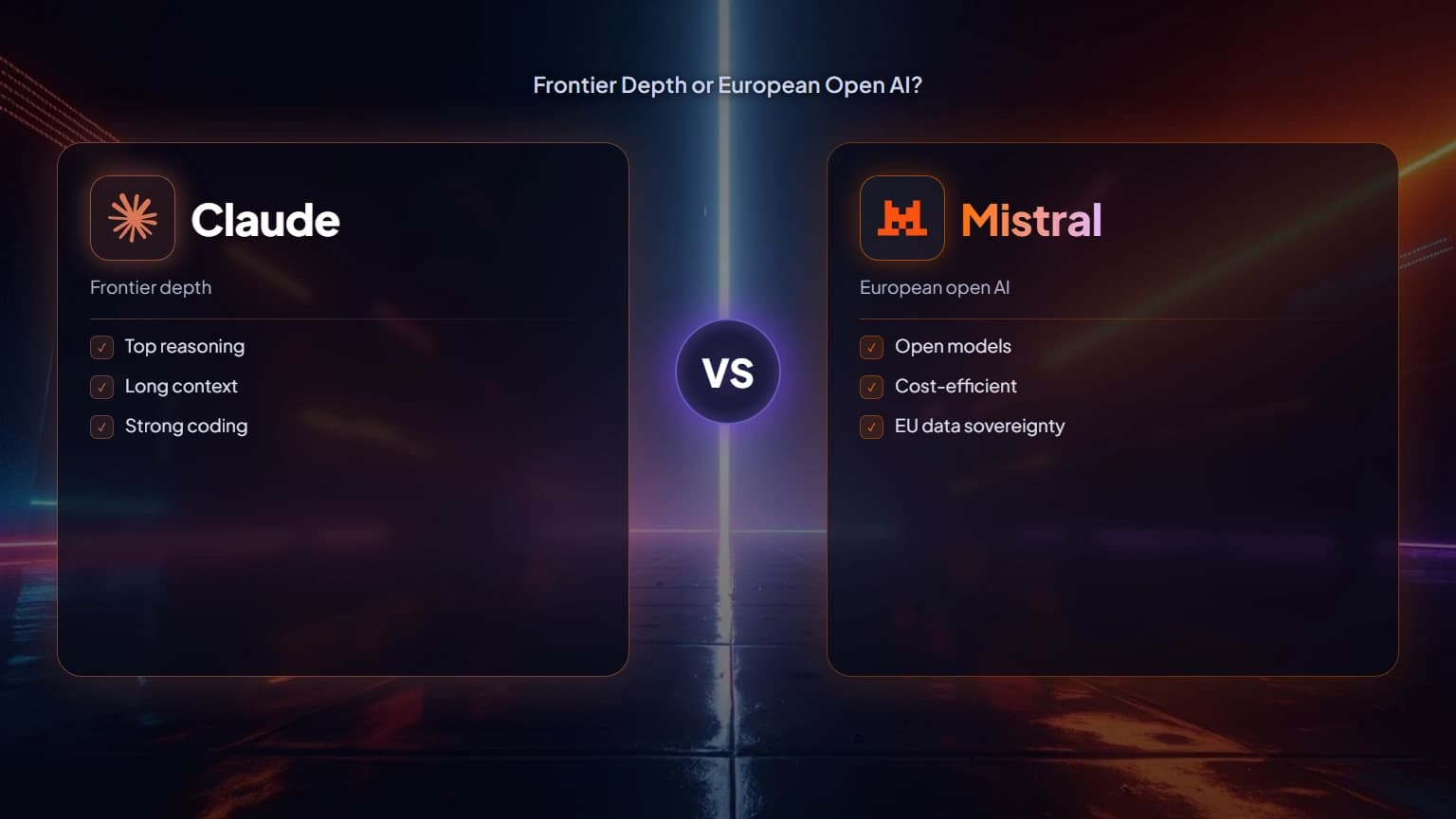
Anthropic tunes Claude for careful frontier output and ships it API-only; Paris-based Mistral tunes for efficiency and openness, publishing weights you can self-host under EU data rules. Depth-first versus openness-first explains nearly every difference below.
Anthropic and Mistral AI are built around opposite bets. Anthropic tunes Claude for careful, verifiable frontier output and ships it API-only. Mistral, based in Paris, tunes for efficiency and openness — publishing open-weight models you can download, self-host, and run under European data rules. Almost every row below follows from that split.
| Claude (Anthropic) | Mistral (Mistral AI) | |
|---|---|---|
| HQ / jurisdiction | United States | France (EU) |
| Model access | API-only, closed weights | Open-weight + API |
| Flagship models | Opus 5, Sonnet 5 | Mistral Large 3, Medium 3.5 |
| Context window | Up to 1M tokens | Up to 256K |
| Self-hostable | No | Yes — Apache 2.0 models |
| Image generation | No | Yes — via Le Chat |
| Signature strength | Frontier reasoning & coding | Efficiency, openness, EU privacy |
Framed simply, the Claude vs Mistral choice is depth-first versus openness-first. Hand both the same hard, multi-file refactor and Claude produces the cleaner, more reliable diff; hand both a million cheap classification calls and Mistral does it for a fraction of the bill. That trade — quality versus cost and control — is the whole comparison in miniature.
Which is stronger for reasoning and coding depth?
Claude leads on hard, agentic engineering — Opus 4.8 tops SWE-bench Pro at 69.2%. Mistral Large 3 matches it on short self-contained functions at roughly 92% HumanEval, then settles into a middle tier as tasks get longer.
This is where Claude vs Mistral stops being close. On the hardest agentic software-engineering work, Claude leads measurably: Claude Opus 4.8 tops the SWE-bench Pro suite at 69.2%, and Claude scores around 80.9% on SWE-bench Verified — the real-world benchmark that matters when an agent has to change code across many files and keep the diff reviewable.
Mistral is no slouch on code. Mistral Large 3 clears roughly 92% on HumanEval, so for short, self-contained functions the two are effectively tied. The gap opens on complexity. On long, multi-step SWE-bench-style tasks and sustained agentic sessions, Mistral lands in a solid middle tier while Claude stays at the frontier. In our own testing, Claude's edits need fewer correction passes on a large repository.
| Coding dimension | Claude | Mistral |
|---|---|---|
| HumanEval (short problems) | ~90%+ | ~92% |
| SWE-bench Pro (hard, real-world) | 69.2% — leads | Mid-tier |
| Multi-file refactoring | Cleaner, more consistent | Capable, less consistent |
| Agentic coding tool | Claude Code | Le Chat / Mistral Vibe |
The claude vs mistral large comparison at the flagship tier is quality against economy. Mistral Large 3's 256K context lets it read a large program in one shot, and it's genuinely useful for exploration and generation at low cost. But when the job is production-grade change across a repository, Claude Code's reasoning depth is what we trust — a difference we unpack against other rivals in Claude vs Gemini.

Openness and self-hosting: Mistral's structural advantage
Mistral publishes genuinely open weights — 7B, the Mixtral models, and NeMo — under Apache 2.0, so you can run and fine-tune them yourself. Claude has no downloadable model at all, which settles air-gapped deployments outright.
Here the balance flips hard. Claude is API-only — there is no Claude model you can download, inspect, or run on your own hardware. Mistral ships a family of genuinely open-weight models: Mistral 7B, the Mixtral mixture-of-experts models, and Mistral NeMo (a 12B model with a 128K context built with NVIDIA), all released under the permissive Apache 2.0 license. You can pull them from Hugging Face, run them with vLLM or Ollama, and fine-tune them on your own data.
For a lot of teams that single fact decides the claude or mistral question before any benchmark. If you need an air-gapped deployment, full control of the weights, or a model that keeps working regardless of a vendor's rate limits and roadmap, Claude simply isn't a candidate and Mistral is. This is the clearest structural win on the board, and it belongs to Mistral.
Privacy, GDPR, and European data residency
Anthropic is a US company under US law; Mistral is French and processes data inside the EU, which many European buyers treat as a procurement requirement. Self-hosting an open model keeps prompts on your own infrastructure entirely.
The jurisdiction difference is not cosmetic. Anthropic is a US company subject to US law; Mistral is French, processes data inside the EU, and markets itself directly at organizations that need GDPR alignment and data sovereignty. For a European bank, hospital, or public body, that's often a procurement requirement rather than a preference — and it's a requirement Claude, as a US API, can struggle to meet.
Self-hosting compounds the advantage: run an open Mistral model on your own EU infrastructure and your prompts never leave your network at all. Claude counters with strong enterprise controls, SOC 2, and zero-retention API options, which satisfy many compliance regimes. But on the specific axis of European data residency and open self-hosting, mistral ai vs claude is not a close call — Mistral wins it.
Pricing: where Mistral undercuts Claude
Mistral Large 3 costs roughly $0.50 per million input tokens and $1.50 output against the Opus tier's $5/$25 — about ten times cheaper on input. On chat plans, Le Chat Pro is $14.99 a month against Claude Pro's $20.
On price, Claude vs Mistral isn't a subtle contest — Mistral is materially cheaper. Mistral Large 3 runs about $0.50 per million input tokens and $1.50 output; Claude's flagship Opus 5 runs $5/$25. That's roughly ten times cheaper on input and over fifteen times on output at the flagship tier — you can confirm Anthropic's side on the official Claude pricing page.
| Claude | Mistral | |
|---|---|---|
| Free tier | Yes — tight caps | Le Chat Free (~25 msgs/day) |
| Entry paid plan | Pro $20/mo | Le Chat Pro $14.99/mo |
| Flagship API price | Opus 5 — $5/$25 per M | Large 3 — $0.50/$1.50 per M |
| Cheapest API model | Haiku 4.5 — $1/$5 per M | Small — ~$0.20 per M |
| Open weights to self-host | None | 7B, Mixtral, NeMo (Apache 2.0) |
Both offer a free way to test. Mistral's Le Chat Free gives real access to its frontier models, image generation, and a code interpreter, soft-capped around 25 messages a day; Claude's free tier gives basic chat with tighter limits. On paid plans Le Chat Pro is $14.99/month against Claude Pro's $20. For high-volume, low-stakes work — bulk classification, summarization at scale — Mistral's per-token price is decisive, a gap we put in context in our Claude API pricing breakdown.

How do Claude and Mistral compare on writing and languages?
Claude is the stronger English long-form writer, holding voice and structure across an extended draft. Mistral's counter is multilingual reach — French, German, Spanish, and Italian — which makes it a better default for European-language content at volume.
In the Claude vs Mistral writing comparison, Claude is the stronger writer for English long-form prose — more human-sounding and nuanced, and it holds voice and structure across an extended draft where Mistral drifts toward a flatter default. That mirrors what we find across every comparison in our hub. Mistral's counter is multilingual reach: it handles French, German, Spanish, and Italian with real fluency, which makes it a better default for European-language content at volume.
On context, Claude now holds the larger ceiling outright. Its current models carry a 1M-token window as standard, comfortably ahead of Mistral Large 3's 256K — though that headroom only matters for whole-corpus jobs, as we explain in our context window guide. For most work, both hold a large codebase or document set comfortably.
The task-by-task verdict
Pick Claude when the quality of a single output is expensive to get wrong: production code, judgment calls, long-form drafts. Pick Mistral when cost, self-hosting, or EU data residency outweighs a marginal quality edge.
No single Claude vs Mistral winner survives real work, so here's the honest call by use case. This is the table we'd hand a team choosing between them.
| Your main task | Better pick | Why |
|---|---|---|
| Complex production coding | Claude | Higher on hard SWE-bench, cleaner multi-file diffs |
| Cheap, high-volume API calls | Mistral | Roughly 10x cheaper per token |
| Self-hosted / on-prem AI | Mistral | Apache 2.0 open weights you control |
| EU data residency & GDPR | Mistral | Paris-based, EU data processing |
| Natural long-form writing | Claude | More nuanced, holds voice over drafts |
| European-language content | Mistral | Strong French, German, Spanish, Italian |
| Careful reasoning & judgment | Claude | Fewer confident errors |
| Reasoning-heavy AI agents | Claude | Deeper tool-use and multi-step reasoning |
| Budget or low-stakes tasks | Mistral | Free Le Chat plus cheap API |
The Claude vs Mistral pattern: Claude is the frontier specialist you pick when the quality of one output — code, a decision, a draft — is expensive to get wrong. Mistral is the efficient, open, European alternative you pick when cost, control, or data residency outweigh a marginal quality edge. Plenty of teams run both and route by task, exactly as they do with the cheaper open-ish rivals we cover in Claude vs DeepSeek.
The quick version:
- Claude leads reasoning, hard coding, and English writing
- Mistral leads on price, open weights, self-hosting, and EU privacy
- Claude is API-only; Mistral you can download and run yourself
- Both have a free tier — test each on one real task before committing
For example, on 1 hard multi-file bug Claude reasoned to a fix in a single pass, while a self-hosted Mistral model kept the data in the EU at roughly a third of the API cost.
Claude pricing at a glance
Claude is free to try, $20 a month on Pro, and from $100 a month on Max. API pricing runs from Haiku 4.5 at $1/$5 per million tokens up to Opus 5 at $5/$25.
| Plan | Price |
|---|---|
| Free | $0 |
| Pro | $20 / month |
| Max | from $100 / month |
| API | Pay per token |
For the full breakdown of every plan, see our how much Claude costs guide.
Frequently Asked Questions

Written by
Edith
Writing about Claude and the Anthropic toolkit — models, Claude Code, pricing, features, and fixes, in clear, practical, hands-on guides tested by daily use.
View all posts →