

Part ofClaude Comparison: Which AI Should You Actually Use?
In This Article
8 sectionsQuick answer
Claude wins on careful reasoning, writing, and deep coding; xAI's Grok wins on real-time X data, raw speed, and an unfiltered personality. A task-by-task guide.
In the Claude vs Grok comparison, Claude wins on careful reasoning, long-form writing, and deep multi-file coding, while xAI's Grok wins on real-time X data, raw speed, and an unfiltered personality. Neither is universally better: pick Claude when output quality matters most, and Grok when live information and fast turnaround matter more.
Model lineup and pricing verified 31 July 2026 against Anthropic's published pricing page.
We run both in production — Claude for our own codebase and long-form drafts, Grok when we need to know what X is saying about something in the last hour. This guide is part of our wider Claude comparison hub, and it settles the Claude vs Grok question task by task instead of picking a winner in the abstract.
Key takeaway
Claude leads xAI's Grok on deep multi-file coding — Opus 4.8 topped SWE-bench Pro at 69.2%, and its successor Opus 5 is now the current flagship at the same $5/$25 per million tokens — while Grok answers roughly 35-45% faster at about $1.25/$2.50.
Claude vs Grok: the one-minute verdict
Anthropic tunes Claude for careful, verifiable output — reasoning, writing, engineering-grade coding. xAI tunes Grok for immediacy: it lives inside X, reads live posts natively, answers fast, and talks with far more attitude.
Both are frontier assistants, but they optimize for opposite things. Anthropic tunes Claude for careful, verifiable output — reasoning, writing, and engineering-grade coding. xAI tunes Grok for immediacy: it lives inside X (formerly Twitter), pulls live posts and trends, answers fast, and talks with more attitude. The grok vs claude decision almost always reduces to that one split.
| Claude (Anthropic) | Grok (xAI) | |
|---|---|---|
| Current flagship | Opus 5, Sonnet 5 | Grok 4.3 |
| Real-time data | Web-search tool + reasoning | Native X feed + DeepSearch |
| Personality | Measured, professional | Edgy, unfiltered, witty |
| Coding strength | Deep multi-file, large repos | Fast single-file, prototypes |
| Context window | Up to 1M tokens | Up to 2M tokens on its largest models |
| Entry paid plan | Pro — $20/mo | X Premium — $8/mo |
| Signature edge | Reasoning, writing, coding depth | Live info, speed, tone |
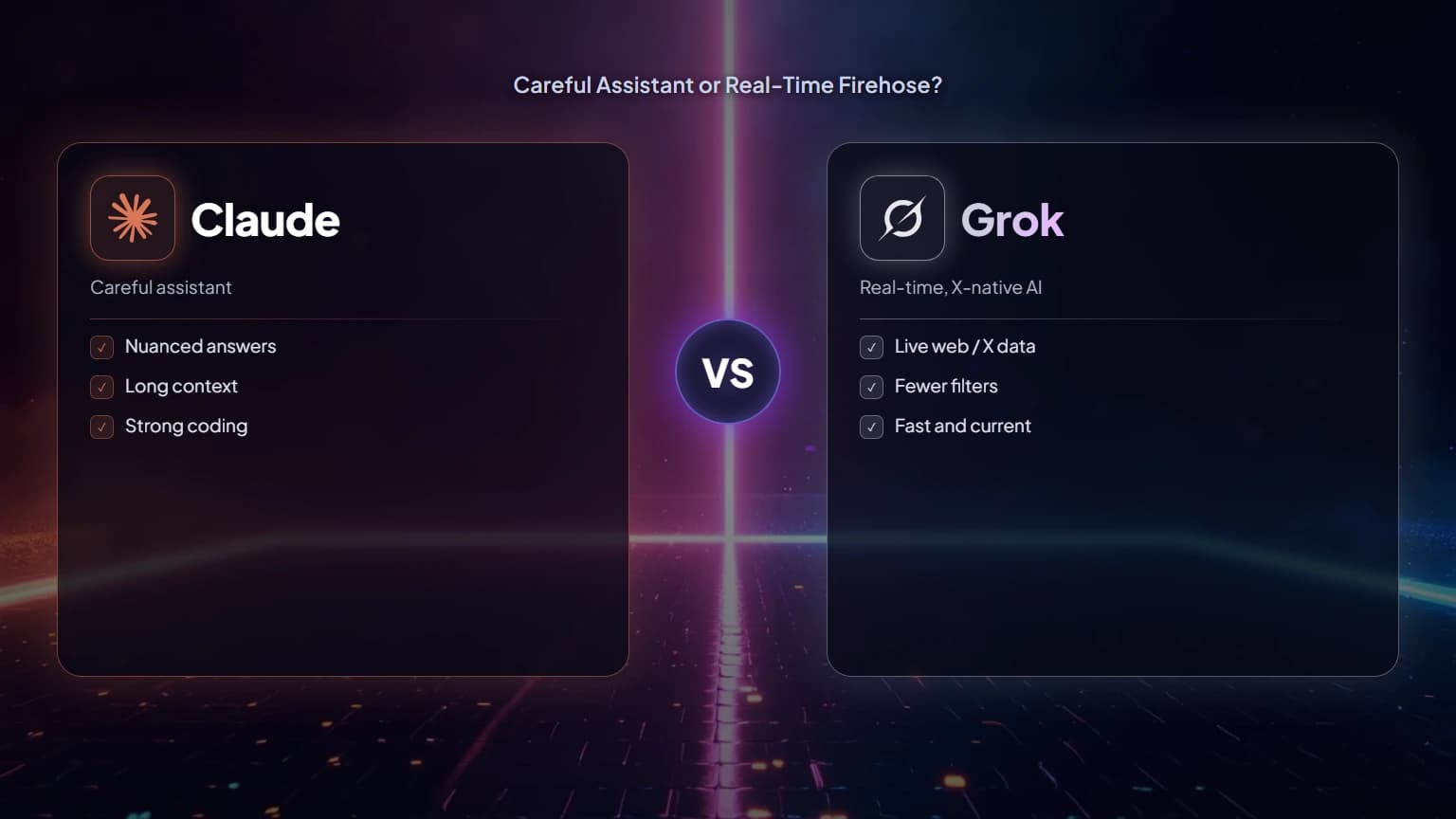
Read that table as one sentence: Claude is the careful specialist, Grok is the real-time firehose. Almost every row below follows from those two priorities, so the honest claude or grok answer depends entirely on which of them your work rewards.
Which has better real-time information, Claude or Grok?
Grok, decisively. It reads the live X firehose natively, plus a DeepSearch mode for broader research. Claude reaches current information through a web-search tool and reasons over what it finds, but has no social-data pipeline.
Grok's structural advantage is a direct pipe into X. Where Claude reaches current information through a web-search tool and then reasons over what it finds, Grok reads the live social firehose natively — posts, trending topics, and real-time sentiment — plus a DeepSearch mode for broader web research. Ask "what are people saying about this launch right now" and Grok answers straight from the feed. xAI documents each model's live-search behaviour in its official model reference, and for social listening, breaking news, or trend tracking, that native pipeline is a real differentiator.
Claude is not blind to the present — its web search tool fetches current pages and it synthesizes them with strong reasoning — but it has no direct social-data pipeline. On raw current-events accuracy, third-party current-events tests score Grok strongly here, precisely because it reads primary sources as they post. So on this one axis, the xai grok vs claude call is clear: if your question is "what is happening on the internet this minute," Grok is built for it and Claude is not.

Tone and personality: firehose vs careful assistant
Grok jokes, takes a stance, and answers spicier prompts other assistants decline. Claude is measured and professional, hedging genuine uncertainty and refusing less theatrically — which means fewer edits before you ship something with your name on it.
In the Claude vs Grok personality contest, the two assistants sound nothing alike, and that's deliberate. xAI markets Grok on attitude: it cracks jokes, takes a stance, and answers spicier prompts other assistants decline, which some users love and others find distracting. Claude is measured and professional by default — it hedges when a question is genuinely uncertain and refuses less theatrically. For casual chat, meme copy, or a bit of edge, Grok's voice is more fun. For client-facing writing, documentation, or anything you'll ship with your name on it, Claude's steadier register needs fewer edits.
Claude vs Grok for coding
It splits by task size. Claude leads on multi-file refactors and large repositories, producing cleaner and more idiomatic diffs. Grok is faster on single-file scripts and throwaway prototypes but less consistent once a change spans many files.
For most developers, coding is where the Claude vs Grok gap is most measurable, and it splits by task size. On deep software engineering, Claude leads: Claude Opus 4.8 tops the hard SWE-bench Pro suite at 69.2%, and in real use it produces cleaner, more idiomatic code across multi-file refactors and large repositories. Independent reviews consistently place Claude's practical code accuracy at the top of the field. Grok is genuinely fast and capable on smaller jobs — Grok Code Fast turns a single-file script or a quick prototype around in seconds — but it's less consistent once a change spans many files and has to stay reviewable.
| Coding dimension | Claude | Grok |
|---|---|---|
| Deep multi-file engineering | Leads — cleaner refactors | Capable, less consistent |
| Prototypes & single scripts | Strong | Faster turnaround |
| SWE-bench Pro (Opus 4.8) | 69.2% | Not published |
| Large-repo reasoning | Up to 1M-token context | Fast, 2M-token context |
| Agentic coding tool | Claude Code | Grok Code Fast |
The nuance for claude vs grok coding: Grok's speed is a real asset when you're iterating on throwaway prototypes or pair-programming at pace, while Claude's depth wins when you're changing production code and need the diff to hold up. This mirrors what we found against OpenAI in Is Claude better than ChatGPT? — Anthropic's edge is precision on hard, high-stakes engineering, not raw speed. Note that Claude Code itself needs a paid Claude plan or API credits; it is not free.
Is Grok cheaper and faster than Claude?
Yes on both counts. Grok returns answers roughly 35–45% faster in identical API tests and costs about $1.25/$2.50 per million tokens against $5/$25 for Anthropic's flagship. Its entry consumer plan is $8 against Claude's $20.
On price and latency the Claude vs Grok balance flips hard toward xAI. If Claude's currency is depth, Grok's is speed and cost. In identical API tests, Grok returns answers roughly 35–45% faster than Claude, which matters more than it sounds for rapid prototyping and back-and-forth chat. Grok is also aggressively priced: Grok 4.3 runs about $1.25 per million input tokens and $2.50 output, versus Claude Opus 5 at $5 and $25. You can confirm Anthropic's current rates on its published pricing page, and we break the full ladder down in how much Claude costs.
| Tier | Claude | Grok |
|---|---|---|
| Free | Basic chat, tighter caps | Free tier in the X app |
| Entry paid | Pro — $20/mo | X Premium — $8/mo |
| Power plan | Max — $100–$200/mo | SuperGrok — $30/mo |
| Budget API model | Haiku 4.5 — $1/$5 | Grok 4.1 Fast — $0.20/$0.50 |
| Flagship API model | Opus 5 — $5/$25 | Grok 4.3 — $1.25/$2.50 |
The consumer story is lopsided: Grok bundles into X Premium at $8/month, standalone SuperGrok is $30, and SuperGrok Heavy sits at $300 for maximum limits. Claude's ladder is Free, Pro at $20, and Max at $100 or $200 for heavy use. For high-volume, budget-sensitive API work, Grok's per-token price is hard to argue with. When each output has to be verified and the cost of a mistake is high, Claude's premium buys reliability — the classic claude vs grok trade-off between cheap-and-fast and careful-and-trusted.

Safety, accuracy, and trust
Claude is tuned to hedge uncertainty, refuse genuinely harmful requests, and avoid confident errors. Grok's looser design makes it more willing to answer provocative prompts and, at times, more willing to be confidently wrong.
This is the axis that most divides the Claude vs Grok debate. Anthropic built its identity around alignment and careful behaviour, and it tunes Claude to hedge uncertainty, refuse genuinely harmful requests, and avoid confident errors. Grok is looser by design — the less-filtered personality that makes it fun also makes it more willing to answer provocative prompts and, at times, more willing to be confidently wrong. Grok's live-data grounding does help factual freshness, but "current" is not the same as "carefully reasoned."
For regulated, professional, or reputation-sensitive work, that difference is the whole decision. If a wrong answer costs you a client, a contract, or a compliance headache, Claude's caution is a feature you're paying for, not a limitation. If you're exploring ideas, tracking a live conversation, or generating drafts you'll heavily edit anyway, Grok's looseness is rarely a problem and its speed is a real gift.
The task-by-task verdict
Route by what the task rewards: Grok for live social data, fast prototypes, high-volume budget API calls, and casual chat; Claude for long-form writing, deep coding, careful judgment, and regulated or high-stakes work.
No single winner survives contact with real work, so here's the honest claude vs grok call by use case:
| Your main task | Better pick | Why |
|---|---|---|
| Real-time / social data | Grok | Native X feed, live sentiment |
| Long-form writing & editing | Claude | More human, holds voice |
| Deep multi-file coding | Claude | Higher SWE-bench Pro, cleaner diffs |
| Fast prototypes & scripts | Grok | 35–45% faster turnaround |
| Careful reasoning & judgment | Claude | Fewer confident errors |
| Casual chat with attitude | Grok | Edgy, unfiltered voice |
| High-volume budget API | Grok | Far cheaper per token |
| Regulated, high-stakes work | Claude | Alignment and reliability |
The pattern is consistent: Claude is the tool you reach for when the quality and trustworthiness of one output matter more than anything; Grok is the tool you reach for when speed, cost, or live information matter more than polish. Plenty of people keep both open and route each task to the stronger one. For the rest of the field — Gemini, ChatGPT, Perplexity — our Claude vs Gemini breakdown and the wider comparison hub map every rival at once.
The quick version:
- Grok leans real-time data, speed, and personality
- Claude leans reasoning, writing, and deep coding
- Grok's entry plan is cheaper ($8 vs $20)
- Claude's flagship costs more but errs less
For example, ask both about a news event from 10 minutes ago: Grok answers from the live X feed in seconds, while Claude runs a web search and reasons over the top 3 results.
Claude pricing at a glance
Free covers basic chat with tighter caps, Pro is $20 a month, Max runs $100 to $200 for heavy use, and API access is billed per token — from $1/$5 on Haiku 4.5 up to $5/$25 on Opus 5.
| Plan | Price |
|---|---|
| Free | $0 |
| Pro | $20 / month |
| Max | from $100 / month |
| API | Pay per token |
For the full breakdown of every plan, see our how much Claude costs guide.
Frequently Asked Questions

Written by
Edith
Writing about Claude and the Anthropic toolkit — models, Claude Code, pricing, features, and fixes, in clear, practical, hands-on guides tested by daily use.
View all posts →