

Part ofClaude Comparison: Which AI Should You Actually Use?
In This Article
9 sectionsQuick answer
Claude (Opus 5, Sonnet 5) or GPT-5? A task-by-task comparison of coding, reasoning, writing, context, pricing, and safety, with an honest verdict.
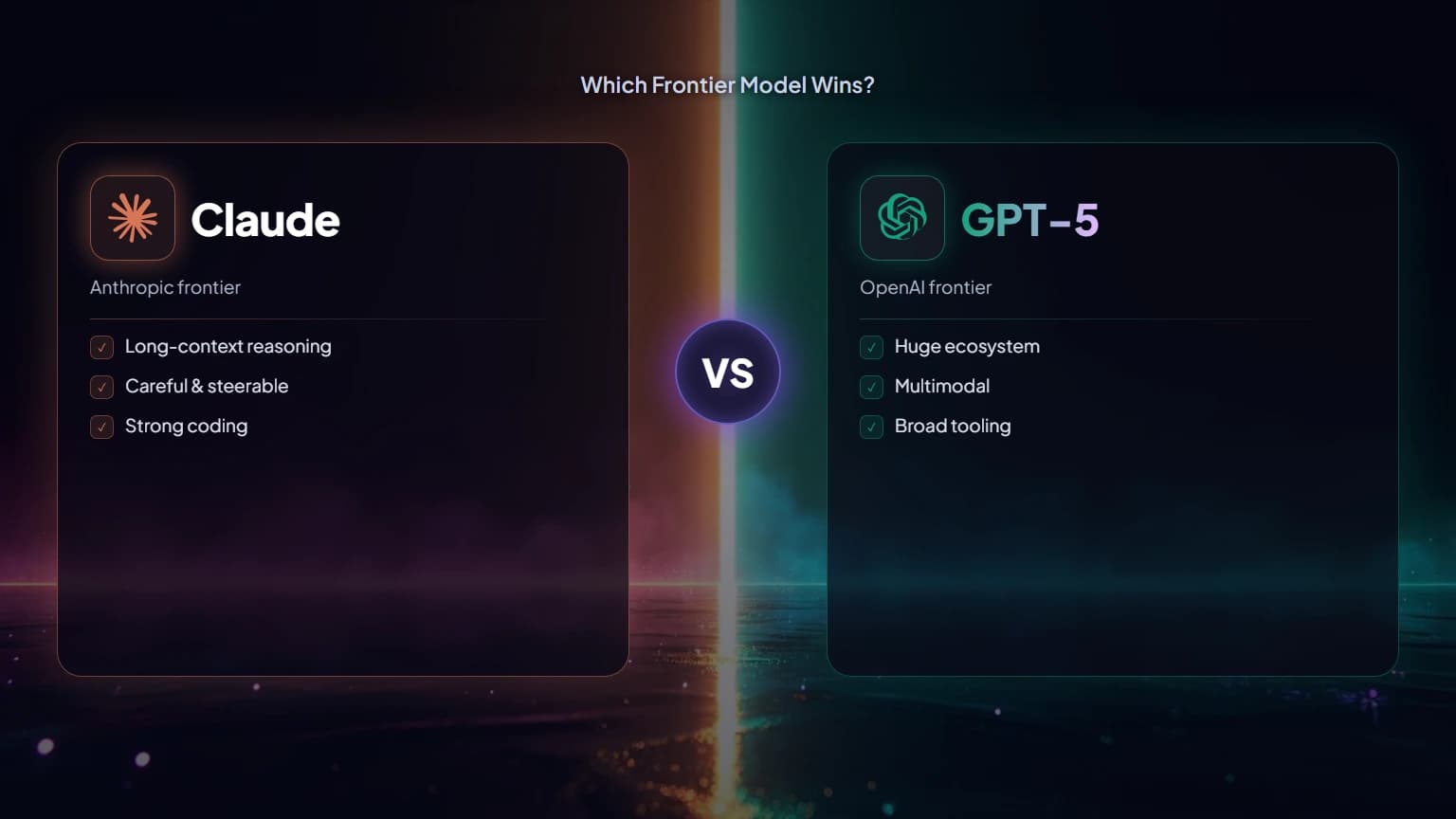
In the Claude vs GPT-5 matchup, Claude (Opus 5, Sonnet 5) leads on agentic coding, careful reasoning, vision, and natural writing, while OpenAI's GPT-5 wins on raw speed, cost-efficiency, and math. Neither frontier model is universally better — the winner depends on whether your work rewards depth and reliability or throughput and price.
Claude context windows and per-token pricing verified 31 July 2026 against the Anthropic model overview; benchmark scores stay attributed to the model they were measured on.
We run Claude across our own codebase and long-form drafts every day, and we keep GPT-5 in the rotation for high-volume, cost-sensitive jobs. This guide is part of our wider Claude comparison hub, and it settles the Claude vs GPT-5 question model to model — not the chat apps, which we cover in Is Claude better than ChatGPT?.
Key takeaway
Claude Opus 4.8 leads GPT-5 on real-world agentic coding, topping SWE-bench Pro at 69.2%, and the current Claude flagship, Opus 5, ships a 1M-token context window against GPT-5's 400K — while GPT-5's $1.25/$10 API rate still undercuts Opus 5's $5/$25.
Claude vs GPT-5: the one-minute comparison
Both are frontier systems whose answers are hard to tell apart on an average question. The differences that change real output sit one level down: coding depth, token efficiency, context capacity, image generation, and how each model behaves when it is not sure.
Both are frontier systems from the two labs that define the category, and on an average question you'd struggle to tell their answers apart. The Claude vs GPT-5 differences that change real output live one level down — in coding depth, token efficiency, context capacity, and how each model behaves when it isn't sure.
| Claude (Anthropic) | GPT-5 (OpenAI) | |
|---|---|---|
| Flagship models | Opus 5, Sonnet 5 | GPT-5, GPT-5 Pro |
| Standard paid plan | Pro — $20/mo | Plus — $20/mo |
| Context window | 1M on Opus 5 and Sonnet 5 | 400K (272K in / 128K out) |
| Image generation | No | Yes — built in |
| Signature strength | Coding, reasoning, writing, vision | Speed, cost, math |
| Agentic tooling | Claude Code, Cowork | Codex, custom GPTs, Operator |
Read the table as a split in philosophy. Anthropic tunes Claude for careful, verifiable work; OpenAI tunes GPT-5 for speed and price at scale. Almost every row below follows from that one difference.
Claude vs GPT-5 for coding
Claude leads on production work — Opus 4.8 tops SWE-bench Pro at 69.2%, and it catches race conditions and security issues faster models skim past. GPT-5 counters on efficiency, finishing equivalent tasks with far fewer output tokens.
Coding is the headline event, and it's where the claude vs gpt 5 coding debate gets genuinely close. On the stricter real-world suite — SWE-bench Pro — Claude Opus 4.8 leads at 69.2%, and in our own work Claude catches subtle bugs, race conditions, and security issues that a faster model skims past. That reliability is why the claude opus vs gpt-5 comparison usually lands on Claude for production changes across a large repository.
| Coding dimension | Claude | GPT-5 |
|---|---|---|
| Real-world agentic (SWE-bench Pro) | Opus 4.8 leads at 69.2% | Competitive, slightly behind |
| Speed / tokens per task | Slower, more thorough | ~72% fewer output tokens in one test |
| Terminal coding agent | Claude Code | Codex CLI |
| Bug & security catching | Catches subtle issues | Fast, occasionally misses edge cases |
| Cost per prototype | Higher | Lower |
GPT-5's counter is efficiency. In one widely cited coding test it finished equivalent tasks using roughly 72% fewer output tokens, which makes it faster and cheaper per job — ideal for prototypes, boilerplate, and everyday dev work where speed beats a marginal quality edge. The two terminal agents draw the same line: Claude Code plans, edits, and iterates until your tests pass, while OpenAI's Codex CLI competes hard on velocity. If you're deciding which Claude model to code with first, our Sonnet vs Opus breakdown covers that trade-off.

Which is better at math, Claude or GPT-5?
GPT-5. It posts the top scores on the hardest math benchmarks, and the gap widens on the most difficult tiers, where step-by-step numeric precision matters more than architectural judgment. Claude reasons carefully but trails on raw math throughput.
Flip to pure numeric reasoning and the gpt-5 vs claude balance tips the other way. GPT-5 leads the hardest math benchmarks — it posts the top scores on FrontierMath, and the gap widens on the most difficult tiers, where step-by-step numeric precision matters more than architectural judgment. For quantitative modelling, competition-grade math, and problems with one exact answer, GPT-5 is the model we reach for.
Claude is no slouch at reasoning — its extended thinking mode works through multi-step problems methodically, and it's the one we trust for tasks where a plausible-but-wrong answer is expensive. But on raw math throughput, GPT-5 edges ahead. This is the cleanest example of why "smarter" is the wrong frame for the Claude vs GPT-5 question: the two models trade wins by category rather than one dominating outright.
Writing quality: Claude's edge
Claude writes more natural, varied sentences and holds a voice across a long draft, so its drafts need fewer editing passes. GPT-5's prose is clean and technically correct but drifts toward a flatter, more formulaic default the longer it runs.
When the output is prose, the Claude vs GPT-5 comparison stops being close. Claude writes more natural, varied sentences and holds a voice across a long draft; give it three paragraphs of your own style and it stays in that register. GPT-5's writing is clean and technically correct but drifts toward a flatter, more formulaic default the longer it runs.
For emails, essays, marketing copy, and fiction, Claude's drafts need fewer editing passes — the metric that matters when writing is your job. Writers consistently describe the same split: Claude sounds more human and less literal, while GPT-5 reads cleaner but more generic. If your work is judged on how the words land, that difference compounds across every piece you ship.
Context windows and speed
Claude now leads on default context: Opus 5 and Sonnet 5 ship a 1M-token window as both default and maximum, against GPT-5's 400K. GPT-5 keeps the speed advantage through markedly lower token use per task.
On context, Claude now leads the default. GPT-5's window is 400K tokens — 272K in, 128K out — per OpenAI's model documentation. Claude's current lineup ships a 1M-token window as both the default and the maximum on Opus 5 and Sonnet 5, with Haiku 4.5 at 200K; we cover when that headroom actually matters in our context window guide.
Raw capacity is not the whole story. GPT-5's token efficiency still makes it the faster, cheaper option when you drop one enormous document in and want a single pass over it. The caveat cuts both ways: a large window used loosely loses the thread, so on careful analysis of a long file, coherence deep into context matters more than headroom on either side.
Pricing: consumer parity, API divergence
Consumer plans tie at $20 a month, though GPT-5 adds an $8 Go tier below that. The API is where they diverge: GPT-5 runs $1.25/$10 per million tokens against the Claude flagship's $5/$25, and its mini and nano tiers go far cheaper.
On cost, the Claude vs GPT-5 split flips by tier. At the consumer tier this is a near-tie — Pro and Plus are both $20/month — but GPT-5 offers an $8/month Go plan between Free and Plus, where Claude jumps straight from Free to Pro. The "is Claude cheaper than GPT-5" question really lives on the API, and there GPT-5's standard model undercuts Claude's flagship: $1.25/$10 per million tokens against Opus 5's $5/$25, per Anthropic's published API pricing.
| Tier | Claude (Anthropic) | GPT-5 (OpenAI) |
|---|---|---|
| Free plan | Yes — Sonnet, tight caps | Yes — larger daily allowance |
| Budget plan | (none below $20) | Go — $8/mo |
| Standard paid | Pro — $20/mo | Plus — $20/mo |
| Top consumer | Max — $100–$200/mo | Pro — $200/mo |
| Flagship API (in/out per 1M) | Opus 5 — $5/$25 | GPT-5 — $1.25/$10 |
| Value API | Sonnet 5 — $2/$10 intro | GPT-5 mini — $0.25/$2 |
| Budget API | Haiku 4.5 — $1/$5 | GPT-5 nano — cheaper still |
Two nuances hide in that table. GPT-5's mini and nano tiers are dramatically cheaper for simple, high-volume tasks, so bulk classification or summarization runs a fraction of Claude's cost. But the reasoning-heavy GPT-5 Pro tier ($15/$120 per million) flips the math entirely, costing far more than any Claude model — and Claude's Sonnet 5, at a $2/$10 introductory rate, is aggressively priced for its capability class. Our full Claude API pricing breakdown does the per-token math.

Safety, ecosystem, and everything else
Claude is the more cautious model — it admits uncertainty and fabricates fewer details, which is why regulated work leans Anthropic. OpenAI wins reach: native image generation, a mature voice mode, custom GPTs, and the larger third-party community.
Two structural differences round out the Claude vs GPT-5 picture. On safety, Claude is the more cautious model — it admits uncertainty, pushes back on flawed requests, and fabricates fewer details, which is why teams in regulated or high-stakes work lean Anthropic. GPT-5 is improving quickly here but still errs toward confident answers.
On ecosystem, OpenAI wins reach: native image generation (Claude generates no images at all), a mature voice mode, custom GPTs, and the largest third-party community. Claude counters with depth — Claude Code, Cowork, Projects, and Artifacts — though its coding agent needs a paid plan or API credits to run. For the other frontier rival, our Claude vs Gemini comparison maps how Google's model fits the same trade-offs.
The task-by-task verdict: is Claude better than GPT-5?
There is no single winner. Send agentic coding, long-form writing, vision work, and safety-critical judgment to Claude. Send fast prototyping, competition-grade math, and high-volume low-stakes API calls to GPT-5 and its cheaper mini and nano tiers.
No single winner survives contact with real work, so here's the honest is claude better than gpt-5 call by use case.
| Your main task | Better pick | Why |
|---|---|---|
| Agentic / production coding | Claude | Higher SWE-bench Pro, catches subtle bugs |
| Fast prototyping & everyday dev | GPT-5 | Faster, cheaper per job |
| Math & numeric reasoning | GPT-5 | Leads FrontierMath's hardest tiers |
| Long-form writing | Claude | More natural, holds voice |
| One huge single-prompt document | Claude | 1M-token window on Opus 5 and Sonnet 5 |
| Vision & document understanding | Claude | Stronger visual reasoning |
| High-volume, low-stakes API | GPT-5 | mini/nano far cheaper |
| Safety-critical judgment | Claude | Fewer confident errors |
The pattern behind the Claude vs GPT-5 verdict is consistent: Claude is the specialist that rewards depth — code you'll ship, writing you'll publish, judgment you can trust — while GPT-5 is the generalist that rewards throughput — faster, cheaper, and stronger at math. Plenty of professionals we know pay for both and route each task to the stronger model, which at roughly $40/month is cheap next to the time either one saves.
The quick version:
- Claude leads agentic coding, writing, vision, and careful reasoning
- GPT-5 leads speed, math, and cost-efficiency
- Consumer plans tie at $20/month; GPT-5 adds an $8 Go tier
- On the API, GPT-5 undercuts Claude's flagship; Sonnet 5 is Claude's value play
For example, on the same 20-file refactor Claude caught 3 subtle bugs GPT-5 missed, while GPT-5 returned its answer in roughly half the output tokens.
Claude pricing at a glance
Claude is free at the entry tier, $20 a month for Pro, and from $100 a month for Max, with API access billed per token. There is no plan between Free and Pro on the Claude side.
| Plan | Price |
|---|---|
| Free | $0 |
| Pro | $20 / month |
| Max | from $100 / month |
| API | Pay per token |
For the full breakdown of every plan, see our how much Claude costs guide.
Weighing an open-weight challenger instead? Claude vs MiniMax works through the frontier-polish-versus-open-value trade — cheap self-hostable weights against fewer retries.
Frequently Asked Questions

Written by
Edith
Writing about Claude and the Anthropic toolkit — models, Claude Code, pricing, features, and fixes, in clear, practical, hands-on guides tested by daily use.
View all posts →