

In This Article
11 sectionsQuick answer
Claude vs Gemini vs Grok, compared fairly: reasoning, coding, writing, multimodal, real-time info, ecosystem and tone — with a clear rule for which to pick.
Key takeaways
- There is no single winner: pick Claude for coding, careful reasoning, and publishable writing; Gemini for Google's ecosystem and multimodal work; Grok for real-time X data and current events.
- Claude's edge is steadiness — holding long multi-step reasoning without drifting and producing clean, maintainable code, with Claude Code handling agentic engineering work.
- Gemini leads multimodal understanding across images, audio, and especially video, and offers the most generous free tier of the three.
- Grok's unique asset is native, live access to X — trending topics, hour-old threads, and public sentiment that no rival can match.
- All three pair a free tier with a paid plan near $20/month; Claude adds Max plans at $100 and $200/month, with context windows up to 1M tokens on its top models.
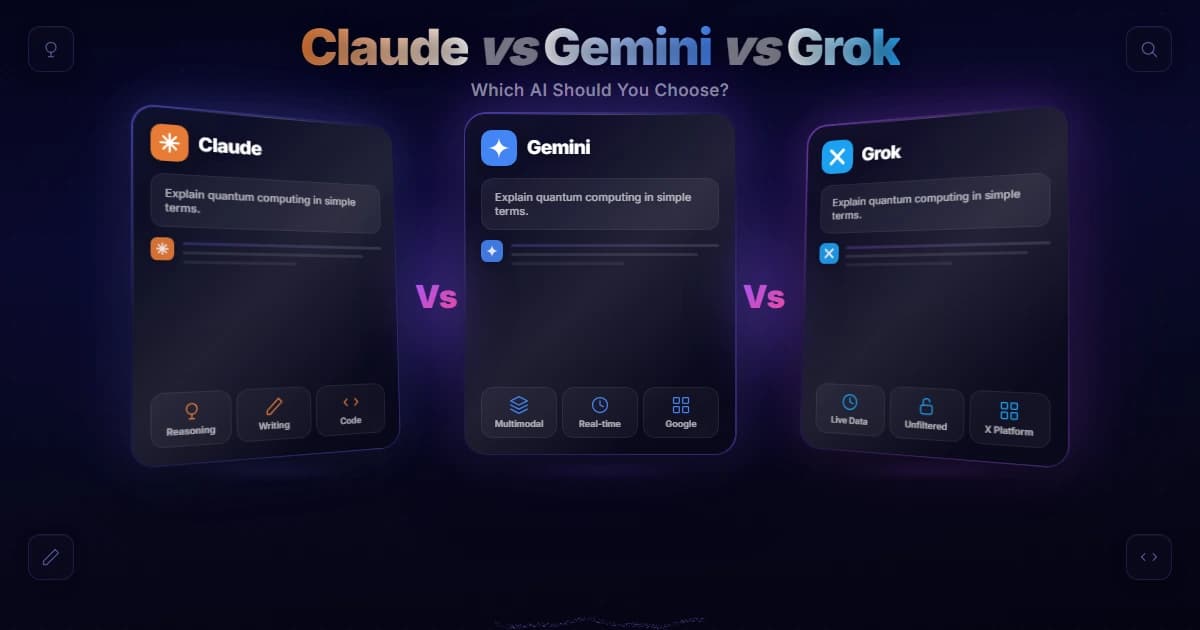
In the claude vs gemini vs grok debate, there is no single winner — the best choice is task-dependent. Pick Claude for careful reasoning, coding, and high-quality writing; pick Gemini for Google's ecosystem, multimodal work, and generous free access; pick Grok for real-time X data, current events, and a looser, more casual tone.
Model lineup, context windows and plan pricing verified 31 July 2026 against Anthropic's model overview.
All three are strong assistants built by serious labs, and on any given week their headline benchmarks trade places. That is exactly why chasing the latest score is a losing game — the numbers move, but each product's core identity does not. Claude currently spans models like Opus 5, Sonnet 5, and Haiku 4.5, and Gemini and Grok refresh their own lineups just as often, so this guide is reviewed regularly and compares the three by enduring positioning rather than by whichever scores are 24 hours old. It walks Claude, Gemini, and Grok one dimension at a time, so you can match the tool to the job instead of the marketing.
Key takeaway
For Claude vs Gemini vs Grok there is no single winner: pick Claude (Opus 5, Sonnet 5, Haiku 4.5) for coding and careful reasoning, Gemini for Google's ecosystem and free multimodal access, and Grok for real-time X data — all three start free with paid tiers near $20/month.
Claude vs Gemini vs Grok at a glance
Claude wins coding, careful reasoning and publishable writing; Gemini wins multimodal work, Google Workspace integration and generous free access; Grok wins real-time X data and casual chat. Find the row that matches your daily work.
Here is the short version of claude vs gemini vs grok before we dig into each dimension. Find the row that matches the work you actually do most, then read on for the detail.
| Assistant | Best for | Strengths | Ecosystem | Watch-outs |
|---|---|---|---|---|
| Claude (Anthropic) | Coding, writing, careful reasoning | Clean, maintainable code; natural prose; large context; steady, safe tone | Claude apps, Claude Code, developer API | Smaller consumer footprint than Google; more measured personality |
| Gemini (Google) | Google users, multimodal, free everyday use | Strong image/audio/video understanding; search grounding; generous free access | Workspace, Android, Search, Pixel | Answers can feel uneven; deep Google lock-in |
| Grok (xAI) | Real-time X and current events, casual chats | Live X data; up-to-the-minute events; direct, informal tone | X (Twitter), xAI apps, Tesla | Edgier tone; less proven for careful or enterprise work |
Meet the three assistants
Anthropic optimises Claude for careful, safety-minded reasoning and code. Google builds Gemini to live inside Search, Android and Workspace as a multimodal default. xAI builds Grok around live X access and a deliberately informal voice.
Before comparing features, it helps to know what each company optimizes for, because that priority shapes every answer you get back.
Claude, by Anthropic
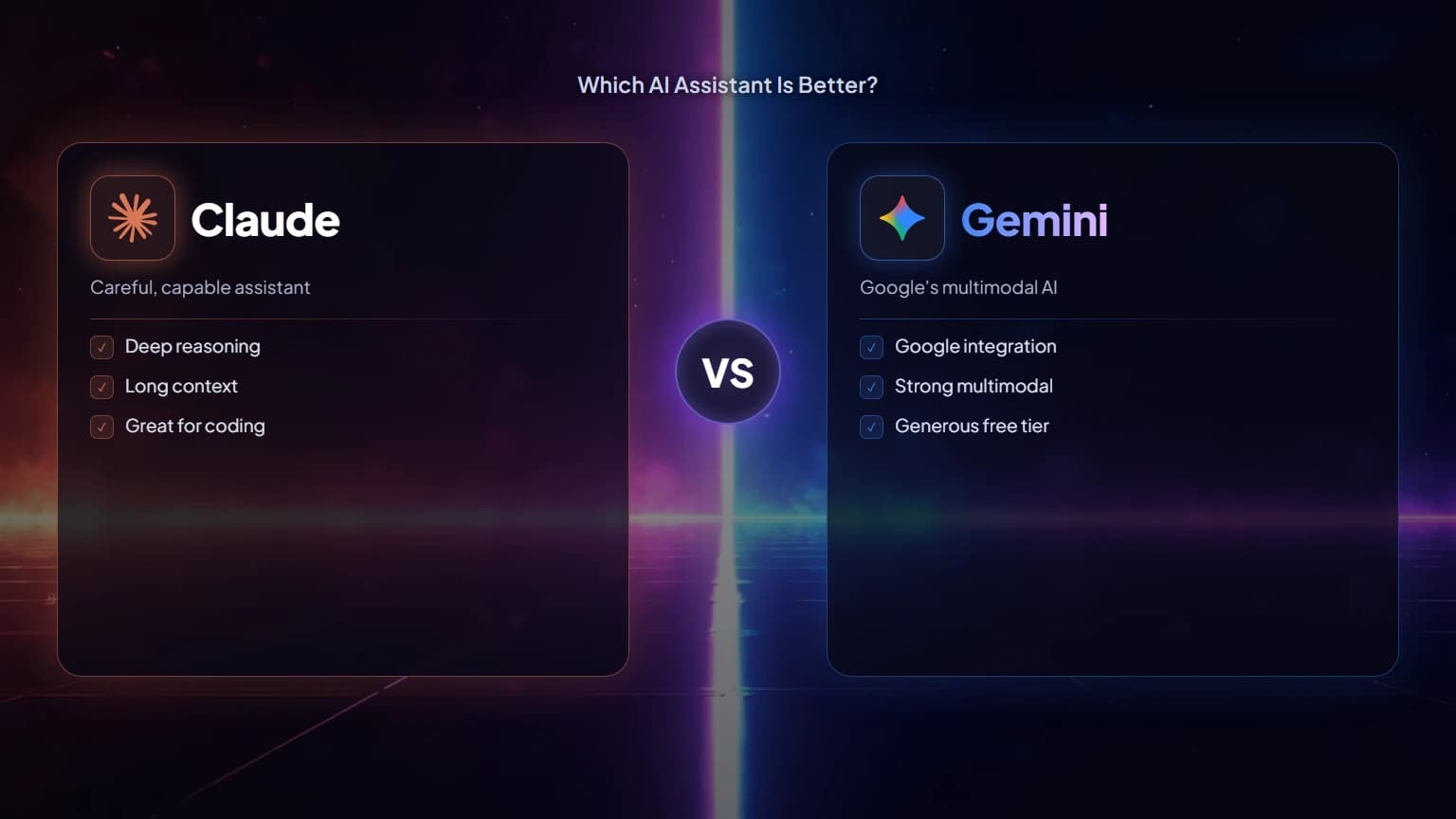
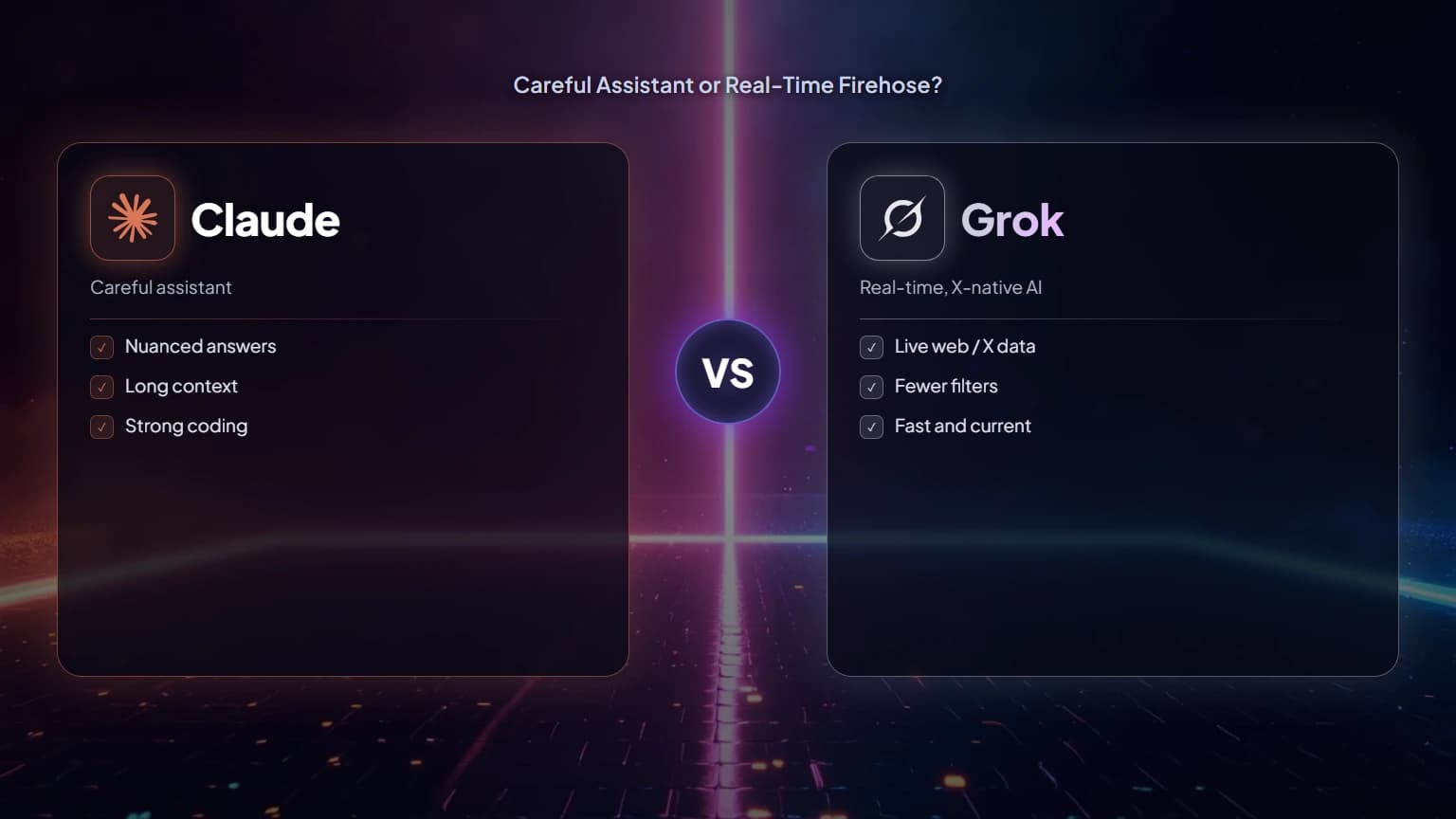
Claude is the assistant people reach for when the quality of the answer matters more than the speed of it. Anthropic built its reputation on careful reasoning, strong coding, natural writing, and a thoughtful, safety-minded tone that rarely goes off the rails. Claude can hold a very large amount of text in a single conversation, which makes it a favorite for long documents and sprawling codebases, and it ships Claude Code, a command-line tool that lets developers hand real engineering work to the model. If you are new to it, our explainer on what Claude AI is covers the basics, and you can browse the full lineup on Anthropic's official site.
Gemini, by Google
Gemini is Google's assistant, and its superpower is being everywhere you already are. It plugs directly into Gmail, Docs, Sheets, and the rest of Google Workspace, lives natively on Android, and ties tightly into Google Search. It is also a genuinely capable multimodal model, comfortable reasoning across images, audio, and video in one prompt. Google offers a useful tier of Gemini for free to an enormous audience, which makes it many people's default for quick, everyday questions.
Grok, by xAI
Grok is xAI's assistant, and it stakes out ground nobody else can easily copy: live access to X, formerly Twitter. That connection gives it a real-time pulse on breaking news, trending topics, and public sentiment. Its personality is deliberately more casual and edgy than its rivals, and because it is built right into the X app, it feels native to anyone who already lives on the platform.
How do they compare on reasoning and answer quality?
Gemini is strongest on hard, self-contained and scientific problems. Claude is steadiest across long multi-step chains, following dense instructions and admitting uncertainty. Grok is fastest and most direct, but the least proven for high-stakes reasoning.
Reasoning is where these three separate in style more than raw ability, and the claude vs gemini vs grok comparison here is less about who is smartest on paper than who is steadiest in practice. Gemini is a powerhouse on abstract and scientific reasoning and often shines on hard, self-contained problems. Claude tends to win on consistency: it holds a long chain of thought without drifting, follows dense instructions faithfully, and is candid when it is unsure rather than confidently wrong. Grok is fast and direct, which is great for quick takes, but it is the least proven of the three for careful, high-stakes reasoning.
If your work involves long, multi-step analysis — reading a contract, untangling a bug, or reasoning over a big research corpus — Claude's steadiness is a real advantage. For one-shot brain-teasers and heavy multimodal reasoning, Gemini is superb.

Coding
Claude is the developer default for code quality, maintainable output and agentic multi-file workflows through Claude Code. Gemini is a strong fit if you already work inside Google tooling; Grok suits quick scripts in a fast, casual chat.
Coding is Claude's strongest suit and, for many developers, the single reason to keep it as a daily driver. If there is one place the claude vs gemini vs grok difference shows up in everyday work, it is here. It produces clean, maintainable code, explains its choices, and handles agentic workflows — planning, editing across files, running tools — better than most. Claude Code brings that ability into the terminal so you can delegate genuine engineering tasks, not just autocomplete. For example, if a rename touches 12 files across a project, you can describe the change once and have it planned, applied file by file, and checked against your tests in a single pass rather than pasted in chunk by chunk. If you want to see how the tiers differ, Anthropic's model overview documentation lays out the family, and our guide to the best Claude model helps you match one to your workload.
Gemini and Grok are both competent coders, and each posts strong benchmark runs, but the developer community still tends to treat Claude as the reference for code quality and reliability. Gemini is a fine choice if you are already in Google's tooling; Grok is handy for quick scripts inside a fast, casual chat.
We only run Claude day to day — it is what we use to build this site in Claude Code on native Windows and PowerShell — so we cannot referee the three-way race, but the reliability point is one we have lived. The rename example above is close to our real workflow: describing a cross-file change once and trusting the agent to apply it and check the tests is a habit only because Claude stays on the plan rather than half-finishing. That day-to-day dependability, more than any leaderboard, is why it stayed our default in the claude vs gemini vs grok field. If your shortlist for engineering work is really just the first two, Claude vs Gemini for coding drops Grok and compares the agentic tooling each one wraps around its models.
Writing
Claude sounds the most human in long-form prose, varying sentence length and absorbing edits well. Gemini excels at drafting from facts inside your Google documents. Grok's punchy informality suits social posts more than polished essays.
For long-form writing, Claude is the assistant most people describe as sounding human. It varies sentence length, avoids the robotic cadence that gives AI text away, and takes edits gracefully, which is why it is a common pick for articles, newsletters, and scripts — our deep dive on using Claude for writing walks through the workflow. Gemini writes cleanly and is excellent at pulling facts from your Google documents into a draft. Grok's writing carries an informal, punchy voice that suits social posts and casual copy more than polished essays.
Multimodal
Gemini leads this dimension. Google built it multimodal from the ground up and it is strongest on images, charts, audio and especially video. Claude handles images and documents capably; Grok has added image and video understanding.
If your work is visual or audio-heavy, Gemini leads this dimension. Google built Gemini as a multimodal model from the ground up, and it is genuinely strong at understanding images, charts, audio, and especially video. Claude is very capable with images and documents and is improving steadily, and Grok has added image and video understanding of its own. But for someone who lives in mixed media all day, Gemini is usually the most natural fit.
Real-time and current information
Grok owns freshness through native, live access to X — trending topics, hour-old threads, public reaction. Gemini grounds answers in Google Search for broad web currency. Claude reaches live facts through its own web search.
This is Grok's home turf. Its live tap into X means it can tell you what is trending right now, summarize a thread posted an hour ago, and gauge public reaction as an event unfolds — no other assistant has that kind of native social-platform access. Gemini leans on Google Search to ground answers in fresh web results, which is excellent for general current events. Claude reaches live information through Claude's web search too, so it is far from stuck in the past; it simply is not wired into a social firehose the way Grok is. In the claude vs gemini vs grok split on freshness, pick Grok for social and breaking chatter, Gemini for broad web currency, and Claude when you want current facts folded into careful analysis.
Ecosystem and integrations
Gemini is unbeatable if your life runs on Workspace, Android, Chrome and Pixel. Claude centres on serious work: its apps, Claude Code, and a developer API companies build on. Grok is woven into X and other xAI surfaces.
Where each assistant plugs in can matter more than raw capability. Gemini is unbeatable if your life runs on Google — Workspace, Android, Chrome, and Pixel all bring it a click away. Claude's ecosystem is centered on serious work: a clean set of apps, the Claude Code developer tool, and a well-regarded API that companies build on top of. Grok is woven into X and increasingly into other xAI and Tesla surfaces, so it is most convenient for people already inside that world.

Tone and personality
Claude is measured and candid about uncertainty, which many professionals prefer. Gemini is neutral and helpful in a classic assistant register. Grok is the loosest of the three — casual, occasionally cheeky, and noticeably less filtered.
Personality is subjective, but in the claude vs gemini vs grok lineup the three have distinct defaults. Claude is measured, thoughtful, and careful — it will push back politely and flag uncertainty, which many professionals prefer. Gemini is neutral and helpful in a classic assistant register. Grok is the loosest of the group: casual, occasionally cheeky, and less filtered, which some users love for candor and others find distracting. Choose the voice that fits your context, because you will read a lot of it.
Pricing: free versus paid
All three pair a free tier with a paid plan near $20 a month. Gemini's free access is the most generous, Grok bundles with paid X subscriptions, and Claude adds Max plans at $100 and $200 monthly.
All three follow the same broad shape: a free tier that covers casual use and a paid subscription that unlocks the strongest models, higher limits, and extra features. Gemini's free offering is especially generous, which is a big part of its everyday appeal. Grok bundles access with certain X subscriptions and offers its own paid options. Claude offers a free tier plus paid plans — Pro at $20/month and Max at $100 and $200/month — for individuals, teams, and developers, with context windows up to 1M tokens on its top models. Prices and limits change often, so check current details on how much Claude costs or the official Claude pricing page, and our Claude models explained guide shows what each tier actually gets you.
Which should you pick? The claude vs gemini vs grok decision rule
Match the tool to the task rather than crowning one winner. Choose Claude when the output has to be right, Gemini when you live in Google's world or want capable free access, and Grok for the real-time social pulse.
You do not have to crown one champion — you just have to match the tool to the task. Here is the simple rule that resolves the claude vs gemini vs grok question for most people:
- Choose Claude when the output has to be right: production code, careful reasoning over long documents, and writing you will actually publish. Its steadiness, code quality, and natural prose are the draw.
- Choose Gemini when you live in Google's world, need strong multimodal understanding, or want a capable assistant for free. Its integration and generous access are hard to beat for everyday use.
- Choose Grok when you need the real-time pulse of X, want breaking-news and social-trend awareness, or simply prefer a looser, more informal chat.
Plenty of people keep two of them open. A common pairing is Claude for deep work and Gemini or Grok for quick lookups and current events. There is no rule that says you must be loyal to one, and mixing them costs you nothing but a browser tab. If your shortlist stretches past these three Western labs, our Kimi vs Claude comparison weighs Anthropic against the open-weight challenger from Moonshot AI.
Frequently Asked Questions

Written by
Edith
Writing about Claude and the Anthropic toolkit — models, Claude Code, pricing, features, and fixes, in clear, practical, hands-on guides tested by daily use.
View all posts →