

In This Article
6 sectionsQuick answer
An honest guide to claude ai alternatives: what ChatGPT, Gemini, Perplexity and local models each do better, and where Claude still genuinely wins.
The best claude ai alternatives depend entirely on the job: ChatGPT for the broadest ecosystem and image generation, Gemini if you live inside Google Workspace, Perplexity for research that needs citations, and open-weights models for privacy or offline use. Most people should run two tools, not one.
Model lineup verified 31 July 2026 against Anthropic's models overview.
We write about Claude here every week, so you can reasonably expect this page to end with "actually, just use Claude." It won't. If you searched for claude ai alternatives, you have a real reason — something Claude refuses to do, or does worse than a competitor — and pretending otherwise would waste your time. What follows draws on our own use of it, including the rough edges you only notice in practice.
So here is the straight version, organised by the job you're trying to do rather than by a feature grid nobody reads.
Key takeaway
The best Claude AI alternative depends on the job: ChatGPT for the broadest ecosystem and image generation, Gemini inside Google Workspace, Perplexity for cited research, and open-weights models via Ollama for privacy or offline use — and most serious users run two tools, not one.
Why "best" is the wrong frame for claude ai alternatives
Raw capability has converged; what you actually feel is the wrapper — the app, the integrations, the file handling, whether it can see your calendar. The useful question is which tool already sits where your work happens.
There is no single winner. The models are close enough on raw capability that the differences most people actually feel come from everything wrapped around the model: the app, the integrations, the file handling, the mobile experience, whether it can see your calendar.
That means the useful question isn't "which of the claude ai alternatives is smartest?" It's "which one is already sitting where my work happens?" A model that's marginally better at reasoning but lives in a tab you never open loses to a slightly weaker one embedded in your inbox.
The second thing worth accepting early: most serious users end up with 2 tools. One general assistant for daily work, one specialist for the thing the generalist is bad at. That combination costs less than the time you'll burn forcing one tool to do everything.
The realistic claude ai alternatives and what each is actually better at
Five contenders cover almost every real case: ChatGPT for ecosystem breadth and images, Gemini for Google Workspace, Perplexity for cited research, Copilot for in-editor autocomplete, and open weights via Ollama for privacy or offline work.
ChatGPT — the broadest ecosystem
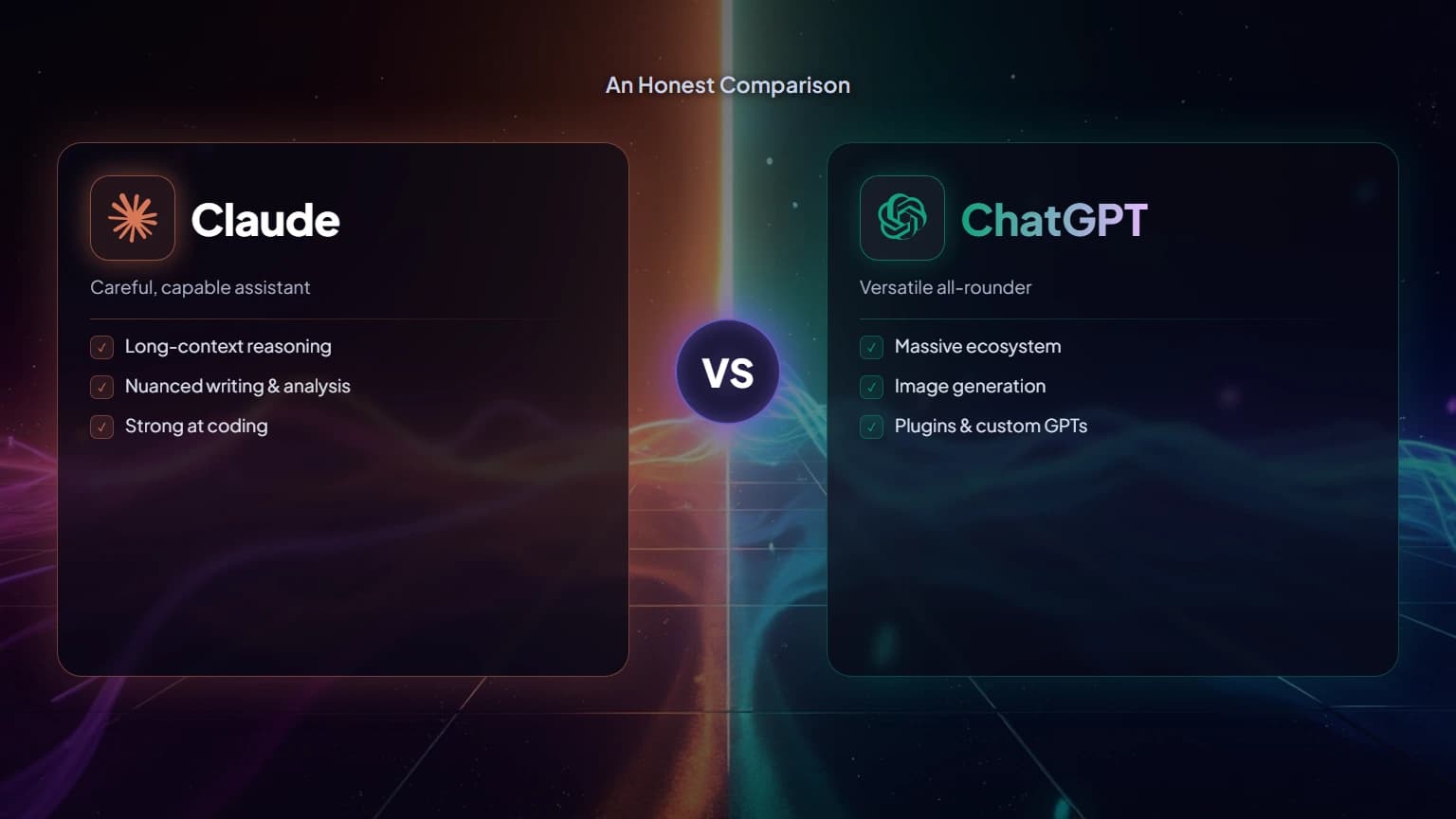
ChatGPT is the default recommendation for general consumers, and that's not just brand recognition. It has the largest surrounding surface: a custom-GPT store, a huge third-party app and plugin ecosystem, voice, and native image generation that Claude simply does not have. If you want one tool that does the most things acceptably, ChatGPT is the honest answer.
It's also the strongest all-rounder for people who don't want to think about model selection. Where it's weaker: long, dense documents, and a tone that can drift toward eager agreement. If you're weighing subscriptions directly, our Claude Pro vs ChatGPT Plus breakdown goes deeper than this section can.
Gemini — if your life is already in Google
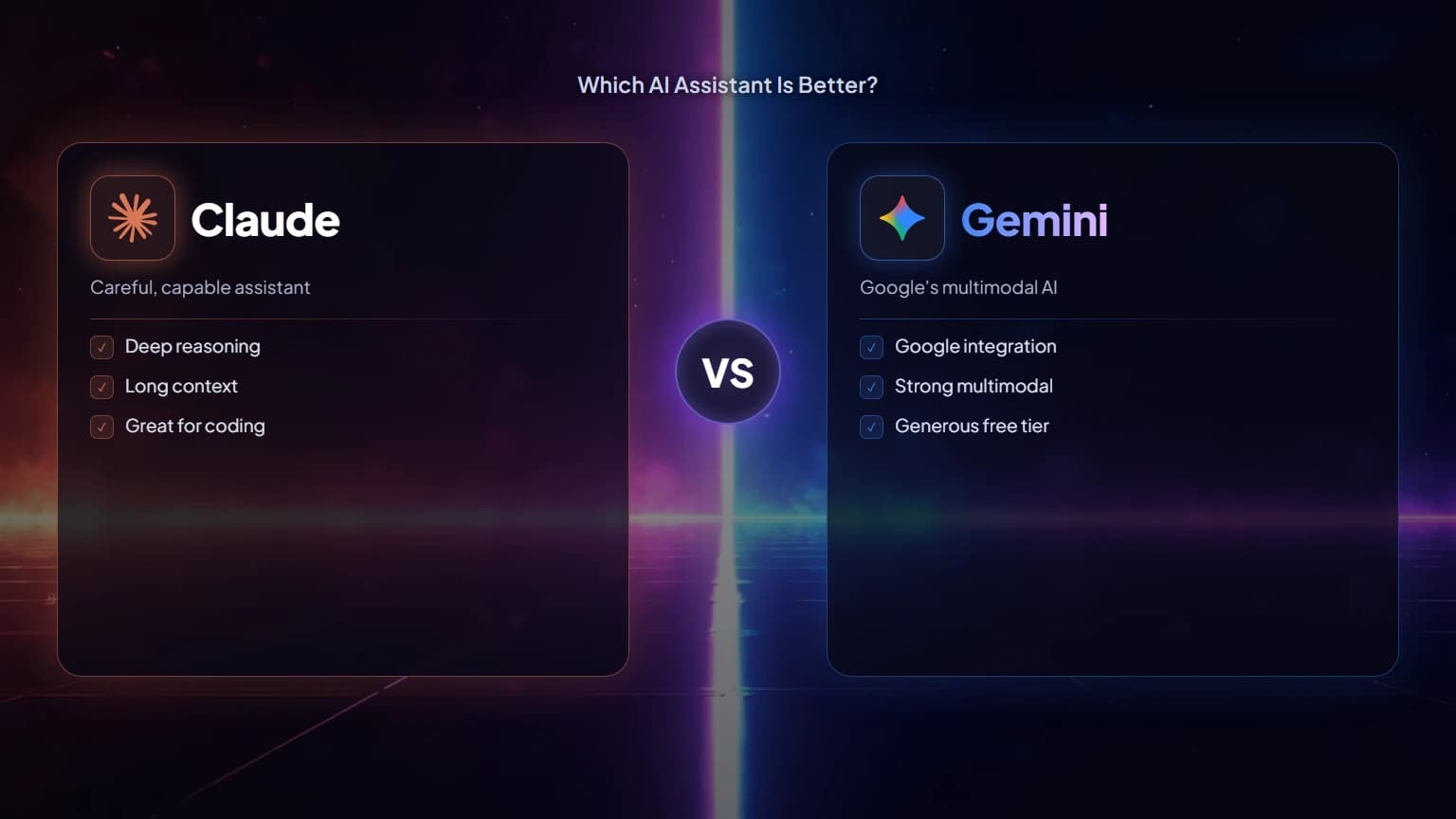
Gemini's advantage is integration, not intelligence. It reaches into Gmail, Docs, Drive, Sheets, Calendar and YouTube without you copy-pasting anything, and its multimodal handling is strong. For a team running entirely on Google Workspace, that removes the single biggest friction of AI work: shuttling context between apps by hand.
If you don't live in Google's tools, that advantage evaporates and you're comparing raw model quality again. We cover that fight in more detail in our Claude vs Gemini vs Grok comparison.
Perplexity — search-first, with sources
Perplexity is built the other way around from a chatbot: real-time web search is the foundation, and the model synthesises on top. Every answer arrives with inline citations you can click.
For any research where sourcing matters — competitive analysis, current events, checking a claim before you repeat it in a meeting — that's a genuine advantage over asking a general assistant from memory. It's less pleasant for long-form writing or extended back-and-forth. Our Perplexity vs Claude piece digs into where each one breaks down.
Copilot and GitHub — coding inside the editor
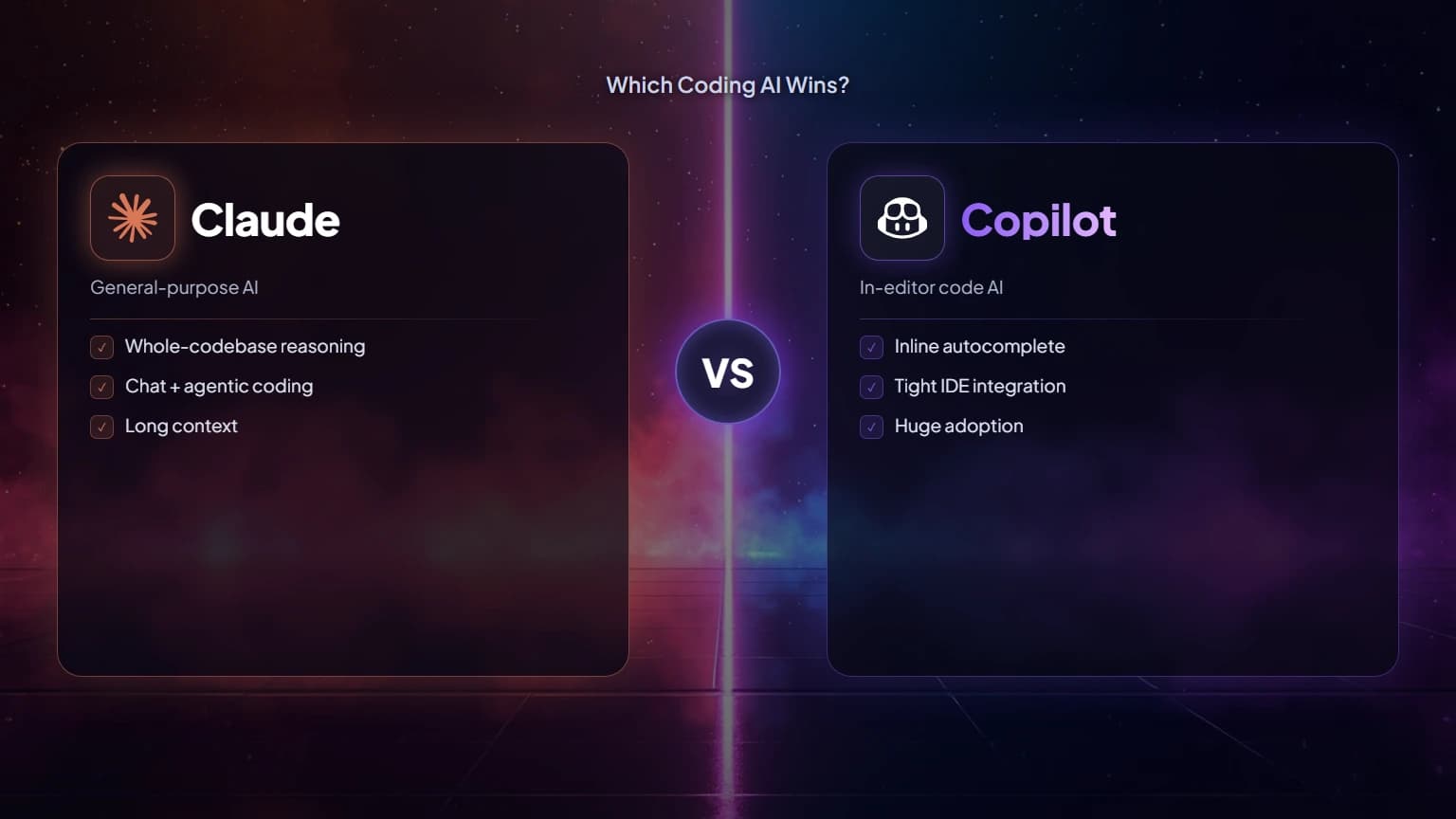
GitHub Copilot's pitch is proximity. It's in your IDE, it knows your repo, and it plugs into GitHub's review and org controls. For inline autocomplete and small in-context edits it's frictionless in a way a chat window can't match.
Open weights via Ollama — the one thing Claude cannot do
This is the honest gap. Claude is a hosted service. You cannot download it, run it on your laptop, or keep the data on your own hardware. If you need privacy, offline access, air-gapped work, or self-hosting for compliance, no amount of Claude quality helps — you need open-weights models, and Ollama is the easiest on-ramp for running them locally.
Quality is genuinely below the frontier hosted models, and you'll need decent hardware. But it's yours. If you want the best of both, running Claude Code with Ollama is a middle path worth knowing about.

Grok, DeepSeek, Mistral and the rest
Quick, honest one-liners:
- Grok — real-time X/Twitter data access, and a looser conversational style. Useful if that firehose is your work.
- DeepSeek — aggressive cost pressure for API-heavy reasoning and coding workloads. The value proposition is price per token.
- Mistral — open-weights, European hosting options, popular where data-residency rules bite.
- Kimi and other newer entrants — the fastest-moving corner of the claude ai alternatives list, and often competitive on long context. Worth a trial rather than a commitment.
Comparing the options at a glance
Read the table by trade-off, not by winner. Every row buys a genuine strength at a specific cost — ecosystem breadth against long-document handling, integration depth against portability, local privacy against frontier quality.
| Alternative | Genuinely better at | Trade-off |
|---|---|---|
| ChatGPT | Broadest ecosystem, image generation, all-round consumer use | Weaker on very long documents; agreeable tone |
| Gemini | Google Workspace integration, multimodal | Advantage disappears outside Google's apps |
| Perplexity | Research with clickable citations | Less suited to long-form writing |
| Copilot | In-editor coding, GitHub integration | Narrow scope outside development |
| Ollama / open weights | Privacy, offline, self-hosting | Below frontier quality; needs hardware |
| Grok | Real-time social data | Narrow use case |
| DeepSeek | Cost per token at scale | Smaller consumer product surface |
Where does Claude genuinely hold up, and where doesn't it?
Long-document reasoning, prose that reads less templated, agentic coding, and a tone that argues back are the consistent strengths. The concessions are real too: no image generation, no self-hosting, and a smaller third-party ecosystem.
Assessment, not sales pitch.
Claude is strong on long-document reasoning. Feed it a contract, a research paper bundle, or 20 files of legacy code and it tends to keep the thread rather than losing the plot halfway. Writing quality is the other consistent strength — the prose comes out less templated, which is why it keeps showing up as a Claude alternative for creative writing in the other direction. Claude Code has also become a serious agentic coding tool rather than a chat window that emits snippets. And the tone is careful and steerable: it pushes back rather than agreeing with everything.
Currently the lineup runs from Claude Haiku 4.5 for speed up through Claude Opus 5 for heavy agentic work, with Claude Fable 5 at the top and the restricted Claude Mythos Preview line alongside it — the official models overview is the only source worth trusting on what's newest, since this changes every few months.
Now the concessions:
- No image generation. If you need images, you need something else. Our Claude vs ChatGPT for images piece is blunt about this.
- No self-hosting. Covered above. It's a hard limit.
- Smaller consumer ecosystem. Fewer integrations, fewer third-party apps, less of the plugin surface ChatGPT has.
- Fewer native app hooks than Gemini has inside Google's own products.
That first concession is not hypothetical for us — we live it daily. Every hero and inline image on this site is produced by a separate image model we drive from our own scripts, precisely because Claude does not draw. It is the cleanest real example we have of why the right answer among claude ai alternatives is so often a pairing rather than a single tool: Claude writes and edits the piece, and a dedicated image model makes the picture that runs on top of it.

The honest recommendation: pick by job
Match tool to task and the decision collapses. Perplexity when sourcing matters, ChatGPT or a dedicated image model for pictures, Gemini inside Google apps, open weights for compliance, Claude for long documents and agentic coding.
Match the tool to the task and this stops being complicated:
- Research where sourcing matters → Perplexity
- Images → ChatGPT or a dedicated image model
- You live in Docs, Gmail and Drive → Gemini
- Privacy, offline, or compliance → open weights, self-hosted
- In-editor autocomplete → Copilot
- Long documents, careful writing, agentic coding → Claude
Two of those, not six. For example, a common pairing is Perplexity for research plus Claude for writing up what the research found — each doing the half it's good at.
The switching cost nobody mentions
Your history does not move. Chat archive, saved projects, custom instructions, everything the assistant learned about you — none of it transfers. That invisible cost usually exceeds whatever capability gap sent you looking.
Here's what gets left out of every comparison table: your history doesn't move.
Your chat archive, your saved projects, your custom instructions, whatever the assistant has learned about how you work — none of it transfers. You start cold. That cost is invisible until you pay it, and it's usually bigger than whatever capability gap sent you looking at claude ai alternatives in the first place.
So trial before you jump. Run the new tool in parallel for 30 days on real work, not on test prompts. Give it the tasks that actually frustrated you. Most free tiers are generous enough for this — you'll know inside 10 sessions whether the switch is real or whether you were just annoyed on a Tuesday.
If you do decide to move, move deliberately rather than half-way. Export what you can, rewrite your custom instructions from scratch instead of pasting the old ones, and rebuild the 3 or 4 workflows you use daily. Half-migrating is how people end up paying for two subscriptions and trusting neither.
Choosing between the big three? Claude vs ChatGPT vs Gemini compares them on verifiable specs rather than the stale model numbers most pages still quote.
Frequently Asked Questions

Written by
Edith
Writing about Claude and the Anthropic toolkit — models, Claude Code, pricing, features, and fixes, in clear, practical, hands-on guides tested by daily use.
View all posts →