

In This Article
6 sectionsQuick answer
Looking for a claude alternative for creative writing? Compare ChatGPT, Gemini, Sudowrite and NovelAI honestly, and see where Claude still leads.
Key takeaways
- The strongest Claude alternatives for creative writing are ChatGPT (a different general-purpose prose voice), Gemini (Google integration and free access), and Sudowrite or NovelAI (purpose-built fiction tools).
- Claude remains the benchmark for natural prose and voice consistency, holding roughly 1M tokens of context on flagship tiers — enough for a novel-length draft in one pass.
- A specialized tool earns its place when you need fiction-specific structure like a story bible or expand-this-scene features that Claude does not build in.
- Local or open-source models are the privacy pick — the manuscript never leaves your machine — at the cost of setup effort and prose quality that usually trails hosted models.
- Many writers blend two tools: Claude as the primary drafting partner, plus a specialized app for one step like organizing world details or generating variations.
The best claude alternative for creative writing depends on your workflow: ChatGPT offers a versatile, popular voice, Gemini brings Google integration and generous free access, and Sudowrite or NovelAI are purpose-built for fiction. Claude itself remains a top pick for natural prose and long, consistent stories.
Model lineup and context-window figures verified 31 July 2026 against Anthropic's model overview.
If you write fiction, poetry, scripts, or short stories, you have probably noticed that Claude is frequently named one of the strongest AI tools for the job. Its prose reads naturally, it holds a character's voice across long passages, and it can keep a whole chapter in view thanks to a large context window. So why search for a claude alternative for creative writing at all?
Usually for one of two reasons. Either you want to compare your options before committing, or you already know you need a specific feature Claude does not focus on, like a dedicated story bible or a purpose-built "write the next paragraph" button. This guide compares the main options fairly, tells you where Claude genuinely wins, and helps you pick the right tool for the kind of writing you actually do. If your needs run wider than writing, our broader rundown of Claude AI alternatives sorts the same tools by the job you need done.
Key takeaway
The strongest Claude alternatives for creative writing are ChatGPT, Gemini, Sudowrite, and NovelAI — but Claude still leads on natural prose and voice consistency, holding a whole manuscript in a context window of roughly 1M tokens across models like Opus 5.
Why Claude is the benchmark for creative writing
Three qualities set the bar: prose that varies its rhythm instead of flattening, a voice that stays consistent across chapter-length passages, and a context window big enough to keep earlier scenes straight rather than contradicting them.
Before we look at a claude alternative for creative writing, it helps to understand what you are comparing against. Claude has built a reputation among writers for a few reasons.
The prose quality is a big one. Claude tends to produce sentences that flow, vary their rhythm, and avoid the flat, repetitive cadence that gives some AI text away. It is also good at holding a consistent voice and character across long stretches, which matters enormously when you are drafting a chapter rather than a tweet. If you want a deeper look at how it handles fiction and nonfiction, our guide to using Claude for writing walks through the practical side.
Two other strengths stand out. First, the large context window means Claude can hold a substantial amount of your manuscript in memory at once, so it references earlier scenes accurately instead of contradicting them. Second, Claude follows nuanced style directions well, and you can codify a voice you like with custom styles so every draft matches your tone. If you are new to the tool entirely, what is Claude AI covers the basics.
None of this means Claude is the only answer. It means the bar is high, and any good claude alternative for creative writing has to earn its place. Claude currently spans models such as Opus 5, Sonnet 5, and Haiku 4.5, and this comparison weighs more than 10 tools before narrowing to the shortlist here, reviewed regularly so every pick stays accurate.

The main alternatives, described honestly
Five realistic options, described by positioning rather than invented feature lists: ChatGPT for a different prose texture, Gemini for Google integration and free access, Sudowrite and NovelAI for fiction-specific workflows, and local models for privacy.
Here are the five realistic options most writers consider, described by their positioning rather than invented feature lists.
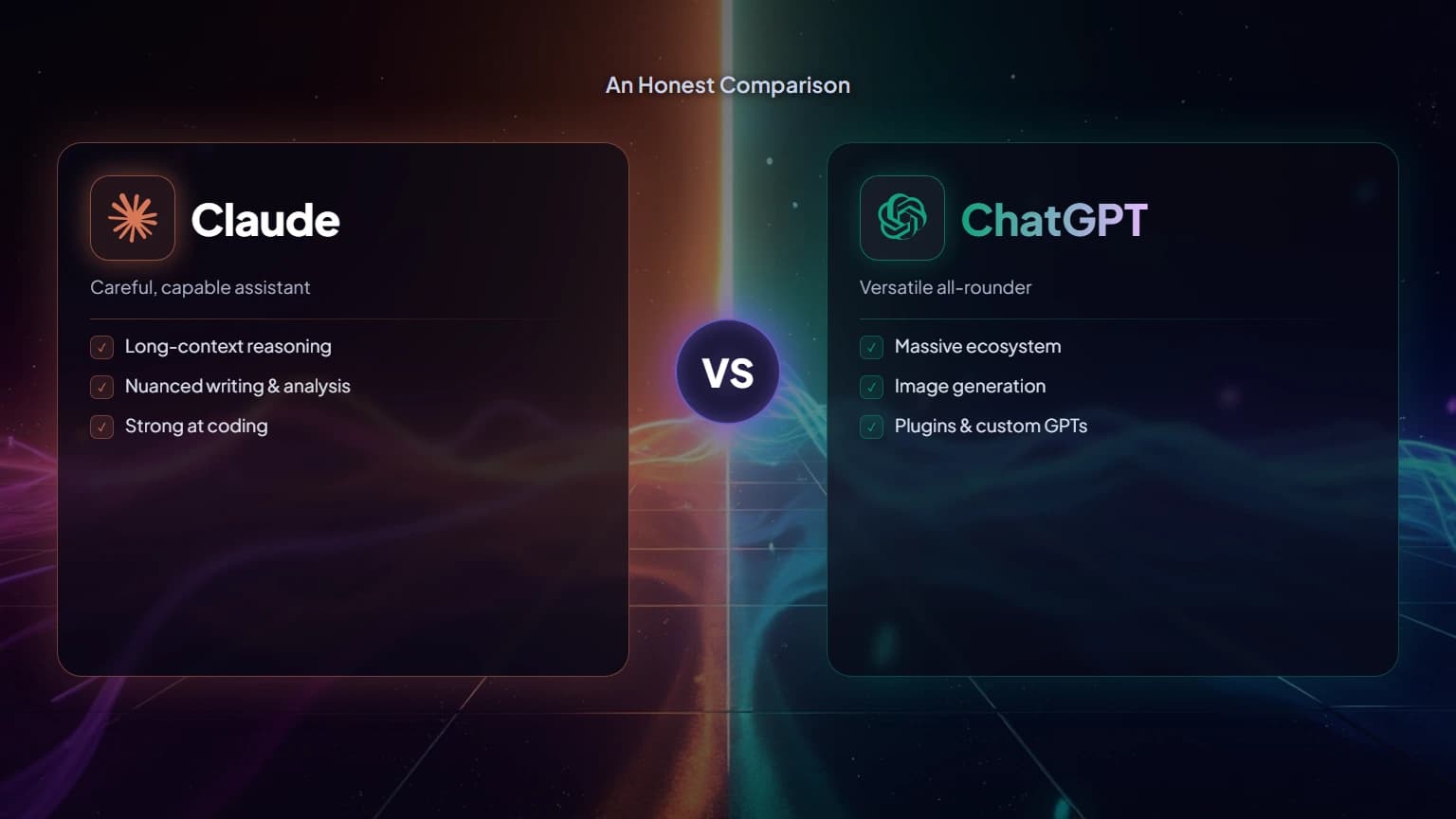
ChatGPT (OpenAI) is the most popular general-purpose AI assistant, and it is a capable creative partner. It is versatile, widely available, and strong at general writing tasks. Its prose voice is simply different from Claude's, and many writers keep both around precisely because the two produce distinct textures. If you want a second voice for brainstorming or a different feel on a scene, ChatGPT is the obvious claude alternative for creative writing to try first.
Gemini (Google) brings multimodal input and tight integration with Google's ecosystem, plus generous free access at the time of writing. If you live in Google Docs and Workspace, or you want to feed images and other media into your process, Gemini fits naturally into that flow. For a broader head-to-head, our Claude vs Gemini vs Grok comparison covers how these general assistants differ.
Sudowrite is purpose-built for fiction. It is designed around a novelist's workflow, with author-focused tools for brainstorming, expanding a draft, and keeping track of your story's world. Writers who want a dedicated fiction environment rather than a general chat assistant often gravitate here.
NovelAI is another specialized storytelling tool, oriented toward long-form fiction and creative control over the narrative. Like Sudowrite, it is built for authors rather than as a do-everything assistant, so it trades breadth for a focused writing experience.
Open-source or local models are worth a mention if privacy is your priority. Running a model on your own hardware keeps your manuscript entirely offline. The trade-off is that setup takes effort and the raw prose quality generally trails the leading hosted models, but for sensitive projects the control can be worth it.
Comparison table
Read the "best for" column as positioning rather than a ranking. Each tool trades something away — breadth for fiction structure, prose polish for offline control, ecosystem fit for voice — and the right trade depends entirely on your project.
Here is a quick, honest overview. Treat "best for" as positioning, not a ranking, since the right choice depends on your project.
| Tool | Best for | Creative-writing strengths | Watch-outs |
|---|---|---|---|
| Claude | Long, voice-consistent drafts | Natural prose, character consistency, big context, nuanced style control | No built-in "story bible" UI for fiction |
| ChatGPT | A different prose voice | Versatile, popular, strong general writing | Distinct voice may not match your target tone |
| Gemini | Google users, free access | Multimodal input, ecosystem integration, generous free tier | Voice and style differ from Claude's |
| Sudowrite | Dedicated fiction workflow | Author-focused brainstorming and drafting tools | Narrower than a general assistant |
| NovelAI | Long-form storytelling control | Purpose-built for fiction and narrative control | Specialized, not a general writing tool |
| Local models | Privacy and offline work | Full control, nothing leaves your machine | Setup effort; prose quality usually trails |
Where Claude wins for creative writing
Four areas hold up under scrutiny: sentence-level prose quality, consistency over manuscript length, nuanced style control you can save and reuse, and a collaborator that pushes back on structure instead of only producing text.
Let us be specific rather than fanboyish. There are a few areas where Claude tends to lead, and they matter most for longer, more serious projects.
Prose quality is the clearest. When you need sentences that read like a human wrote them, with natural rhythm and restraint, Claude is consistently strong. That is the difference between a draft you can polish and one you have to rewrite.
Consistency over length is the second. Because Claude can hold a large slice of your manuscript in its context window — roughly 1M tokens on the flagship tiers, enough for a novel-length draft in one pass — it keeps a character's voice, backstory, and small details straight across a whole chapter or more. Many general tools start to drift or contradict earlier scenes once a piece gets long. We draft long-form prose with Claude every day to run this site, and one pattern we trust: when a passage has to carry a consistent voice over real length, dropping to a cheaper model to save time is a false economy. We default to Sonnet for ordinary drafting but escalate to Opus 5 for the hardest voice-critical stretches, and that single habit does more for consistency than any prompt trick — worth remembering before you reach for a claude alternative for creative writing on tone grounds alone.
Nuanced style control is the third. You can describe a voice in detail, and Claude follows it. With custom styles you can save that voice and reuse it, so a whole series of scenes shares one tone. Picking the right model matters too, which is why our best Claude model guide is worth a read if you want the strongest option for creative work.
Finally, Claude is a thoughtful collaborator. It pushes back gently, offers alternatives, and works with you on structure rather than just spitting out text. For a first-time setup, how to use Claude AI gets you productive quickly.

When a claude alternative for creative writing fits better
Four honest situations: you want a purpose-built novel environment, you live inside Google Workspace, you need a prose texture Claude does not naturally produce, or privacy is non-negotiable and the draft must never leave your machine.
Choosing a claude alternative for creative writing makes sense in several honest situations.
If you want a purpose-built fiction workflow, Sudowrite or NovelAI give you an environment designed around drafting a novel, complete with tools for expanding scenes and organizing your story world. That structure can save time even if the underlying prose is comparable.
If you are deep in the Google ecosystem or you want the most generous free access, Gemini is a reasonable pick. Writing inside tools you already use lowers friction, and free capacity lets you experiment without cost.
If you simply want a different prose voice, ChatGPT is the classic choice. Sometimes a scene calls for a texture that Claude does not naturally produce, and swapping tools is faster than fighting the prompt.
And if privacy is non-negotiable, a local model keeps everything on your machine, at the cost of setup and some quality.
How to pick the right tool
Match the tool to the workflow instead of hunting for one winner. Ask what you are writing, how you like to work, and which of prose quality, price, privacy, and ecosystem fit you would sacrifice last.
The trick is to match the tool to your workflow rather than looking for a single winner. Ask yourself a few questions:
- What are you writing? Long fiction rewards Claude's consistency and context, or a dedicated tool like Sudowrite. Short pieces and quick brainstorming are fine on any of them.
- How do you work? If you want one collaborative drafting partner, Claude is a natural home base. If you want a structured novel-writing suite, a specialized fiction tool earns its keep.
- What matters most? Rank prose quality, price, privacy, and ecosystem fit, and the choice usually becomes obvious.
In practice, many writers do not choose just one. They use Claude as the primary drafting partner for its prose and voice, then reach for a specialized tool for a specific step, like organizing a story bible or generating a batch of variations. There is no rule that says you must pick a single claude alternative for creative writing and abandon everything else. The healthiest workflow often blends two tools that each do one thing well.
If you want to go deeper on positioning across the major assistants, the official Claude site and Anthropic's Claude overview explain the product's strengths directly, which is a useful reference when you compare it against any alternative.
Frequently Asked Questions

Written by
Edith
Writing about Claude and the Anthropic toolkit — models, Claude Code, pricing, features, and fixes, in clear, practical, hands-on guides tested by daily use.
View all posts →