


Aux heat after setback happens because a heat pump cannot close a large temperature gap quickly, so the thermostat calls electric backup heat to catch up. That backup heat can cost more than the setback saved.
This is the single most expensive mistake in heat pump thermostat settings, and almost nothing written about it names the thermostats people actually own. This guide does.
Table of Contents
Why does aux heat come on after a setback?
Aux heat after setback happens because the thermostat treats a large gap between current and target temperature as an emergency. Most thermostats call auxiliary heat once the room is a few degrees below the setpoint, and a deep overnight setback guarantees that gap in the morning.
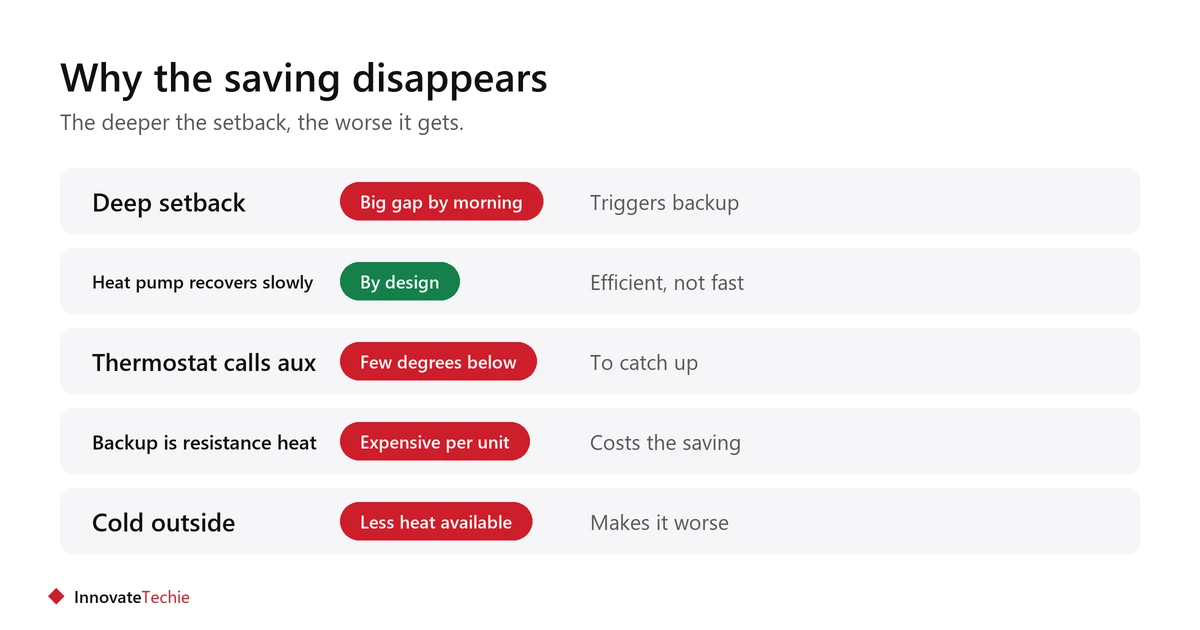
- A heat pump heats slowly and steadily. It is efficient, not fast.
- A setback of several degrees creates exactly the gap that triggers backup heat.
- Electric backup heat is typically far more expensive to run per unit of heat than the heat pump itself.
- So the deeper the setback, the more backup heat on recovery, and the saving disappears.
- Cold outdoor temperatures make it worse, because the heat pump produces less heat just when you are asking for more.
How do you know it is happening?
The thermostat shows it. Look for an indicator labelled AUX, Aux Heat, Em Heat or Auxiliary Heat, and note when it appears. Aux heat after setback shows up during the recovery window and not at other times.
- Watch the display for an hour after the morning recovery begins.
- If AUX appears during recovery and not at other times, the setback is the cause.
- Check the thermostat’s own runtime or energy history. Most log auxiliary runtime separately.
- Compare a mild night with a cold one. If AUX only appears on cold mornings, outdoor temperature is a factor.
- If AUX runs all day regardless of the schedule, that is a different problem and may need a technician.
The settings that stop it
Three settings do most of the work: a shallower setback, early recovery, and a lockout that restricts when backup heat may run at all.
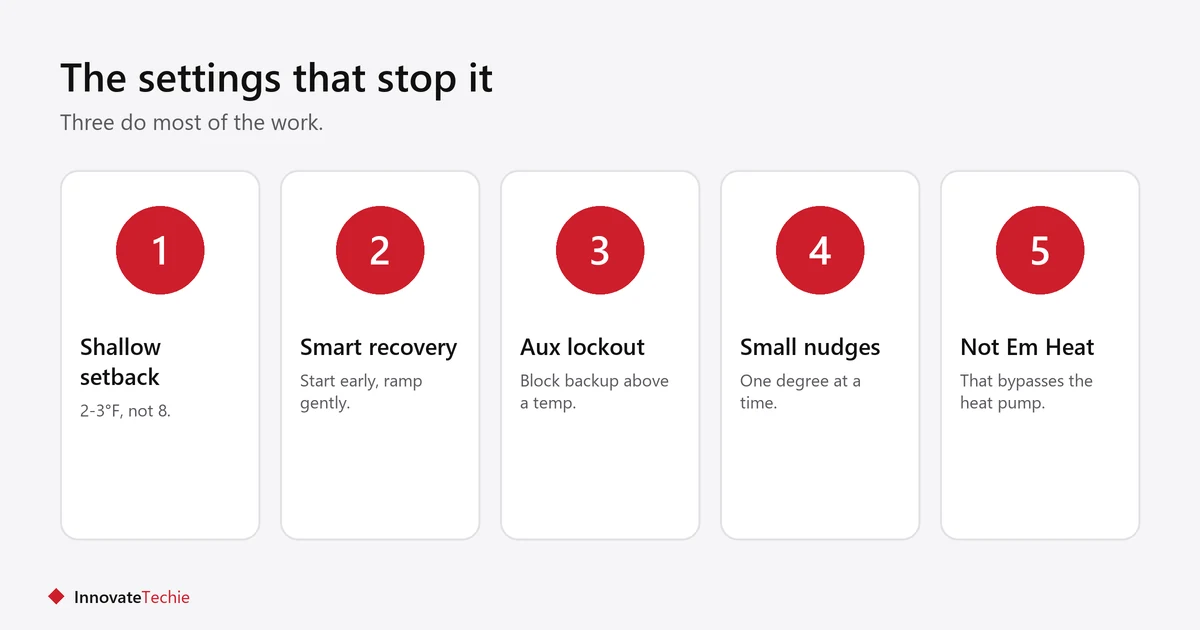
- Reduce the setback depth. Two to three degrees rather than eight. On a heat pump this often saves more, not less.
- Turn on smart or adaptive recovery. It starts earlier and ramps gradually instead of demanding a fast catch-up.
- Set an aux heat lockout temperature if your thermostat offers one. Below that outdoor temperature the backup is allowed; above it, the heat pump works alone.
- Avoid large manual jumps. Nudging the target up by one degree at a time is gentler than raising it five at once.
- Never leave it on Emergency Heat, which bypasses the heat pump entirely. That mode is for a failed heat pump, not for cold weather.
Nest settings
Nest learns and uses Early-On to reach temperature by the scheduled time. The relevant controls sit in the system and equipment settings.
- Enable Early-On so recovery starts ahead of the scheduled time rather than at it.
- Check the heat pump balance setting, which trades comfort against backup heat use. Biasing it toward savings restricts aux heat.
- Nest reports auxiliary heat use in its Home Report and history, which is the quickest way to confirm a change worked.
- If your system is dual fuel, confirm Nest knows that during setup. Getting that wrong changes everything downstream.
Ecobee settings
Ecobee exposes this more directly than most, under the installation or threshold settings.
- Smart Recovery starts heating early so the setpoint is met at the scheduled time.
- Compressor Min Outdoor Temperature sets the point below which the heat pump stops and backup takes over.
- Aux Heat Max Outdoor Temperature blocks backup heat above a given outdoor temperature. This is the single most useful setting here.
- Ecobee’s HomeIQ reports show auxiliary runtime, so you can compare weeks after a change.
Names differ by firmware version. If a setting is not where this says, search the model number plus the setting name rather than guessing.
What is the right setback for a heat pump?
Shallow. Two to three degrees, with smart recovery on, is a reasonable starting point for most heat pumps, and it is the simplest way to avoid aux heat after setback altogether.
| System | Setback depth | Why |
|---|---|---|
| Gas or oil furnace | Deeper is fine | Recovers quickly, no electric backup |
| Heat pump, mild climate | 2-3°F | Recovery stays within the heat pump’s range |
| Heat pump, cold climate | 0-2°F | Backup heat triggers easily when it is cold out |
| Heat pump with aux lockout set | 3-5°F | The lockout protects you from the expensive case |
For context on setbacks generally, the U.S. Department of Energy figure of up to 10% from a 7-10°F setback applies to conventional systems, and ENERGY STAR notes heat pumps need their own approach. Our smart thermostat settings guide covers the rest of the schedule.
When it is not the setback
If aux heat runs constantly, or on mild days, the cause is mechanical rather than a schedule.
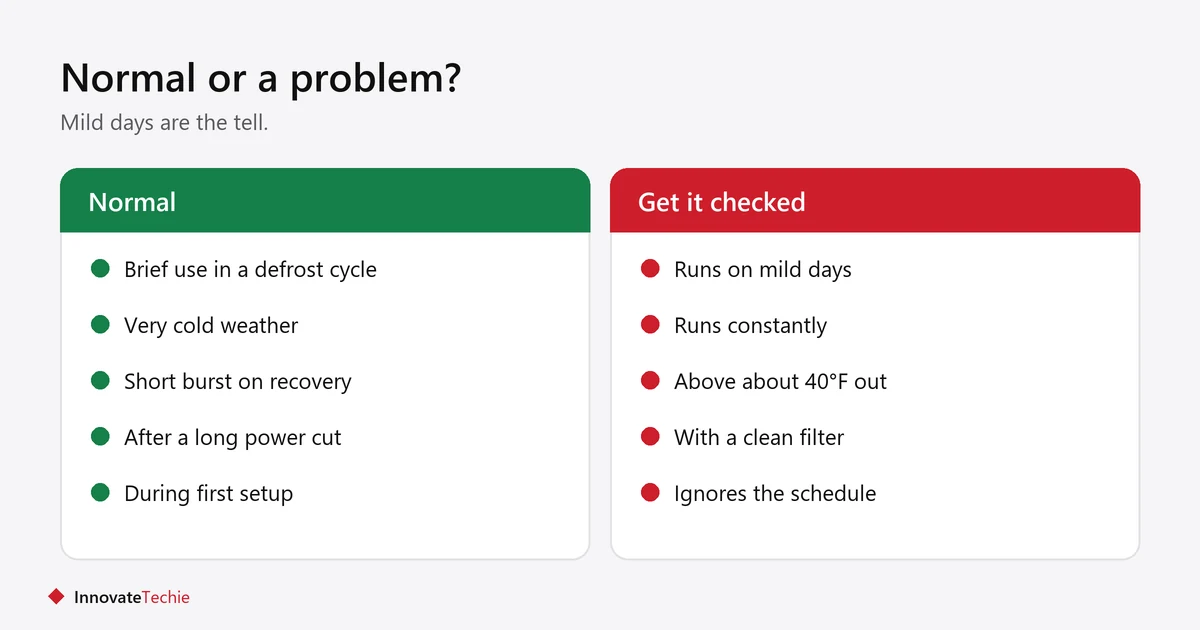
- A defrost cycle briefly uses auxiliary heat. That is normal and short.
- A dirty filter or blocked outdoor unit reduces capacity and forces backup heat.
- Low refrigerant does the same, and needs a technician.
- A miswired thermostat can call aux heat whenever there is any call for heat.
- If AUX shows above about 40°F outdoors with no obvious cause, have the system checked.
If the thermostat is fighting you in other ways, smart device not connecting to wifi covers the connection side.
Related guides
- Smart Thermostat Without a C Wire: 5 Real Options
- Is a Smart Thermostat Worth It? 6 Honest Checks
- Smart Home Devices That Save Money: 6 Best Options
Frequently asked questions
Why does my aux heat come on after a setback?
A heat pump heats slowly, so a deep setback leaves a gap it cannot close quickly. The thermostat calls electric backup heat to catch up, and that backup often costs more than the setback saved.
Should I use a setback with a heat pump?
A shallow one, to avoid aux heat after setback. Two to three degrees with smart recovery enabled suits most heat pumps. Deep setbacks of eight degrees or more tend to trigger expensive backup heat on recovery.
How do I stop my thermostat using auxiliary heat?
Reduce the setback depth, turn on smart or adaptive recovery, and set an aux heat lockout temperature if your thermostat has one. Avoid raising the target by several degrees at once.
Is auxiliary heat expensive?
It is usually far more expensive per unit of heat than the heat pump, because it is resistance electric heating. Short bursts are fine; daily use on every recovery is what costs money.
What is the difference between aux heat and emergency heat?
Auxiliary heat assists the heat pump when it cannot keep up. Emergency heat switches the heat pump off entirely and uses backup only. Emergency heat is for a broken heat pump, not cold weather.
Is it normal for aux heat to come on sometimes?
Yes. Brief use during a defrost cycle or in very cold weather is normal. Aux heat running on mild days, or running constantly, points to a filter, airflow or refrigerant problem.
About the author: Hamza Javaid is a web developer and the editor of InnovateTechie. Read our editorial policy.
Last updated: October 2026. Prices, plans and app menus change often, so confirm details on the manufacturer’s page before you buy.
