


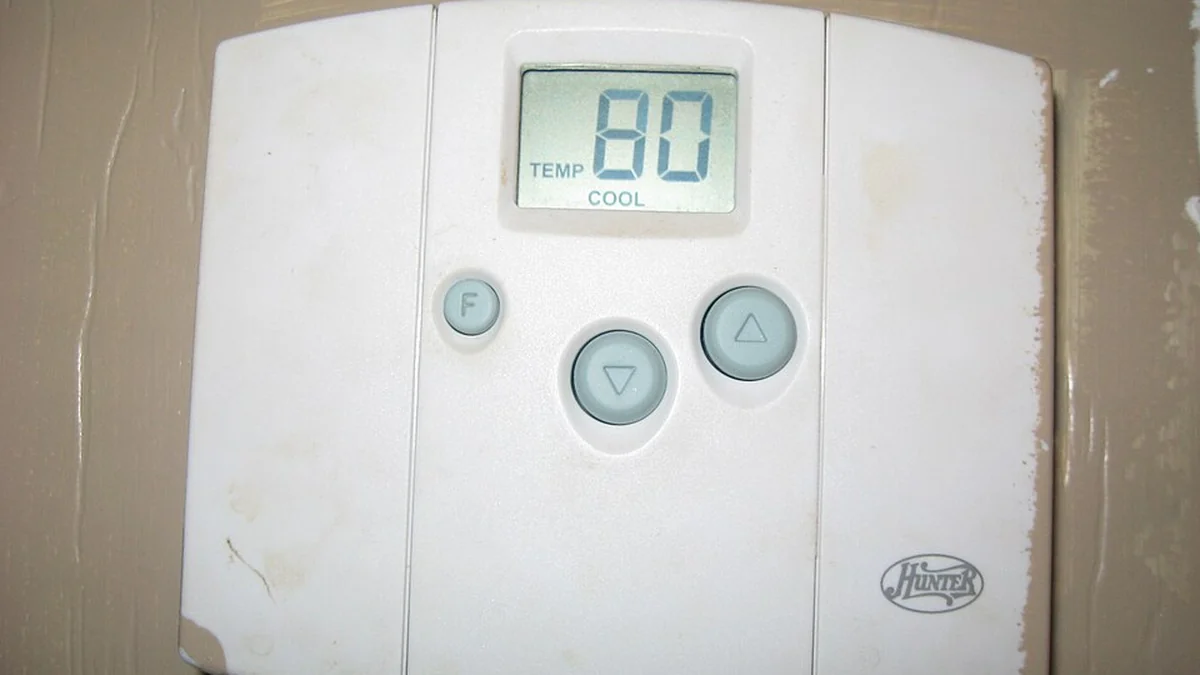
You have five options for a smart thermostat without a c wire: use an adapter kit, add a power extender, repurpose the fan wire, buy a thermostat that runs on batteries or power sharing, or run new cable. Most people end up with one of the first two.
The C wire, or common wire, is what gives a thermostat continuous power. Older homes often have no C wire at the thermostat, and that is the single most common reason a smart thermostat install stalls.
Table of Contents
Do you actually have a C wire?
Pull the thermostat off its plate and look at the terminal block. A wire in the terminal marked C means you have one. An unused wire tucked into the wall cavity often means you have one that was never connected.
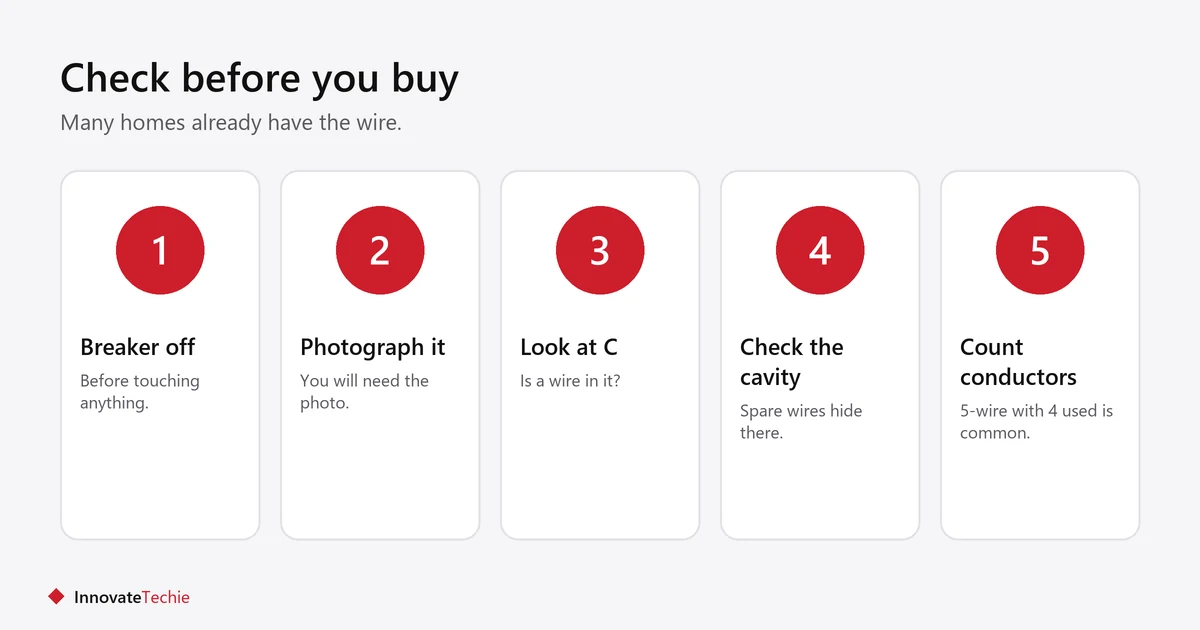
- Turn off power to the heating and cooling system at the breaker first. This is not optional.
- Take a photo of the wiring before touching anything. You will need it.
- Look for a wire in the C terminal. Common colours are blue or black, but colour is not a guarantee of function.
- Check for a spare wire pushed back into the wall. A 5-wire cable with only 4 connected is very common.
- If a spare exists, the job becomes connecting it at both ends rather than buying anything.
That last point is worth checking carefully. A surprising number of homes have the wire already and simply never used it.
What are the 5 options?
They differ in cost, how much wiring you touch, and whether you need to open the furnace or air handler.
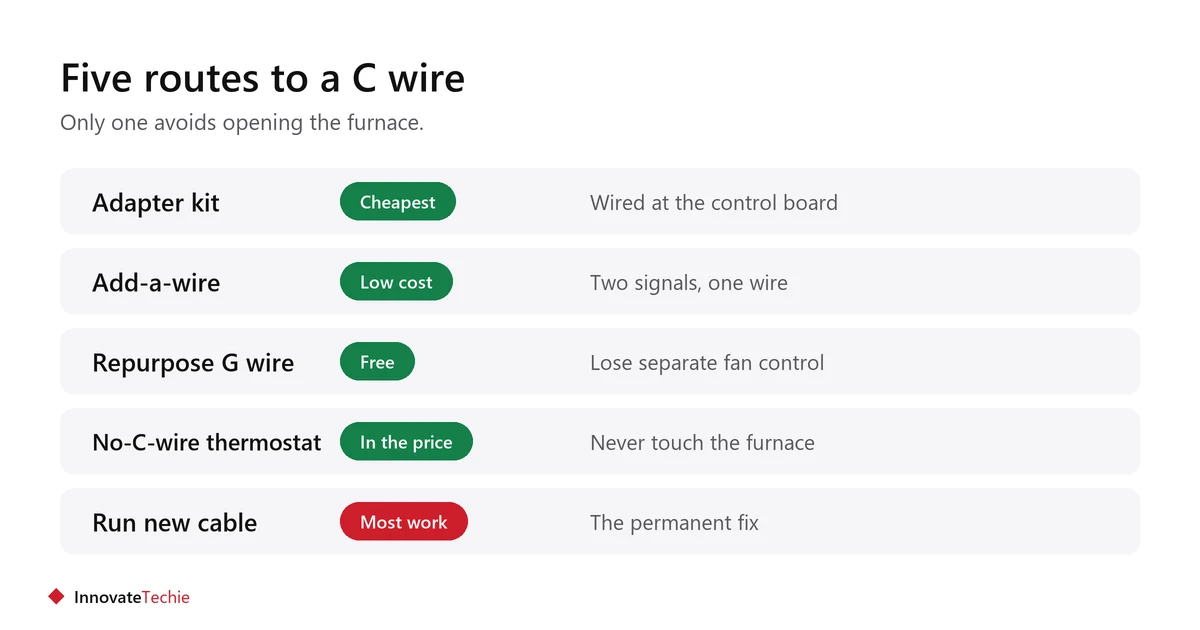
| # | Option | What it involves | Touches the furnace? |
|---|---|---|---|
| 1 | Adapter or power extender kit | A small module wired at the furnace control board | Yes |
| 2 | Add-a-wire module | Sends two signals down one wire | Yes |
| 3 | Repurpose the G (fan) wire | Reassign the fan wire as common | Yes |
| 4 | A thermostat that needs no C wire | Battery or power-sharing model | No |
| 5 | Run new cable | Pull a new 5-wire cable to the thermostat | Yes |
Option 4 is the only one that avoids opening the furnace. If you are not comfortable working at the control board, start there.
Which thermostats work without a C wire?
Two kinds: models that run on batteries, and models that borrow small amounts of power from the heating wire between calls, sometimes called power sharing or power stealing.
- Battery models are the simplest. They need battery changes, and some report wider temperature swings than mains-powered models.
- Power-sharing models work without batteries but are fussier about system compatibility, especially with some high-efficiency furnaces.
- Some brands include an adapter in the box. Check before buying it separately.
- Check the compatibility tool on the maker’s site with a photo of your actual wiring. Every major brand has one and they are reliable.
Whether the thermostat is worth it at all is covered in is a smart thermostat worth it.
How does an adapter kit work?
It sits at the furnace control board and creates a common connection using the wires you already have. The thermostat then sees a normal C wire.
- Power off at the breaker, and confirm it is off.
- Open the furnace or air handler and find the control board.
- Fit the module per its diagram, which reassigns the existing wires.
- Reconnect at the thermostat end to match.
- Restore power and test heating and cooling separately, not just one.
If the diagram does not match what you see at your control board, stop. Boards vary, and guessing here can damage the system.
The one workaround to never try
Do not jump the R and C terminals, and do not run a thermostat off the transformer by bridging terminals to “create” power. It can short the control board and damage the system.
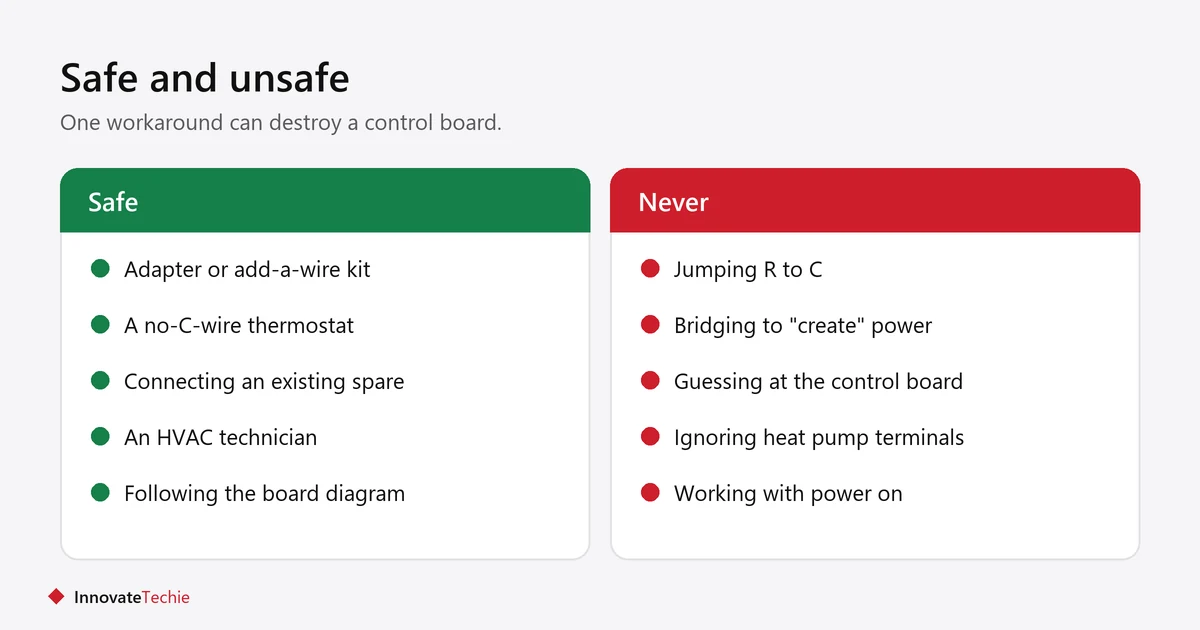
Some guides online suggest energising the system to power the thermostat. Treat that advice as a reason to distrust the rest of the page. If the safe options do not fit your setup, an HVAC technician fitting a C wire is usually a short, inexpensive visit.
What about heat pumps and high-efficiency systems?
Be more careful. Heat pumps use extra terminals for reversing valves and backup heat, and some high-efficiency furnaces do not tolerate power sharing.
- The U.S. Department of Energy advises heat pump owners to use a thermostat designed for heat pumps.
- Count your wires before shopping. Heat pump systems commonly use more conductors than a simple furnace.
- Power-sharing models are the ones most likely to misbehave on high-efficiency equipment.
- With a heat pump, an adapter kit or a proper C wire is usually the safer route than a battery model.
What does it cost?
An adapter kit is the cheapest route and a technician visit the dearest, with the gap between them smaller than people expect.
| Route | Rough cost | Best for |
|---|---|---|
| Connecting an existing spare wire | Nothing | Homes that already have the wire |
| Adapter or add-a-wire kit | Low | Most people |
| A no-C-wire thermostat | Built into the price | Anyone avoiding the furnace |
| HVAC technician fits a C wire | A short service call | Heat pumps, odd wiring, no confidence |
More ways to cut a heating bill are in smart home devices that save money, and ENERGY STAR publishes the savings estimates for certified models.
Related guides
Frequently asked questions
Can I install a smart thermostat without a c wire?
Yes. You can use an adapter kit, repurpose the fan wire, or buy a thermostat that runs on batteries or power sharing. Check first whether a spare wire is already in the wall.
What is a c wire on a thermostat?
The common wire. It gives the thermostat continuous power rather than only powering it when the system runs. Smart thermostats need steady power for Wi-Fi and the screen.
Which smart thermostats do not need a c wire?
Battery-powered models and power-sharing models. Battery models are simpler but need battery changes; power-sharing models are fussier about system compatibility.
Can I use the g wire as a c wire?
On many systems yes, by reassigning the fan wire at both ends. You lose independent fan control, and it needs changes at the furnace control board, so it suits someone comfortable with that.
Is it safe to jump r and c on a thermostat?
No. Bridging those terminals to create power can short the control board and damage the system. Use an adapter kit or have a technician run a proper C wire instead.
How much does it cost to add a c wire?
An adapter kit is inexpensive. If a technician runs a new wire it is usually a short service call. Connecting a spare wire that is already in the wall costs nothing.
About the author: Hamza Javaid is a web developer and the editor of InnovateTechie. Read our editorial policy.
Last updated: October 2026. Prices, plans and app menus change often, so confirm details on the manufacturer’s page before you buy.
