


Robot vacuum vs stick vacuum comes down to effort against depth: a robot cleans often with no effort from you, a stick cleans better when you do it. In a small home a stick often finishes faster than a robot does.
Most homes end up with both. If you are buying one, this guide covers which to start with and why.
Table of Contents
Robot vacuum vs stick vacuum: what is the real difference?
A robot is a maintenance cleaner that keeps dust down between proper cleans. A stick is a cleaning tool that does a better job when you use it. They solve different problems.
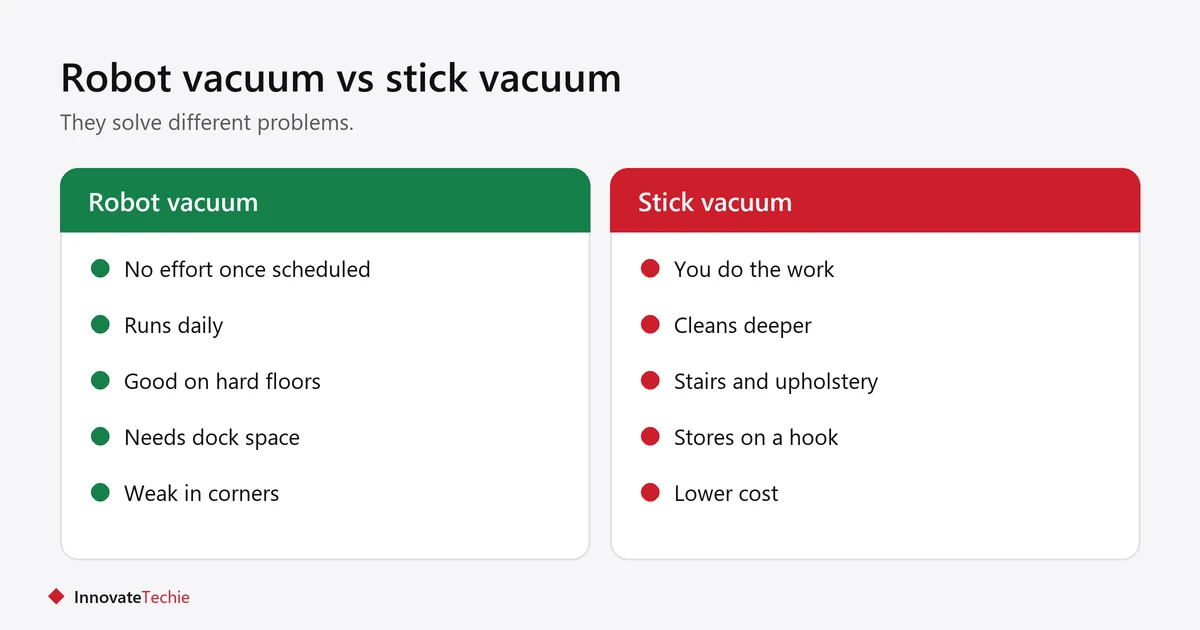
| Robot vacuum | Stick vacuum | |
|---|---|---|
| Effort | None once scheduled | You do the work |
| Frequency | Daily, easily | When you get to it |
| Corners and edges | Weak | Strong |
| Stairs | No | Yes |
| Upholstery | No | Yes with tools |
| Typical cost | Higher | Lower |
| Storage | Dock needs floor space | Wall mount or cupboard |
Whichever you choose, the U.S. Environmental Protection Agency suggests a vacuum with a HEPA filter to cut dust build-up, and advises anyone with asthma or allergies to leave the room while it runs.
Which is better for a small home?
For a studio or one-bedroom with hard floors, a stick vacuum usually cleans the whole place in a few minutes. A robot takes longer but you are not doing it.
- A small floor is quick by hand, which weakens the robot’s main advantage.
- Dock floor space matters more in a small home than a big one.
- A stick stores on a wall hook. A robot needs a permanent spot.
- If the floor is usually covered in items, a robot will struggle and a stick will not.
Room-by-room detail is in our guide to a robot vacuum for small apartment.
Which is better with pets?
Both help, differently. A robot running daily keeps shed hair from building up. A stick has a bigger bin and deals better with heavy shedding and upholstery.
- Daily robot runs stop hair accumulating in corners and under furniture.
- A stick clears sofas, beds and car seats, which a robot cannot reach.
- Pet hair tangles robot brushes, so maintenance rises. See robot vacuum maintenance.
- Litter and food scatter is better suited to a stick, which you can aim.
What does each cost to own?
Robots cost more up front and have ongoing parts. Sticks cost less and have fewer consumables, though batteries fade on both.
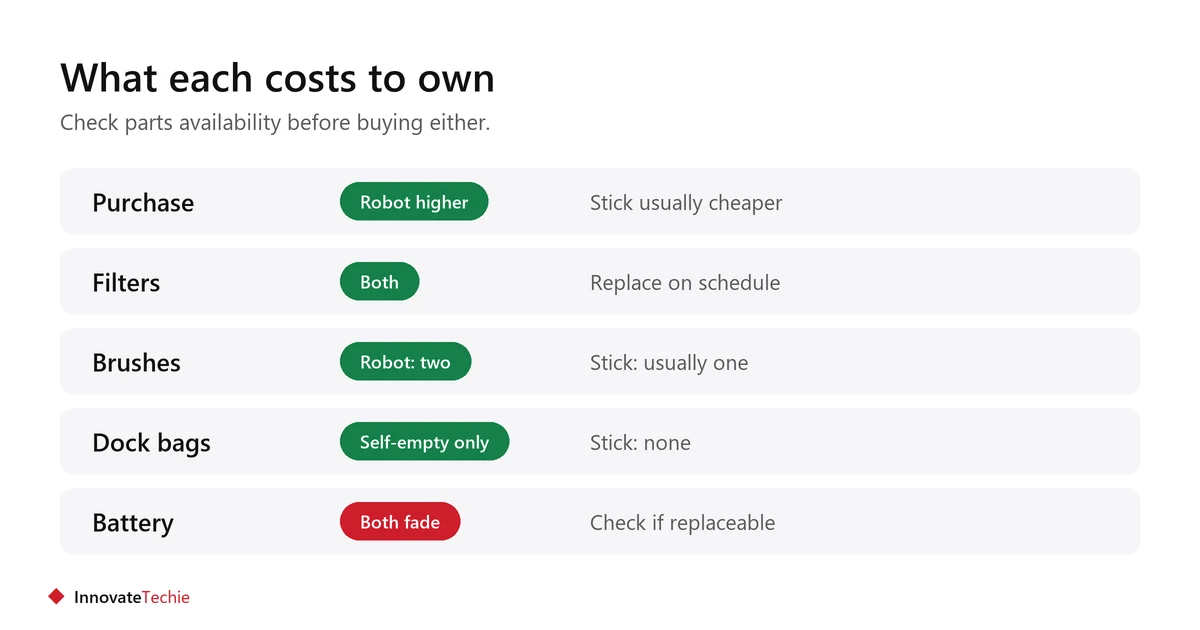
| Cost | Robot vacuum | Stick vacuum |
|---|---|---|
| Purchase | Higher | Lower |
| Filters | Yes | Yes |
| Brushes | Main and side | Usually one |
| Dock bags | Only self-empty models | None |
| Battery | Replaceable on some | Replaceable on many |
Check the price and availability of parts before buying either. A cheap machine with hard-to-find parts is not cheap over three years.
Which is better on carpet?
A stick vacuum, in most cases. Carpet needs agitation and sustained suction, and a robot is limited by its height, its brush size and its battery.
- Deep pile can stop a robot altogether, or it rides up and loses contact with the floor.
- Many robots raise suction on carpet, which drains the battery faster and shortens the run.
- The edge where carpet meets the skirting board is consistently missed by a round robot.
- A stick with a powered brush head is the better tool for a carpeted bedroom, and the only option on stairs.
- On hard floors the gap narrows a lot, which is why robots suit tiled and wooden apartments best.
Can one replace the other?
A robot cannot fully replace a stick, because it cannot do stairs, upholstery or a spill. A stick can replace a robot, but only if you actually vacuum often.
Be honest about that last point. The robot’s real advantage is that it runs whether or not you feel like cleaning.
Which should you buy first?
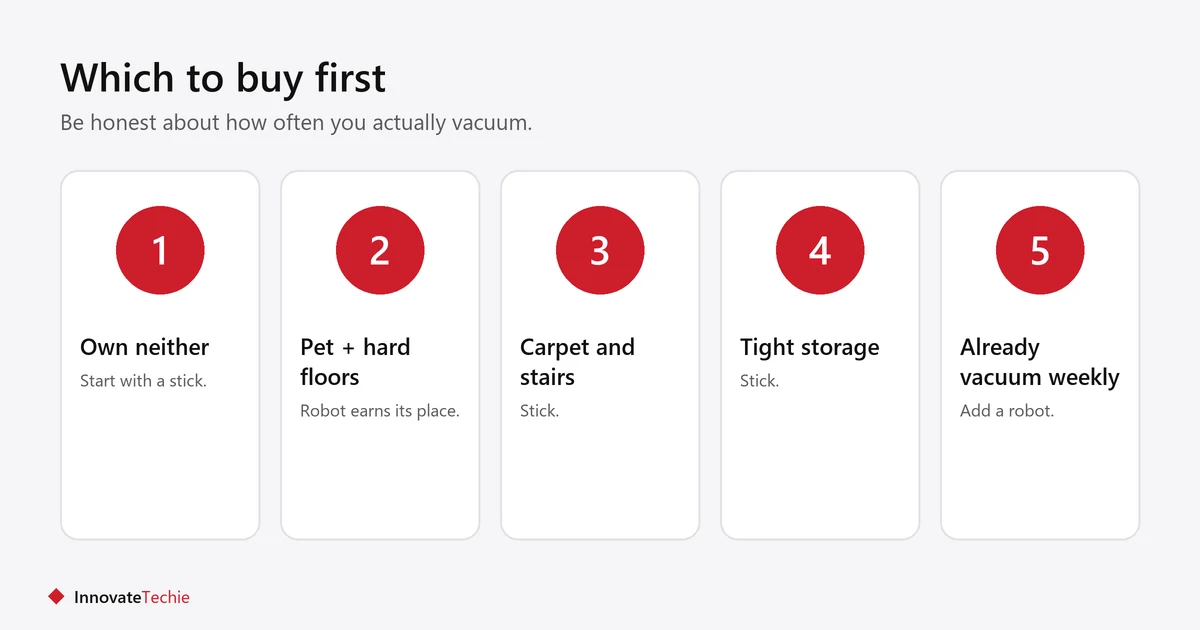
Buy the stick first if you own neither. It handles everything, costs less, and nothing is beyond it. Add a robot when the daily upkeep is the part you want to stop doing.
| Your situation | Start with |
|---|---|
| You own neither | Stick vacuum |
| Hard floors, shedding pet, busy | Robot |
| Carpet, stairs, clutter | Stick |
| Small flat, tight storage | Stick |
| You already vacuum weekly and want it automated | Robot |
If you go the robot route, our buying tips cover height, navigation and running costs.
Related guides
Frequently asked questions
Is a robot vacuum better than a stick vacuum?
In robot vacuum vs stick vacuum, neither is better overall. A robot cleans often with no effort from you, while a stick cleans more thoroughly when you do use it. Most homes end up with both.
Can a robot vacuum replace a regular vacuum?
Not fully. It cannot do stairs, upholstery or a sudden spill, and it struggles in corners. It keeps floors tidy between deeper cleans.
Which is better for pet hair, robot or stick?
A robot running daily stops hair building up. A stick has a bigger bin and reaches sofas and beds. Pet hair also tangles robot brushes, so maintenance increases.
Is a robot vacuum worth it in a small apartment?
It can be if you want daily cleaning with no effort and have mostly hard floors. A stick often cleans a small flat faster, and stores more easily.
Which is cheaper, a robot or a stick vacuum?
Stick vacuums usually cost less to buy and have fewer consumable parts. Robots add filters, brushes and sometimes dock bags over time.
Should I buy a stick vacuum or a robot first?
If you own neither, start with a stick. It handles everything including stairs and upholstery. Add a robot when daily upkeep is what you want automated.
About the author: Hamza Javaid is a web developer and the editor of InnovateTechie. Read our editorial policy.
Last updated: October 2026. Prices, plans and app menus change often, so confirm details on the manufacturer’s page before you buy.
