


To remove adhesive mounts without damaging paint, warm the adhesive with a hairdryer on low, then pull slowly along the wall rather than away from it. Pulling outward is what tears paint off.
Smart home kit in a rental lives on adhesive: sensors, cameras, light strips, button switches, cable clips. All of it has to come off at the end of a tenancy, and this is the step that costs deposits.
Table of Contents
Why adhesive pulls paint off
Because the bond to the paint is often stronger than the paint’s bond to the wall. Mounting tape is designed not to fail, so when something has to give, it is usually the paint film.
- Foam mounting tape grips extremely well, which is the point of it.
- Fresh paint, under about four weeks old, is far more likely to lift.
- Cheap builder-grade flat paint on new plasterboard is the worst case.
- Time and warmth cure the adhesive harder, so a mount left for two years is harder to remove than one left two months.
- Pulling straight out concentrates all the force on one small area of paint.
The method that works
Warm it, cut the bond from behind if you can, and peel at a low angle. Slowly.
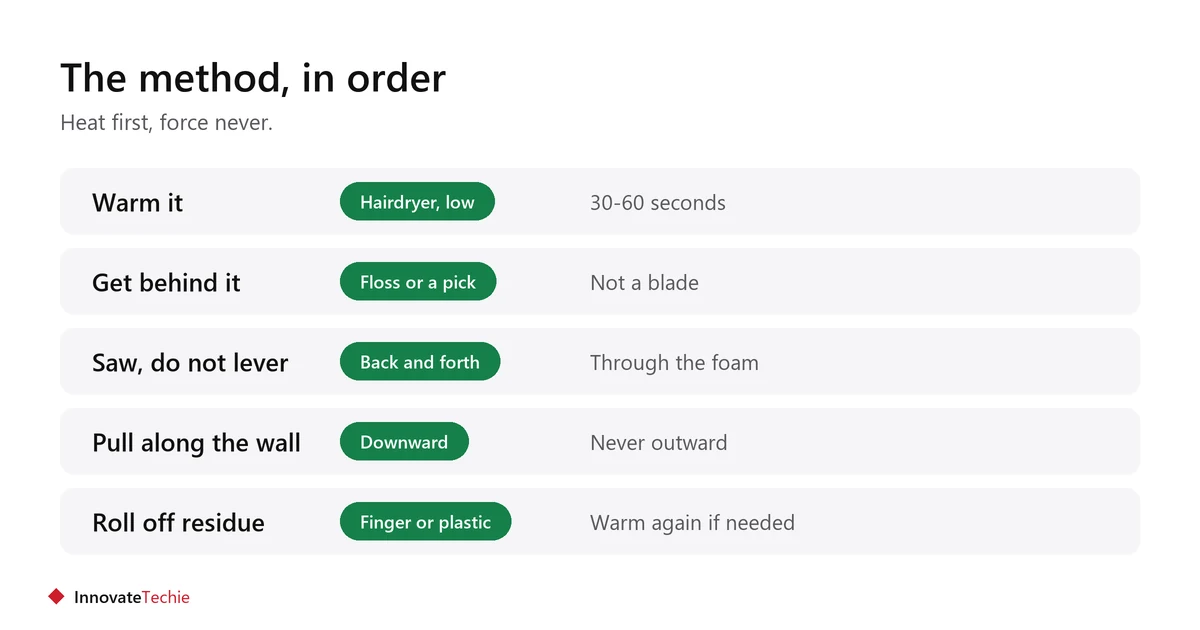
- Warm the mount with a hairdryer on low for 30 to 60 seconds, held a few inches away. Warm, not hot.
- Work a slim tool behind it if there is a lip. Dental floss, fishing line or a guitar pick work; a metal blade does not.
- Saw floss back and forth through the foam rather than levering.
- If you must pull, pull downward along the wall, keeping your hand close to the surface. Never straight out.
- Go slowly. Adhesive releases far better under slow, steady tension than a sharp tug.
- Roll off any residue with a fingertip or a plastic scraper, warming again if needed.
If the paint starts to lift at any point, stop and add more heat rather than more force.
What about command-style stretch tabs?
Pull the tab straight down, slowly, parallel to the wall, and keep pulling until it releases. These are designed to come off cleanly, and most failures come from pulling at an angle or stopping halfway.
- Stretch the tab slowly. It can extend a long way before releasing.
- Keep the pull flat against the wall, not outward.
- If the tab snaps, warm the area and use the floss method on what is left.
- Never twist the tab.
Removing residue safely
Heat and patience first. Solvents last, and only after a test on a hidden patch.
- Warm the residue and roll it off with your finger. This alone handles most of it.
- Use a plastic scraper or an old credit card, never a metal blade.
- If a solvent is needed, test it somewhere hidden first, such as behind a door or low on a skirting board.
- Apply it to a cloth, not directly to the wall, and work in small circles.
- Wipe with clean water afterwards, because residue from the remover attracts dirt.
Most household adhesive removers are formulated for hard surfaces. On emulsion paint they can lift the colour even when the adhesive comes off, so the test patch matters more than it sounds.
What to avoid
Sharp tools, high heat, solvents without a test, and speed. Each of these turns a clean removal into a repair.
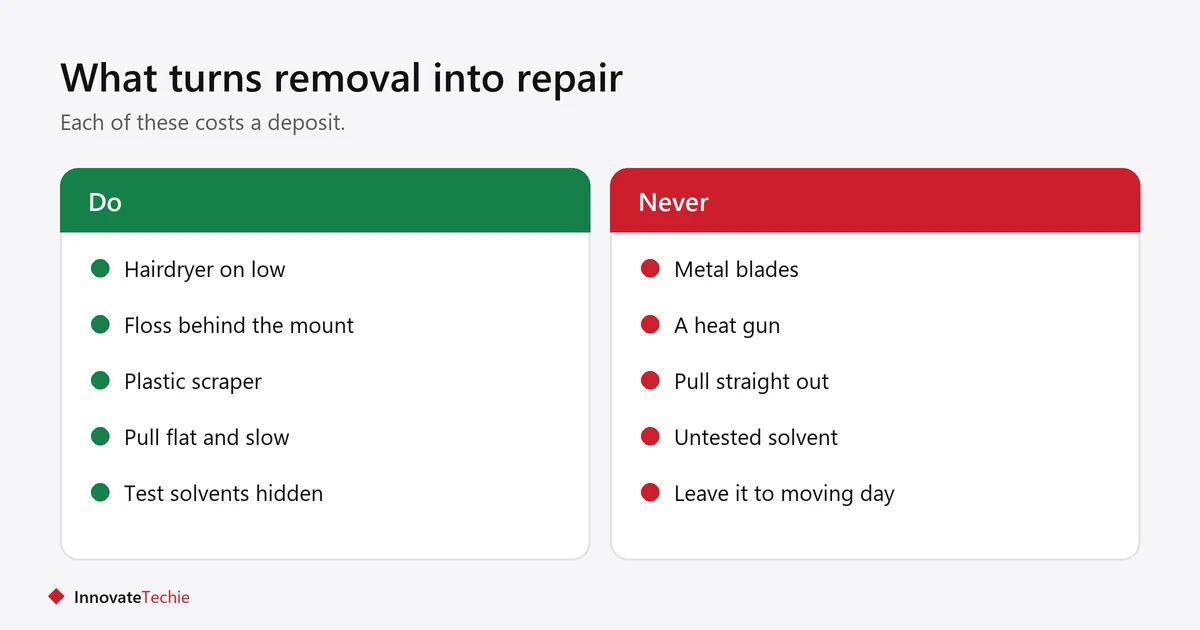
- Metal blades and knives: they gouge plaster and slice paint.
- A heat gun: too hot. It blisters paint and can scorch. A hairdryer is enough.
- Pulling straight out: the single most common cause of torn paint.
- Solvents on untested paint: can strip colour in a patch you cannot hide.
- Doing it on moving day: leave time, because rushing is what causes damage.
If the paint comes off anyway
Small lifts are usually cheaper to fix than to argue about. Fill, sand lightly, and touch in with matching paint.
- Photograph it before and after the repair.
- For a lifted paint film with no plaster damage, light sanding and touch-up paint is enough.
- One caution for older buildings: in homes built before 1978, paint may contain lead, and sanding or scraping it is not a DIY job. The EPA explains how to protect your family from lead. If the building is that old, tell the landlord rather than sanding it yourself.
- For a gouge, fill with a small amount of filler, let it dry, sand flat, then paint.
- Ask the landlord or agent for the paint reference. Many keep it, and an exact match is invisible.
- Touch in a slightly larger area and feather the edges, rather than dabbing the exact spot.
How to avoid this next time
Choose mounts you can remove, put them where paint is least at risk, and keep a record.
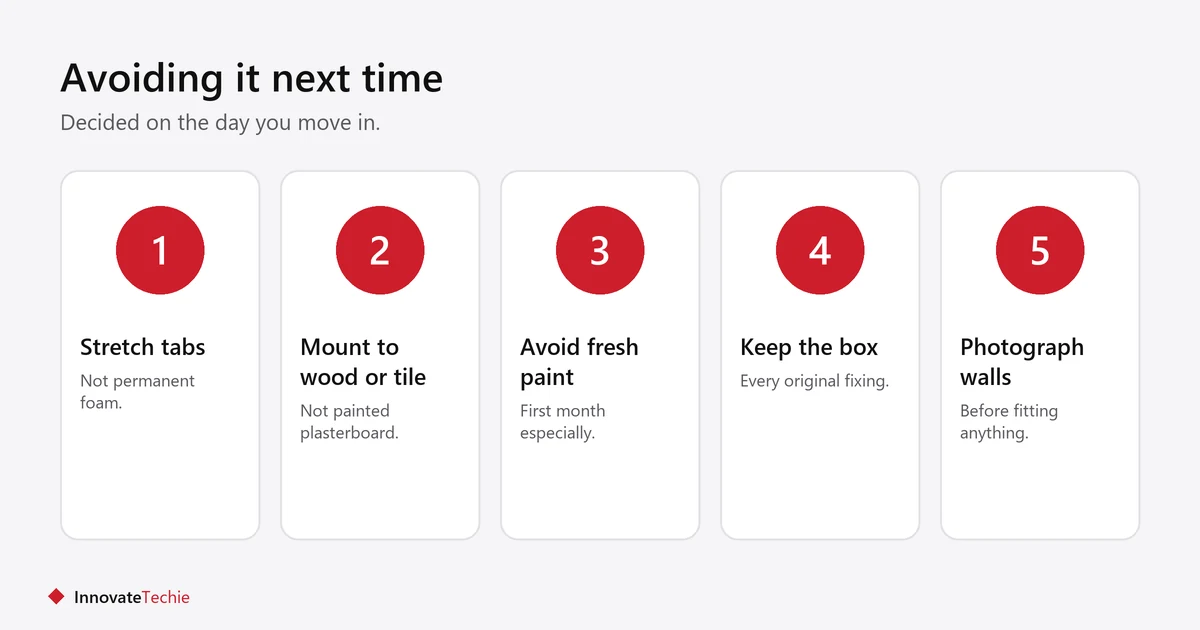
- Prefer stretch-release tabs over permanent foam tape where the weight allows.
- Mount to woodwork, tile or glass rather than painted plasterboard where you have the choice.
- Avoid freshly painted walls entirely for the first month.
- Keep every original fixing and the packaging in one labelled box from day one.
- Photograph each wall before you fit anything.
The wider version of this, covering what is safe to install in a rental at all, is in our smart home ideas for renters, and smart home on a budget covers what to buy first.
Related guides
- Video Doorbell for Renters: 6 Easy No-Drill Options
- Smart Lock for Renters: 6 No-Drill Options Explained
- Smart Lighting for Renters: 7 Easy No-Drill Ideas
Frequently asked questions
How do I remove adhesive mounts without damaging paint?
Warm the mount with a hairdryer on low, then peel slowly downward along the wall rather than pulling outward. Pulling straight out is what tears the paint film.
Will a hairdryer damage the paint?
Not on a low setting held a few inches away for under a minute. A heat gun will — it gets far hotter and can blister or scorch paint.
How do I remove sticky residue from a wall?
Warm it and roll it off with a fingertip or a plastic scraper. Use a solvent only if that fails, and test it on a hidden patch first since many lift emulsion paint.
Do command strips damage paint?
They usually do not if you pull the tab slowly straight down, flat against the wall, and keep going until it releases. Pulling at an angle or stopping halfway is what causes damage.
Can my landlord charge me for paint damage?
They can usually deduct for damage beyond normal wear. A small lift is often cheaper to repair yourself with matching paint than to dispute, so ask the agent for the paint reference.
What is the safest way to mount smart home devices in a rental?
Use stretch-release tabs rather than permanent foam tape where the weight allows, prefer woodwork or tile over painted plasterboard, and avoid walls painted in the last month.
About the author: Hamza Javaid is a web developer and the editor of InnovateTechie. Read our editorial policy.
Last updated: October 2026. Prices, plans and app menus change often, so confirm details on the manufacturer’s page before you buy.
