


In This Article
11 sectionsQuick answer
Every major Claude AI feature mapped in one place — Cowork, Skills, Artifacts, Projects, Memory, Connectors and more — plus what's free vs paid .
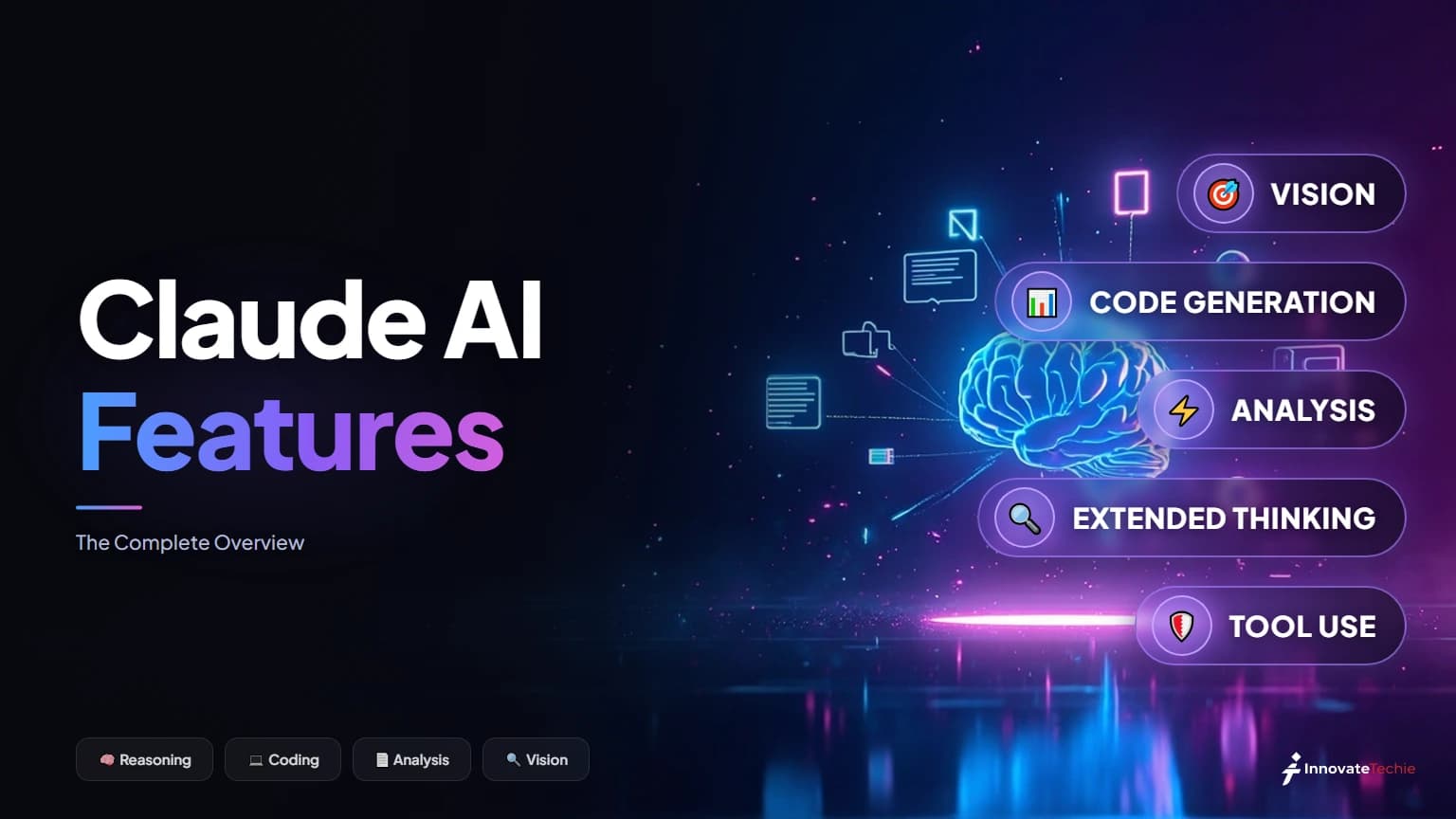
Claude AI features in 2026 span twelve major capabilities: Cowork, Skills, Artifacts, Claude Design, Projects, Memory, Connectors, computer use, web search, file analysis, Claude in Excel, and limited voice. Free users get core chat on Claude Sonnet; the agentic features — Cowork, Claude Code, Claude in Excel — require a paid plan starting at $20/month.
Model lineup and API pricing verified 9 August 2026 against Anthropic's model overview.
This page maps the entire surface of Claude AI features: what each one actually does, which plan unlocks it, what shipped recently versus what's battle-tested, and where the honest gaps are. We use these Claude AI features daily, and we link out to deeper guides wherever a paragraph isn't enough.
Key takeaway
Claude AI features cluster into three layers — an agentic layer (Cowork, Claude Code, Skills), a workspace layer (Artifacts, Projects, Memory), and a data layer (Connectors, web search, files) — spanning twelve capabilities in total, of which the free tier runs only the chat product on Claude Sonnet and every agentic feature sits behind a paid plan starting at $20/month.
Claude AI features at a glance: the master table
Twelve capabilities, three plan tiers. Artifacts, Projects, web search, and file analysis run on every plan including free. Cowork, Claude Code, Skills, Memory, Connectors, and Claude in Excel need a paid plan; computer use is a research preview.
Anthropic has shipped Claude AI features at a relentless pace since 2024, and Claude is now much more than a chat box. Here is the full map of Claude AI features.
| Feature | What it does | Plan required |
|---|---|---|
| Cowork | Agentic knowledge work — Claude completes whole tasks across your files in Claude Desktop | Paid plans (Pro and up) |
| Claude Code | Agentic coding in the terminal, VS Code/JetBrains, desktop, and web | Paid plan or API |
| Skills | Reusable instruction packs Claude loads automatically when relevant | Paid plans; also Claude Code |
| Artifacts | Documents, code, and interactive mini-apps rendered in a side panel | All plans, including free |
| Claude Design | Describe an idea and Claude builds designs, prototypes, and slides you refine by chat | Paid plans (research preview) |
| Projects | Persistent workspaces with knowledge files and custom instructions | All plans |
| Memory | Carries context across conversations, fully viewable and editable | Pro and up |
| Connectors | Links Claude to external tools (Drive, GitHub, Notion) via MCP | Pro and up |
| Computer use | Claude operates a screen — clicks, types, navigates | API (beta); research preview in Cowork and Claude Code on Pro and Max |
| Web search | Live web results with citations | All plans |
| File uploads & analysis | Reads PDFs, spreadsheets, images, code; runs data analysis | All plans |
| Claude in Excel | Builds, explains, and fixes spreadsheets from inside Excel | Pro and up |
| Voice | Spoken conversations on the mobile apps | Mobile apps (limited) |
The clearest mental model we've found for the Claude AI features is three layers: an agentic layer (Claude does work for you), a workspace layer (Claude remembers and organizes), and a data layer (Claude reaches your information). We'll walk through them in that order.

The agentic layer: Cowork, Claude Code, Skills, computer use
This is where Claude stops answering questions and starts completing tasks: Cowork works through a folder of files, Claude Code works through a repository, Skills package repeatable procedures, and computer use drives a screen directly.
These are the Claude AI features where Claude stops answering questions and starts completing tasks. They're also the features that most clearly separate paid plans from free.
Claude Cowork
Cowork is the headline feature of 2026: you point Claude Desktop at a folder, state a goal — "reconcile these 30 invoices into a summary spreadsheet" — and Claude works through the files agentically, reading, editing, and creating documents while you supervise. In our testing, a folder of scattered meeting notes became an organized structure with per-project summaries in about six minutes; the manual version takes over an hour.
It's Claude Code's working model applied to knowledge work instead of code, and it's included on all paid plans. We wrote a full deep dive in What is Claude Cowork? covering setup, real use cases by role, and the failure modes we still babysit.
Claude Code
Claude Code is the developer-side equivalent: an agent that reads your codebase, plans, edits files, runs tests, and iterates until the job is done. It started as a terminal CLI and now also runs as VS Code and JetBrains extensions, in the desktop app, and on the web at claude.ai/code. It requires a paid plan or API credits.
Its extension points — skills, plugins, MCP servers, subagents, plan mode, hooks — have grown into a genuine platform. If you're weighing it against an AI-native editor, our Cursor vs Claude Code comparison covers that decision in depth.
Skills
Skills are reusable instruction packs: folders containing instructions, scripts, and reference files that Claude loads automatically when a task matches. A brand-voice skill makes every draft sound like your company, much like Claude's custom styles do for tone and format. A reporting skill formats data identically every time. They work across the Claude apps and Claude Code, and because they load on demand, they don't clutter every conversation. A dedicated guide to writing your own Claude Skills is coming to this site soon.
Computer use
Computer use lets Claude operate a screen directly — moving a cursor, clicking, typing into applications. The raw tool is an API-level beta, and the same engine also ships as a supervised research preview inside Cowork and Claude Code on Pro and Max. Either way it is the substrate agentic products are built on, and most people will meet it indirectly, through Cowork, rather than raw.
The workspace layer: Artifacts, Projects, Memory
Artifacts render substantial output in a side panel you can iterate on. Projects hold standing instructions and knowledge files for one area of work. Memory carries facts about you across every conversation, and everything it keeps is viewable and editable.
Artifacts
Artifacts render substantial output — documents, code files, diagrams, even working interactive mini-apps — in a dedicated panel beside the chat instead of buried inline. You can iterate on them turn by turn, publish them, and share them. Shipped in mid-2024, Artifacts are the most mature feature on this list and available on every plan, including free. Anthropic has since pushed past static artifacts toward generative UI in a short-lived Claude Imagine research preview, where Claude built the interface live instead of saving it.
Projects
Projects are persistent workspaces: custom instructions plus uploaded knowledge files plus every related chat, grouped in one place. If you do the same kind of work repeatedly — one client, one codebase, one course — a Project means never re-explaining context. Available on all plans.
Memory
Memory carries context across conversations: your role, preferences, ongoing work, and writing style. Unlike Projects, it follows you everywhere. Everything Claude retains is viewable, editable, and deletable, and incognito chats leave no trace. Memory requires a paid plan.
Because these three overlap, here's the decision rule we actually use:
| You want Claude to… | Use |
|---|---|
| Follow standing instructions in one area of work | Projects |
| Remember facts about you across everything | Memory |
| Execute a repeatable procedure identically every time | Skills |
| Reach live data sitting in another tool | Connectors |
The data layer: Connectors, web search, files, Excel
This layer is how Claude reaches information it was not given. Connectors bridge to Drive, GitHub, and Notion through MCP; web search pulls live cited results; file uploads take PDFs, spreadsheets, and code; Claude in Excel works inside the workbook.
Connectors
Connectors plug Claude into external tools — Google Drive, GitHub, Notion, calendars — through MCP (Model Context Protocol), the open standard Anthropic released in late 2024 that the wider industry has since adopted. Once connected, Claude can pull a document or an issue into the conversation without copy-paste. Browsing the in-app directory requires a paid plan.
Web search
Claude searches the web when a question needs current information and cites its sources inline. It's available on all plans and works well for research synthesis — though we still click the citations on anything we're going to act on. Trust, then verify.
File uploads & analysis
Upload PDFs, spreadsheets, images, or code and Claude reads them directly; for data files it can write and run code to produce statistics and charts rather than eyeballing numbers. With the 1M-token context window on recent models, entire books and codebases now fit in a single conversation — a genuine differentiator at this scale.
Claude in Excel
Claude in Excel puts the model inside your workbook: it builds financial models, explains inherited formula chains, and fixes broken references while showing its changes. It requires Pro or above. For spreadsheet-heavy roles, this plus Cowork is the strongest pitch for the $20/month upgrade.
Voice: the limited one
Voice on the mobile apps handles spoken back-and-forth adequately but is the least developed capability here — it is not the fluid, expressive conversational voice some competitors ship. If voice is your primary interface, look elsewhere.
Voice exists on the Claude mobile apps, and we'll be blunt: it's the least developed feature here. It handles spoken back-and-forth adequately, but it isn't the fluid, expressive conversational voice some competitors ship. If voice is your primary interface to an AI assistant, Claude is not the strongest choice in 2026 — and we'd rather tell you that than let you discover it after subscribing.

What Claude does NOT do
No image generation, no video generation, limited voice, and no hands-off browsing agent. Claude reads and analyses images extremely well and can draw SVG diagrams through code, but photorealistic generation needs a separate tool.
An honest Claude AI features overview has to include the gaps:
- No image generation. Claude cannot create, edit, or produce images — full stop. It reads and analyzes images extremely well, and it can generate SVG diagrams and charts through code, but photorealistic generation requires a separate tool like Midjourney or DALL·E.
- No video generation. Same story: analysis in, nothing generated out.
- Limited voice, as covered above.
- No hands-off browsing agent. Screen control ships as a supervised research preview in Cowork and Claude Code, but there is no "Claude, browse the web for me" product that runs without you watching.
Whether these gaps matter depends on your workload. We scored the full trade-off — where Claude wins on writing, long context, and agentic coding versus where the feature checklist favors the competition — in Is Claude better than ChatGPT?
Which Claude AI features are free vs paid
The free tier gives you the chat product; paid plans give you the agent. Anything where Claude does sustained work on your behalf — Cowork, Claude Code, Excel — sits behind Pro at $20 a month, because sustained agentic work burns tokens.
| Plan | Price | What you get |
|---|---|---|
| Free | $0 | Chat on Claude Sonnet (tight caps), Artifacts, Projects, web search, file uploads |
| Pro | $20/mo | Everything above plus Cowork, Claude Code, Memory, Connectors, Claude in Excel, Opus access, ~5× free usage |
| Max 5x | $100/mo | All Pro features at 5× Pro usage |
| Max 20x | $200/mo | 20× Pro usage — enough to default to Claude Opus 5 all day |
| Team / Enterprise | Per-seat | Central billing, admin controls, higher shared limits |
The pattern is easy to summarize: the free tier gives you the chat product; paid plans give you the agent. Every feature where Claude does sustained work on your behalf — Cowork, Claude Code, Excel — sits behind the paywall, because sustained agentic work burns tokens.
The API is priced separately, per million tokens: Claude Sonnet 5 at an introductory $2/$10 (in/out) until August 31, 2026, Claude Opus 5 at $5/$25, Claude Haiku 4.5 at $1/$5 — all listed on Anthropic's pricing page.
What shipped recently vs what's mature
Artifacts and Projects are boring in the best sense and safe to build daily workflows on. Memory and Connectors are reliable but still growing. Cowork and Claude in Excel are genuinely useful and still occasionally need a human to unstick them.
These features vary in age, and that matters: mature ones are safe to build daily workflows on, while new ones still have rough edges worth expecting.
| Feature | Maturity | Shipped |
|---|---|---|
| Artifacts | Mature | Mid-2024 |
| Projects | Mature | 2024 |
| Web search, file analysis | Mature | 2025 |
| Connectors (MCP) | Maturing | 2025 |
| Memory | Maturing | Late 2025 |
| Claude in Excel | New | Late 2025 |
| Cowork | New | Early 2026 |
| Claude Sonnet 5 (model) | New | June 30, 2026 |
| Claude Opus 5 (model) | New | 2026 |
Our practical read: Artifacts and Projects are boring in the best sense — they just work. Memory and Connectors are reliable but still growing surface area. Cowork is genuinely useful today and still occasionally needs a human to unstick it, which is exactly what "new" means.
The models underneath every feature
Which model you are on changes feature quality more than most people expect. Sonnet 5 is the fast default, Opus 5 is the deep-reasoning flagship for long agentic sessions, and Haiku 4.5 handles high-volume, low-stakes work cheaply.
Every one of the Claude AI features above runs on the same model family, and which model you're on changes feature quality more than most people expect. Claude Sonnet 5 (released June 30, 2026) is the fast default; Claude Opus 5 is the deep-reasoning flagship, succeeding Claude Opus 4.8 (May 28, 2026), which scored 69.2% on SWE-bench Pro; either can slow down to reason step by step with extended thinking, and Claude Haiku 4.5 handles high-volume, low-stakes work.
A Cowork session on Opus drifts less over a long task; a quick Artifact iteration on Sonnet feels instant. The full decision framework — benchmarks, worked cost math, when escalating to Opus actually pays — is in Claude Sonnet vs Opus.
Deep dives in this series
This pillar stays at overview altitude. Four companion guides go deeper: Cowork end to end, choosing between Sonnet and Opus with cost maths, the feature-gap scorecard against ChatGPT, and Claude Code against the leading AI editor.
This pillar stays at overview altitude across the full set of Claude AI features. For depth:
| Guide | What it covers | Status |
|---|---|---|
| What is Claude Cowork? | Anthropic's agentic knowledge-work feature, end to end | Live |
| Claude Sonnet vs Opus | Which model to run under these features, with cost math | Live |
| Is Claude better than ChatGPT? | The feature-gap scorecard against the main rival | Live |
| Cursor vs Claude Code | Claude Code against the leading AI editor | Live |
| Claude Skills: the complete guide | Writing and packaging your own skills | Coming soon |
| Claude Projects vs Memory | When to use which, with setup walkthroughs | Coming soon |
Claude pricing at a glance
Claude's Free tier costs nothing, Pro is $20 a month, Max starts at $100 a month, and API access is billed per token. The paywall sits exactly where the agentic capabilities begin.
| Plan | Price |
|---|---|
| Free | $0 |
| Pro | $20 / month |
| Max | from $100 / month |
| API | Pay per token |
For the full breakdown of every plan, see our how much Claude costs guide.
Frequently Asked Questions

Written by
Edith
Writing about Claude and the Anthropic toolkit — models, Claude Code, pricing, features, and fixes, in clear, practical, hands-on guides tested by daily use.
View all posts →