


An energy monitoring smart plug is worth buying once, as a measuring tool you move from appliance to appliance — not for every socket in the house. It tells you which devices actually cost you money, which is information almost nobody has.
The catch is accuracy. Published figures disagree sharply, and the readings are estimates rather than billing-grade measurements. That matters less than it sounds, for reasons this guide explains.
Table of Contents
What it actually measures
Power drawn by whatever is plugged into it, in watts, logged over time so you can see energy used in kilowatt-hours.
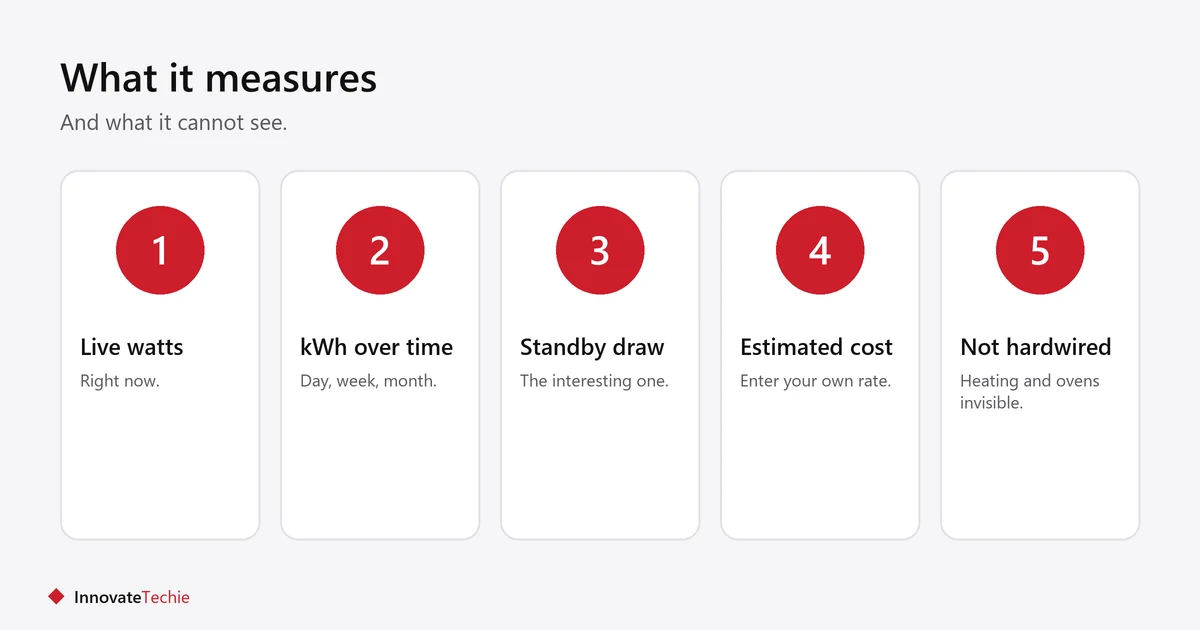
- Live wattage: what the device is drawing right now.
- Energy over time: kilowatt-hours per day, week or month.
- Estimated cost: only if you enter your electricity rate. The default rate is usually wrong.
- Standby draw: what the device uses while apparently off, which is often the interesting number.
- It measures only what is plugged into it. Hardwired things — the heating, the oven, the immersion heater — are invisible to it.
How accurate is it really?
Accurate enough to compare devices, not accurate enough to check your bill. The published figures genuinely conflict.
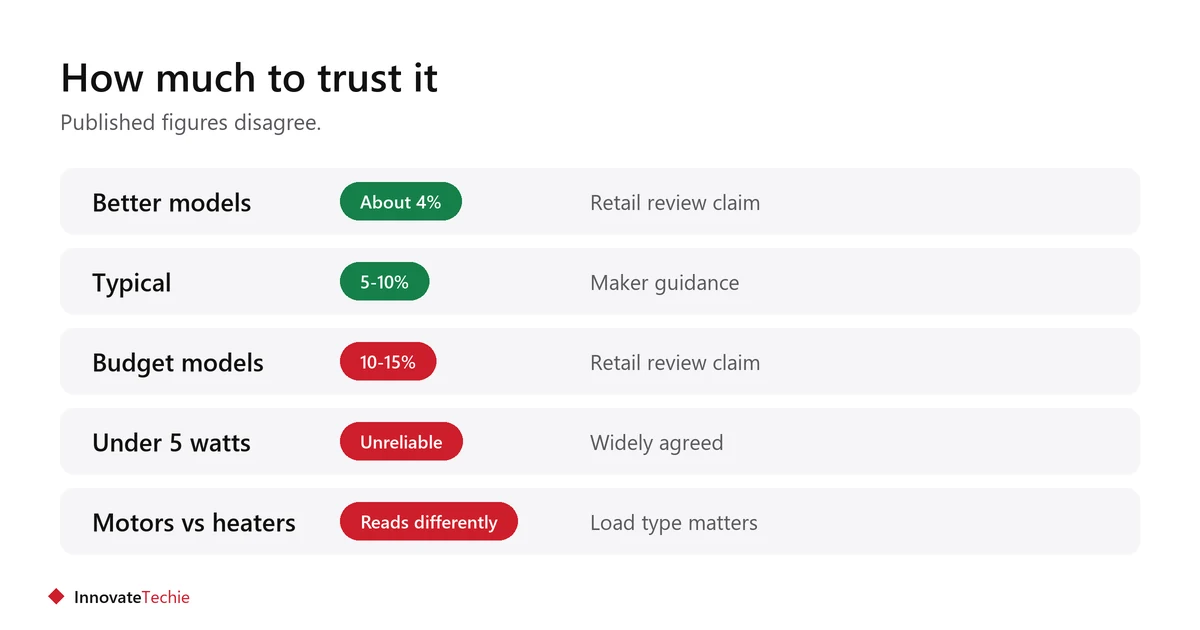
- One retail review claims budget plugs drift 10 to 15 percent while better models stay within about 4 percent.
- A manufacturer troubleshooting guide puts typical accuracy at 5 to 10 percent, varying with the type of load.
- Several sources agree readings get unreliable at very low loads, under about 5 watts.
- Motor-driven and inductive devices read differently from simple resistive ones such as heaters and kettles.
- None of these figures come from independent lab testing, so treat all of them as rough.
The honest summary: assume roughly ten percent either way, and more at very low wattages.
Why that accuracy is good enough
Because the useful finding is almost never a precise number. It is a surprise.
Discovering that an old second fridge draws four times what you assumed does not need accuracy to within one percent. Neither does finding that a games console you thought was off is drawing meaningful power all night. Ten percent error does not change either decision.
Where it is not good enough: disputing an electricity bill, submitting readings for anything official, or comparing two devices that are within a few percent of each other.
How to sanity-check yours
Measure something with a known draw and compare. It takes five minutes and tells you how much to trust the readings.
- Find an appliance with a clearly printed wattage, such as a simple heater, a kettle, or an incandescent bulb if you still have one.
- Plug it through the monitoring plug and run it.
- Compare the reading with the printed figure.
- Repeat with a low-draw device such as a phone charger, where plugs are weakest.
- If the high-load reading is close and the low-load one is not, that is normal behaviour rather than a fault.
The one job it does best
Finding standby draw. It is the only easy way to see what your house uses while nobody is doing anything.
- Measure each suspect device overnight while it is “off”.
- Rank them by what they actually draw, not by what you assumed.
- Put the worst offenders on a schedule or a switched strip.
- Re-measure a week later to confirm the change did something.
- Move the plug on to the next device.
What is worth switching off, and what should never be on a smart plug at all, is in what not to plug into a smart plug.
Monitoring plug or whole-home monitor?
Different tools for different questions. A plug answers “what does this device use”. A whole-home monitor answers “where is my electricity going”.
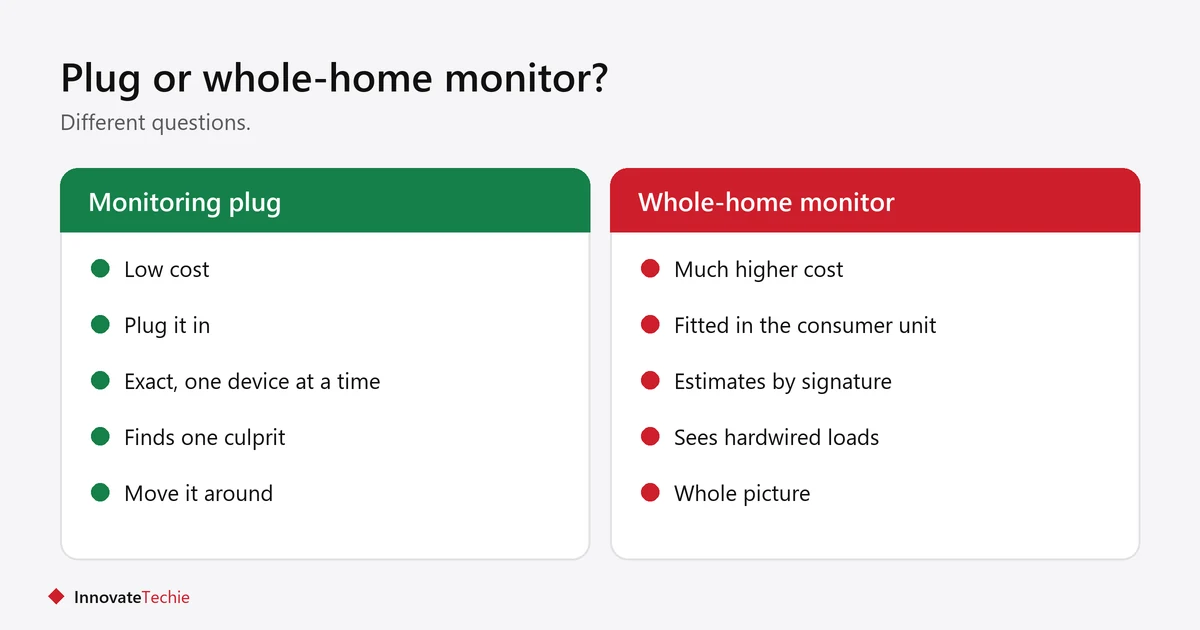
| Monitoring plug | Whole-home monitor | |
|---|---|---|
| Cost | Low | Much higher |
| Covers hardwired loads | No | Yes |
| Installation | Plug it in | In the consumer unit |
| Per-device detail | Exact, one at a time | Estimated, by signature |
| Best for | Finding one culprit | Seeing the whole picture |
For most homes the plug is the sensible starting point. The U.S. Department of Energy covers where household energy generally goes, and smart home devices that save money ranks what is worth buying.
Before you buy
Check the model number, because manufacturers mix monitoring and non-monitoring plugs in the same range with nearly identical names.
- Confirm monitoring is listed in the specification, not just implied by the range name.
- Check the maximum load, especially for heaters and anything with a motor.
- Check whether history is kept in the app or only shown live.
- Check whether you can enter your own electricity rate.
- One plug is usually enough. Buy a second only once the first has run out of things to measure.
Related guides
- Smart Thermostat Without a C Wire: 5 Real Options
- Aux Heat After Setback: Why It Happens and the Fix
- Do Smart Plugs Save Energy? 5 Honest Answers
Frequently asked questions
Is an energy monitoring smart plug worth it?
Yes, as a measuring tool you move from device to device. It finds which appliances actually cost money, especially standby draw. It is not worth fitting one to every socket.
How accurate are energy monitoring smart plugs?
Published figures range from about 4 percent on better models to 10 to 15 percent on budget ones, and readings get unreliable below about 5 watts. Assume roughly ten percent either way.
Can I use a smart plug to check my electricity bill?
No. The readings are estimates, not billing-grade measurements, and the plug only sees what is plugged into it. Hardwired loads like heating and ovens are invisible to it.
What is the best use of an energy monitoring plug?
Measuring standby draw. Running each suspect device overnight while it is supposedly off shows what your home uses when nobody is doing anything.
Do all smart plugs measure energy?
No, and brands mix monitoring and non-monitoring models within the same range under similar names. Check the specification for the exact model number before buying.
Should I buy a monitoring plug or a whole-home energy monitor?
A plug if you want to find one culprit cheaply. A whole-home monitor if you need to see hardwired loads like heating and the oven, which a plug cannot measure.
About the author: Hamza Javaid is a web developer and the editor of InnovateTechie. Read our editorial policy.
Last updated: October 2026. Prices, plans and app menus change often, so confirm details on the manufacturer’s page before you buy.
