

Part ofWhat Is Claude Code? The Complete Guide
In This Article
6 sectionsQuick answer
OpenCode is open-source and model-agnostic; Claude Code is Anthropic's polished, Claude-native agent. Feature matrix, cost, and a clear pick for each use case.
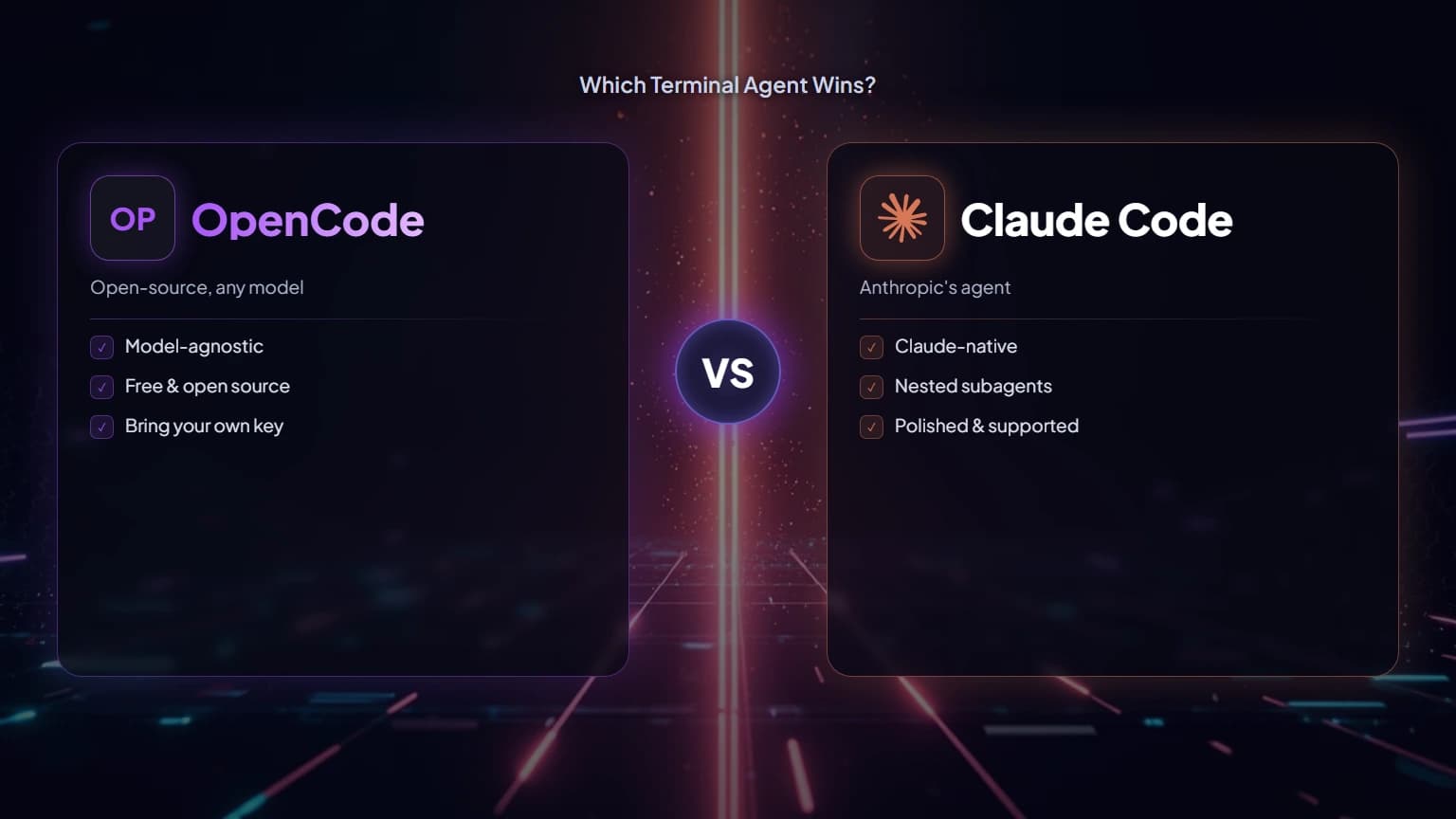
In OpenCode vs Claude Code, the split is clean: OpenCode is open-source and model-agnostic — run any provider (Anthropic, OpenAI, Gemini, local models) with your own key, for free. Claude Code is proprietary and Claude-only, but more polished, with deeper agentic orchestration like nested subagents. Choose OpenCode for model freedom and zero lock-in; choose Claude Code for the most capable Claude-native experience.
Model lineup and Claude Code pricing verified 31 July 2026 against Anthropic's model overview.
Both are terminal-first AI coding agents that read your repo, plan changes, edit files, and run commands — so the OpenCode vs Claude Code decision isn't really about basic capability. It's about openness, which models you can use, cost structure, and how advanced you need the orchestration. We've run both; here's the honest breakdown and a clear pick for each kind of developer. Claude Code currently runs on the latest Claude models — Opus 5, Sonnet 5, and Haiku 4.5 — and OpenCode can point at any of them or roughly 20 other providers, so we review this comparison regularly to keep it accurate. We have walked this exact path in our own terminal, so the guidance here is grounded in doing rather than describing.
Key takeaway
OpenCode is free, open-source, and model-agnostic — run any provider with your own key — while Claude Code is proprietary and Claude-only (from $20/month) but offers deeper orchestration like nested subagents; pick OpenCode for model freedom, Claude Code for the most capable Claude-native agent.
OpenCode vs Claude Code: the quick verdict
OpenCode is free, open source, and runs any model provider you hold a key for. Claude Code is proprietary, Claude-only, and starts at $20/month, but ships the deeper agentic orchestration. Freedom versus capability.
| OpenCode | Claude Code | |
|---|---|---|
| License | Open source | Proprietary (Anthropic) |
| Models | Any provider (BYO key) | Claude only |
| Cost | Free tool; pay your provider | Paid plan or API |
| Interfaces | Terminal, desktop, IDE | Terminal, IDE, desktop, web |
| Orchestration | Simpler agent patterns | Nested subagents, fallback chains |
| Best for | Flexibility, no lock-in | The deepest Claude-native agent |
The one-line version: OpenCode optimizes for freedom; Claude Code optimizes for capability. Which matters more depends entirely on your priorities.
Models and openness: the headline difference
OpenCode is model-agnostic: bring your own key for Anthropic, OpenAI, Gemini, Bedrock, Groq, or a local model, and switch by editing one config line. Claude Code targets Claude alone, which is what lets it ship tuned first-party features quickly.
This is the headline difference. OpenCode is model-agnostic — you bring your own API key and point it at OpenAI, Anthropic, Google Gemini, AWS Bedrock, Groq, Azure, OpenRouter, or even local models. If a better model ships next month, you switch a config line. It's also fully open source, so you can read it, fork it, and self-host with confidence.
Claude Code is the opposite by design. It's locked to Anthropic's Claude models and is proprietary — you can't read or fork its source code. That's not a flaw so much as a trade: because it only targets Claude, it's tuned tightly to those models and ships polished, first-party features fast. In the OpenCode vs Claude Code contest, this is the fork in the road: model freedom versus a single, deeply integrated stack.

Is OpenCode cheaper than Claude Code?
OpenCode itself costs nothing — you pay your provider per token and nothing else. Claude Code requires a Claude plan from $20/month or metered API access. OpenCode wins on raw flexibility; the subscription wins on predictable monthly spend.
The cost models are structurally different. OpenCode is free software — there's no subscription and no account. You pay only your chosen provider for tokens, directly, based on usage. For someone who already has API credits, that can mean a very cheap agent.
Claude Code needs a paid route: a Claude subscription (Pro at $20/month, Max at $100–$200) or pay-per-token API access — we break the numbers down in our Claude Code cost guide. The subscription bundles usage predictably, which many developers prefer over watching a token meter. So in OpenCode vs Claude Code on price, OpenCode wins on raw flexibility, while Claude Code's subscription wins on predictability.
OpenCode vs Claude Code on features and agentic power
Both run the same core agent loop with gated plan and build modes. Claude Code goes further on orchestration — multi-level nested subagents, fallback model chains, auto mode — while OpenCode stays deliberately lean with strong LSP and MCP support.
Both do the core agent loop well, and both have plan/build-style modes that gate edits until you approve. Where they diverge is depth of orchestration. Claude Code has pushed harder on advanced agentic features: nested subagents (a parent agent spawning children several levels deep for layered task decomposition), fallback model chains, an auto mode, and a redesigned desktop app for parallel work. OpenCode focuses on clean, simpler agent patterns with strong LSP and MCP support.
| Capability | OpenCode | Claude Code |
|---|---|---|
| Plan / build modes | ✓ | ✓ (plan mode) |
| MCP support | ✓ | ✓ |
| Nested subagents | Simpler | Deep (multi-level) |
| Model switching | Any provider | Claude tiers via /model |
| Privacy | Doesn't store your code | Anthropic's data policy |
If you want the most sophisticated agentic orchestration available today, Claude Code is ahead. If you want a lean, open, model-flexible agent that respects a bring-your-own-everything philosophy, OpenCode is compelling.

Which should you choose?
Choose OpenCode if you need multiple providers, local models, or a forkable tool with no subscription. Choose Claude Code if you already pay for Claude and want the deepest orchestration and first-party polish. Running both on different projects is entirely reasonable.
Here's the OpenCode vs Claude Code decision in one table:
| If you… | Pick |
|---|---|
| Want to use multiple model providers or local models | OpenCode |
| Need an open-source, self-hostable, forkable tool | OpenCode |
| Already pay for Claude and want the best Claude agent | Claude Code |
| Want the deepest orchestration (nested subagents, auto mode) | Claude Code |
| Want zero subscription and pay only per token | OpenCode |
| Want a polished, first-party, well-supported experience | Claude Code |
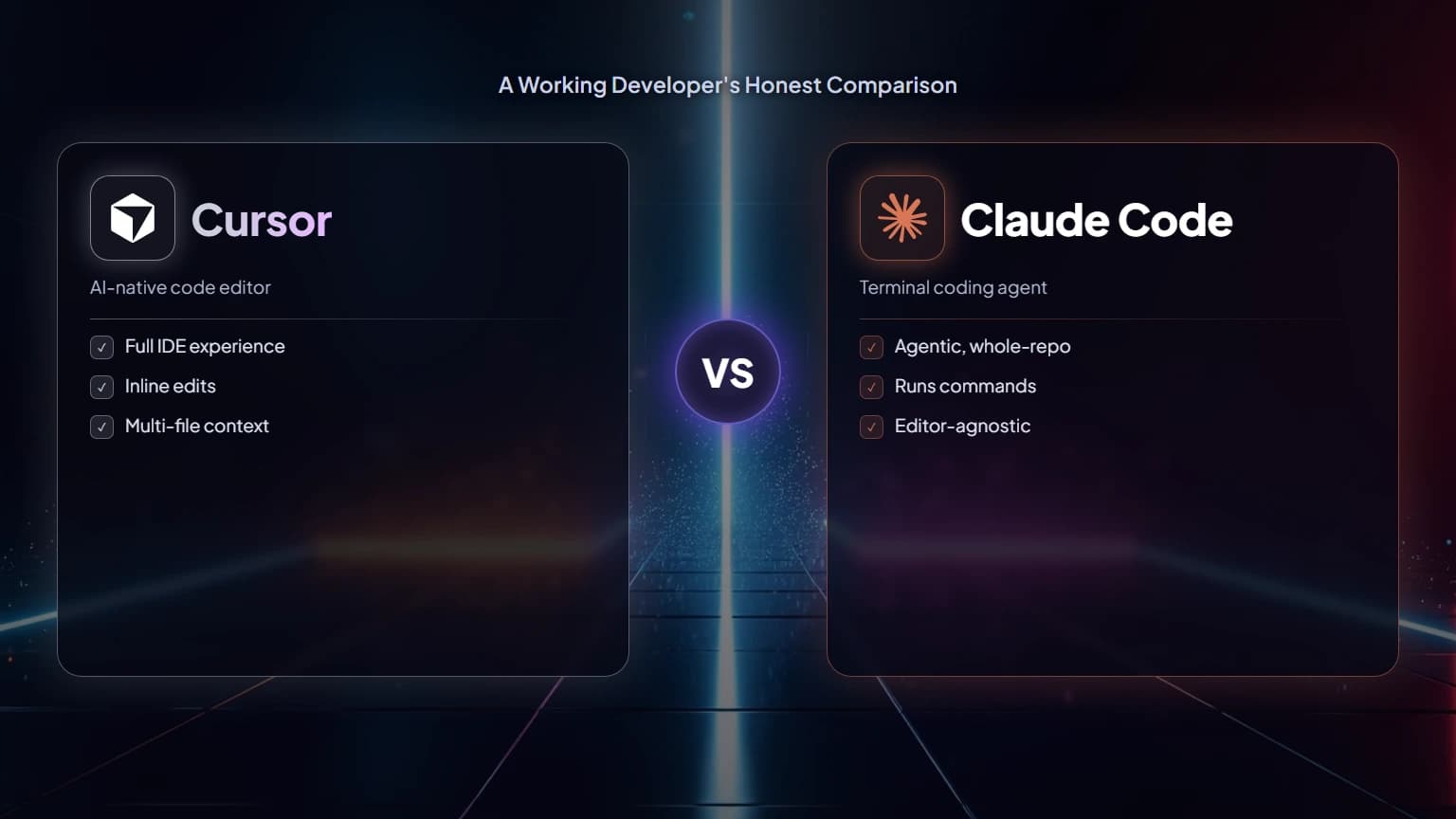
Most developers who are deep in the Anthropic ecosystem — or who want the strongest agentic features — land on Claude Code. Those who value openness, model choice, and avoiding lock-in reach for OpenCode. They're not mutually exclusive, either: nothing stops you from using OpenCode on one project and Claude Code on another. For how Claude Code stacks up against other rivals, see our Cursor vs Claude Code and Codex vs Claude Code comparisons.
In our own use we land on Claude Code as the daily driver, because the orchestration depth and first-party polish matter more to us than model choice — we route almost everything across Claude's own tiers anyway. But we keep OpenCode in mind for exactly the case the table names: a project where we want a local or non-Claude model in the loop without paying a subscription to reach it. The honest read from the OpenCode vs Claude Code question is that it's a values choice, not a quality gap — both drive a strong model competently, so pick the one whose trade-offs you actually care about rather than chasing a winner that doesn't exist.
Getting started with either agent
Both are a one-command install. OpenCode asks which provider you want and takes an API key with no account; Claude Code installs via npm or a native installer and signs in with a Claude plan or API key.
Both are a one-command install, but the setup philosophy differs. OpenCode installs from a script or package manager, and because it's open source, you can also clone and build it yourself. On first run you point it at a provider by adding an API key — Anthropic, OpenAI, Gemini, or another — and you're coding. The full instructions live on the OpenCode site, and there's no account to create.
Claude Code installs via npm (npm install -g @anthropic-ai/claude-code) or a native installer, then signs in with your Claude account or an API key. Anthropic's overview docs walk through the first session. The trade shows up even at install time: OpenCode asks "which provider?", while Claude Code assumes the answer is Claude and drops you into a tuned, first-party experience faster.
A few practical setup notes for the OpenCode vs Claude Code choice:
- Keys vs plans. OpenCode expects a provider API key up front. Claude Code accepts either a subscription login or an API key, so non-API users can start without touching a token dashboard.
- Configuration surface. OpenCode's config is open and text-based, which power users love for version-controlling their setup. Claude Code leans on
CLAUDE.md,settings.json, and slash commands. - Updates. OpenCode updates like any open-source CLI — your package manager or a git pull. Claude Code auto-updates in the background and via
claude update. - Privacy posture. OpenCode advertises that it doesn't store your code or context; with Claude Code, your data is handled under Anthropic's policy, which matters for some teams.
Neither install is hard, and both land you in a working terminal agent within minutes. The OpenCode vs Claude Code question isn't really decided at setup — it's decided by whether you want an open, multi-provider tool or a polished, Claude-tuned one. Once you know which of those you value, the rest of the choice falls into place.
Frequently Asked Questions

Written by
Edith
Writing about Claude and the Anthropic toolkit — models, Claude Code, pricing, features, and fixes, in clear, practical, hands-on guides tested by daily use.
View all posts →