

Part ofHow Much Does Claude Cost? Full Pricing Breakdown
In This Article
6 sectionsQuick answer
Claude API vs subscription: the API-equivalent figures everyone quotes ignore prompt caching. The honest cache-adjusted math, three worked personas, and where the break-even really lands.
Key takeaways
- Usage trackers price tokens at list rate, overstating what the same work would cost on a metered key.
- Prompt caching is why: cache reads bill at roughly 10% of the input list price and dominate agentic sessions.
- Assuming ~85% of input tokens are cache reads, a cache-adjusted figure lands near 30% of the headline — a reasoned estimate, not a published statistic.
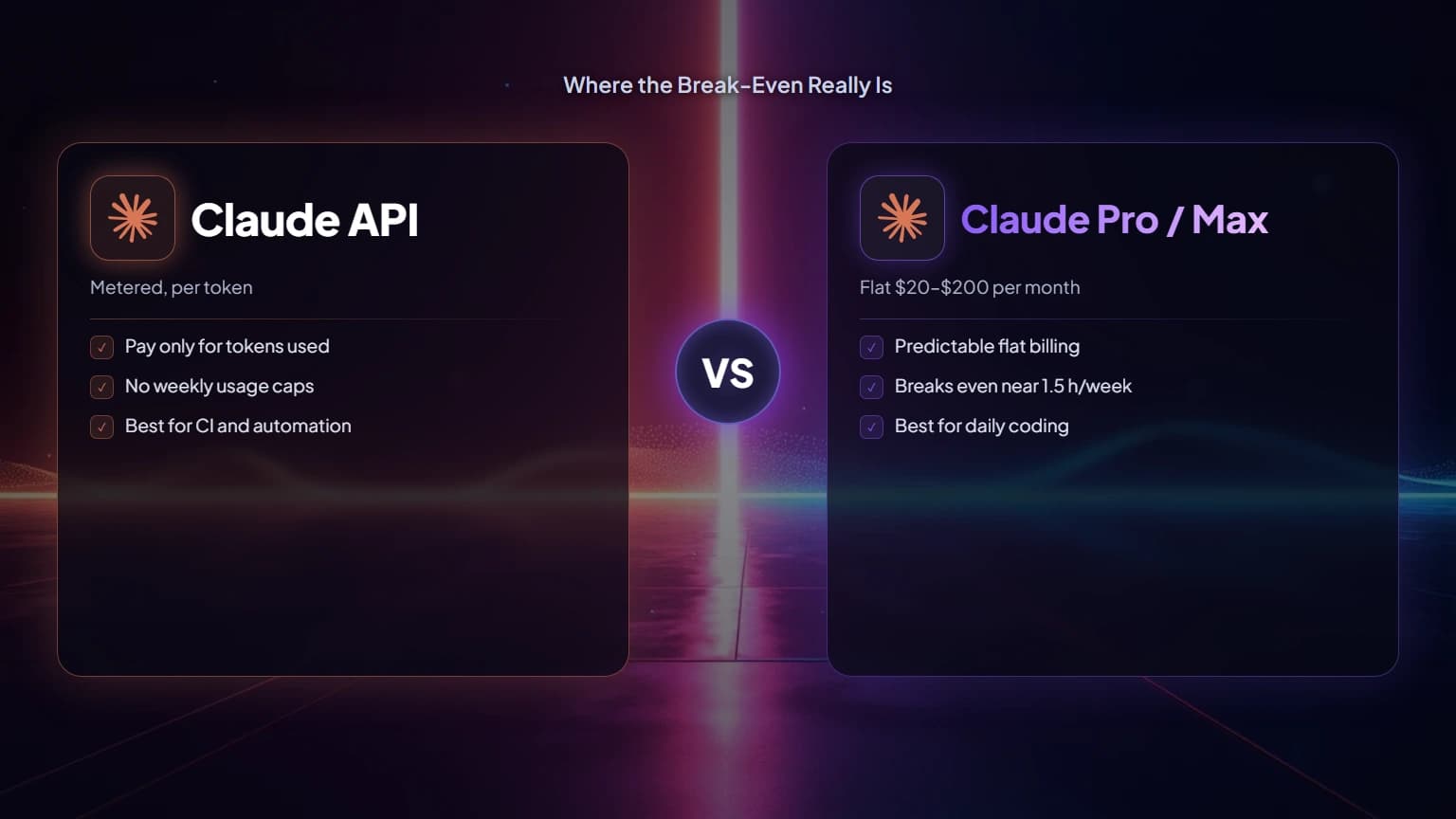
- Even so, Claude Pro at $20/month breaks even at about 1.5 active hours a week, so nearly every daily coder is better off subscribed.
- The API still wins for bursty use, unattended automation, programmatic workloads, and anywhere weekly caps would bite.
Claude API vs subscription is not the close call the usual numbers suggest. On honest, cache-adjusted math, Claude Pro at $20/month beats pay-as-you-go at roughly an hour and a half of active Claude Code per week — well below the break-even people assume. Past that, your tier is decided by usage caps, not cost.
Plan prices and per-token rates verified 21 August 2026 against Anthropic's pricing page.
Almost every comparison quotes one inflated number: the API-equivalent total your usage tracker prints. Here are both, naive and cache-adjusted.
What Claude API vs subscription actually compares
Two billing models, not two products: flat-rate access with weekly caps, or metered per-token billing with neither.
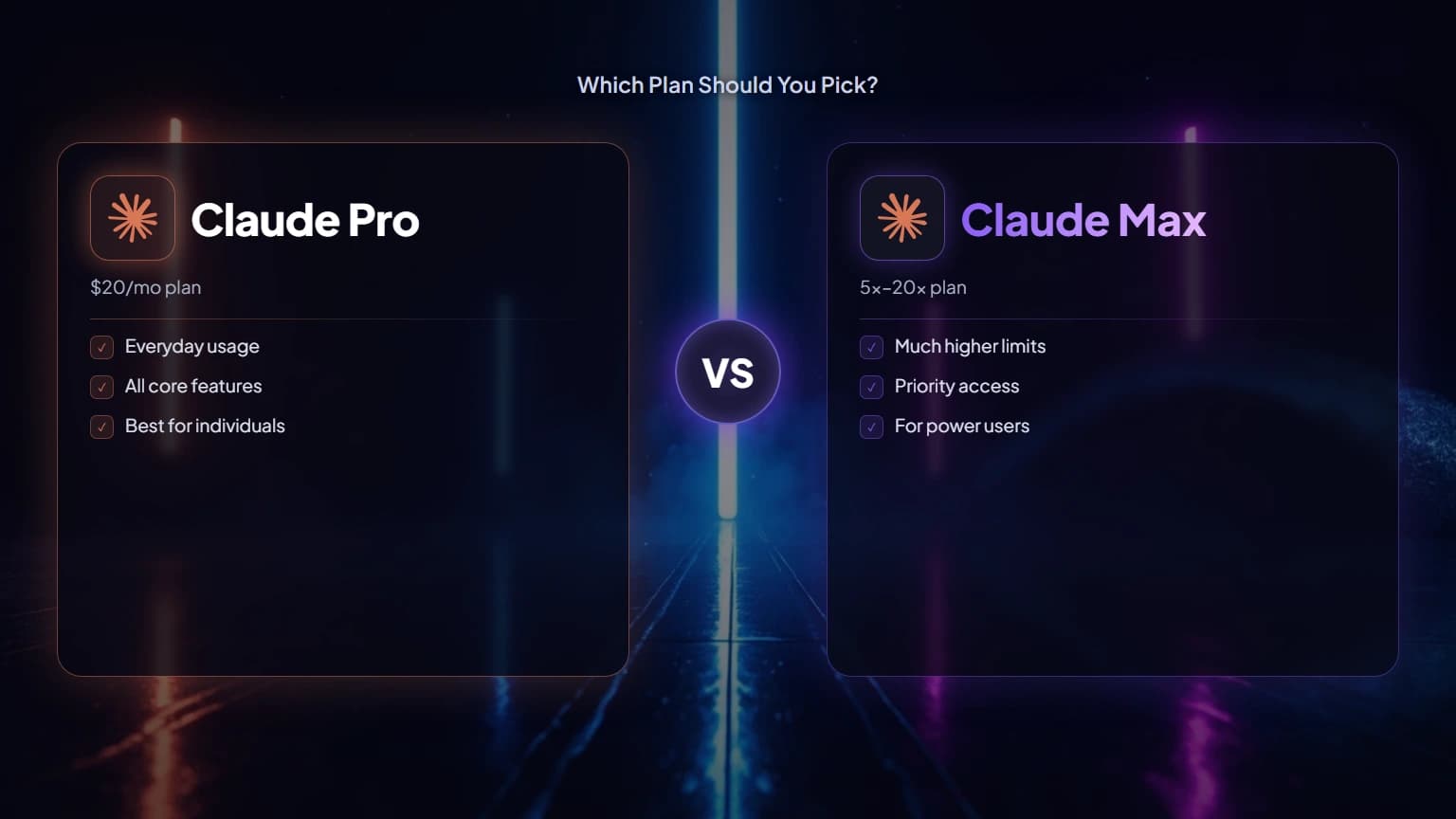
Both routes run the same models — as our best Claude plan for coding guide explains, only the meter differs. A subscription is $20 (Pro), $100 (Max 5×) or $200 (Max 20×) a month against rolling weekly limits. The API meters per token with no ceiling on a runaway loop: $1/$5 per million for Haiku 4.5, $3/$15 Sonnet 5, $5/$25 Opus 5, $10/$50 Fable 5 — our Claude API pricing reference has the rest.

The naive API-equivalent number everyone quotes
Total tokens × list price — the screenshot number that makes a subscription look like a twenty-fold bargain.
Usage trackers total your session-log tokens at list price. The output is an API-equivalent estimate, not a bill — and it is routinely enormous.
Take one active hour on Sonnet 5. Agentic loops re-send the working context every turn, so a busy hour pushes roughly 3 million input tokens while producing about 60,000 output tokens — a 50:1 ratio, normal for tool-heavy coding and abnormal for chat. At list price that hour is 3 × $3 + 0.06 × $15, or about $10: some $650 a month over a 15-hour week against $20 for Pro. A 32× saving, except it assumed all 3 million input tokens billed at full price.
Why prompt caching deflates that number
Cache reads bill at about a tenth of the input list price, and in an agentic session they are most of the tokens.
Claude Code leans hard on prompt caching: your CLAUDE.md, the files in context and the conversation form a stable prefix, cached once and re-read every turn. Anthropic prices those states differently:
| Token state | Billed at | What it is |
|---|---|---|
| Fresh input | 1× input rate | Content the model has not seen |
| Cache write | ~1.25× input rate | One-time cost of storing a prefix |
| Cache read | ~0.1× input rate | Re-reading an already-cached prefix |
| Output | 1× output rate | Everything the model generates |
Now redo that hour. Assume 85% of input tokens are cache reads, 5% cache writes and 10% fresh. The blended input multiplier is 0.85 × 0.1 + 0.05 × 1.25 + 0.10 × 1.0, about 0.25: input at a quarter of list, output unaffected. The hour now costs 3 × $3 × 0.25 + 0.06 × $15 ≈ $3.10 against the naive $10 — roughly 31% of the headline, which is why 25–35% is the sensible band rather than a single precise number.
Two honesty flags: the 85% share is an assumption, not a measurement — check yours via cache_read_input_tokens — and the ratio moves with your input:output balance, since output never caches.
Claude API vs subscription: the numbers side by side
Both figures, every tier. The naive column gets quoted; the cache-adjusted column is what to reason with.
At ~$10 per active hour naive and ~$3.10 cache-adjusted, over 4.345 weeks:
| Active hours / week | Naive API-equivalent | Cache-adjusted | Pro | Max 5× | Max 20× | Cheapest that fits |
|---|---|---|---|---|---|---|
| 2 | ~$87 | ~$27 | $20 | $100 | $200 | Pro |
| 5 | ~$217 | ~$67 | $20 | $100 | $200 | Pro |
| 10 | ~$435 | ~$135 | $20 | $100 | $200 | Pro |
| 15 | ~$652 | ~$202 | $20 | $100 | $200 | Pro |
| 25 | ~$1,086 | ~$337 | caps bite | $100 | $200 | Max 5× |
| 40 | ~$1,738 | ~$539 | caps bite | $100 | $200 | Max 20× |
The subscription wins every row: the correction changes the size of the win, not its sign. Plug your hours into our Claude Code cost calculator and cross-check our Claude Code cost breakdown.

Where the break-even really lands
Divide each plan price by the cache-adjusted hourly rate and the ladder falls out:
- Pro ($20) breaks even at about 6.5 active hours a month — roughly 1.5 hours a week.
- Max 5× ($100) breaks even at about 32 hours a month — roughly 7.5 hours a week.
- Max 20× ($200) breaks even at about 64 hours a month — roughly 15 hours a week.
Those are not "which tier to buy" thresholds; they are the points at which each tier costs less than metered access. Buy the cheapest tier whose limits cover you — Pro is published at roughly 40–80 Sonnet hours a week, Max 5× at 140–280, Max 20× at 240–480, and heavy sessions burn those caps twice as fast. So cost picks the subscription almost immediately; capacity picks the tier, as our Claude Pro vs Max and Claude Max guides work through. Opus users can skip the math: Pro has no Opus in Claude Code.
When each route actually wins
The API wins when:
- Usage is bursty — a key bills nothing in the quiet months.
- Nobody is at the keyboard — CI jobs, batch scripts, nightly pipelines.
- The workload is programmatic — anything built on top of Claude.
- Weekly caps are unacceptable, or you need per-job cost attribution.
The subscription wins when:
- You code most days — that clears the break-even by a wide margin.
- You want predictable billing — no ceiling risk from a runaway agent loop.
- You use Opus heavily — 1.67× a Sonnet hour puts a 15-hour week near $340 cache-adjusted, against $100 on Max 5×.
- You mix terminal and browser work — one subscription covers Claude Code and claude.ai, per our how much does Claude cost guide.
Frequently Asked Questions

Written by
Edith
Writing about Claude and the Anthropic toolkit — models, Claude Code, pricing, features, and fixes, in clear, practical, hands-on guides tested by daily use.
View all posts →